

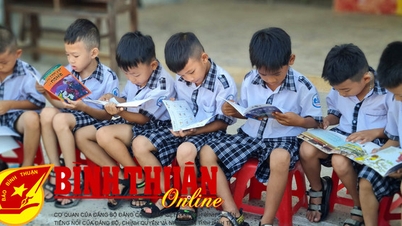
Books are great teachers, quiet and seemingly peaceful, but they are actually treasures of knowledge, sometimes containing stories about lives full of storms.

Those who live in a house with a bookshelf, especially one that is carefully curated, are fortunate. Each member of the family will be bathed in its magical light. Those who, from a young age, have read books they cherish, even books that are their bedside companions, not just once, but repeatedly, pondering over them many times, are also fortunate.
Are people being cruel to books, or is there some more fundamental reason driving people to bars more often than to libraries and bookstores? But surely, it would be a great loss and a great disservice if our souls no longer had the sensitivity to love books and to live better lives with what they offer.
In the past, living in the countryside, books were extremely rare. My grandfather often went to the town to borrow thick, seemingly old books to read. He also didn't forget to borrow thinner, easier-to-read books, the kind that instilled innocence and aspirations in us. We, his grandchildren and the neighborhood children, would pass them around to read. I always kept in mind the saying, "Read to live," because books are teachers. Confused by those thick books, I wondered if adults should read big books, meaning they should meet great teachers. When I asked him about it, he said, "It's not that thick books are necessarily good. Their value lies in each person's individual perception. It's just that adults will read more difficult books than children." Back then, I would read "The Adventures of the Cricket," "The Southern Forest Land," and many more books that were so valuable to children.
Later, when I went to school in the city, my teachers talked a lot about "books as teachers" and their value in life. However, not everyone thinks about that and cherishes books. Some people love books as much as their own flesh and blood, reading them every day like they need to eat, drink, and breathe. Others only read when absolutely necessary and just go through the motions. Of course, those who love books and read diligently will have a rich and vibrant cultural and spiritual life.
Even now, people still say that reading culture is declining. And rightly so, life is difficult, people are preoccupied with making a living, chasing after the dream of escaping poverty, and some are far from books. Or they spend their time drinking and carousing at bars, laughing and talking, then vomiting. Yet, they are reluctant to invest a few tens of thousands of dong to buy a book to read.
Then there are the luxurious, multi-story houses, each floor adorned with gleaming furniture, and large wine cabinets filled with sparkling, expensive imported wines. Yet, you can hardly find a small bookshelf. Investing in a bookshelf isn't as expensive as a wine cabinet, but wine-loving homeowners still relentlessly enrich their wine collections.
In the past, living in the countryside, books were extremely rare. My grandfather would often go to the town to borrow thick, seemingly old books to read. He also made sure to borrow thinner, easier-to-read books, the kind that instilled in us innocence and aspirations.
Are there still people who read and live with books, as there was a time when the soul of books reigned in the lives of some, to the point that they forgot to eat and sleep, engrossed in the written word? Are people being cruel to books, or is there some more fundamental reason driving people to bars more often than to libraries and bookstores? But surely, it would be a great loss and a great disservice if our souls no longer had enough feeling to love books and live better with what books offer.
I've seen those beer-bellied men collecting books. They're wealthy, buying large, luxurious bookshelves and lots of rare books, some as thick as a hand's width. But they only display them, to give the impression of being studious and avid readers. To project an image of high moral character and talent. They never actually read them. Those books are never opened. Strangely, their bookshelves just keep growing, like their beer-filled bellies.
I ran into those guys again at the beer pub. They were showing off their knowledge and books, just like they've been showing off their increasingly flabby, sagging bellies. One man said he'd just invested ten million dong in books at a book fair, enough to fill a large bookcase. He said, "I drink a lot of beer, but the money spent on books is nothing." Another chimed in, "That's right, just buy them and put them there, read them whenever you can. We share that hobby, it's fun. Soon, I might buy another ten million dong worth of books to add to those new ivory cabinets. At least it'll make my house look nicer."
Every time a book fair ends, people say tens of thousands of books have been sold. Many books are discounted by more than half, some are sold for just 5,000 or 10,000 VND. You can own a book for 50,000 VND. You can take home 10 books for 50,000 VND. People flock to buy them, jostling and even pushing each other to park their cars. Among them are some who come simply to collect books to fill their shelves. It's a rare opportunity to find cheap, new books. Unlike buying books on the street at bargain prices, which are often pirated copies from ages ago, with bent covers, torn edges, or covered in dust. Comparing beer to books, many people are still happy. Because, after all, if someone saves money on beer to buy books, even if they don't read them, it's still very helpful. At least it contributes to the book industry's consumption and, in a small way, reinforces the reading culture because they are also... buying books. Therefore, it also helps to reduce the amount of alcohol absorbed into the body.
However, there's an opinion about these gentlemen that we find reasonable. That is, they have money; they invest it in books, and the money they spend on beer doesn't decrease, but rather increases. Because they buy books, talk about books, and they celebrate with beer.
But anyway, you gentlemen have contributed to comforting and easing the burden on the publishing industry. Many companies are operating at a loss, and publishers have to work hard to find partners and sell licenses to supplement their meager income.
If you calculate that each discounted book could be exchanged for one glass of draft beer, then hundreds of thousands of glasses of draft beer consumed daily would be enough to buy hundreds of thousands of books. Who says our people don't have money to buy books? Our people do have money, but even when they lack it, they always prioritize food and drink. Few people would forgo beer to buy books. Few people still love books as much as they used to, saving up their money from snacks and breakfast to buy the books they liked.
Source: https://daidoanket.vn/bia-hoi-va-sach-10293809.html
![[Video] Sunset at Lap An Lagoon – Where the sun sets over the fishing nets](https://vphoto.vietnam.vn/thumb/1200x675/vietnam/resource/IMAGE/2026/05/31/1780192137701_beach-landscape-sea-water-nature-grass-745871-pxhere-com.jpeg)





























![[Image] Nearly 125,000 Hanoi students completed the Literature exam for the 10th grade entrance exam.](https://vphoto.vietnam.vn/thumb/1200x675/vietnam/resource/IMAGE/2026/05/30/1780117233041_ndo_br_thiet-ke-chua-co-ten-2-png.webp)
































![[Video] Sunset at Lap An Lagoon – Where the sun sets over the fishing nets](https://vphoto.vietnam.vn/thumb/402x226/vietnam/resource/IMAGE/2026/05/31/1780192137701_beach-landscape-sea-water-nature-grass-745871-pxhere-com.jpeg)



































Comment (0)