

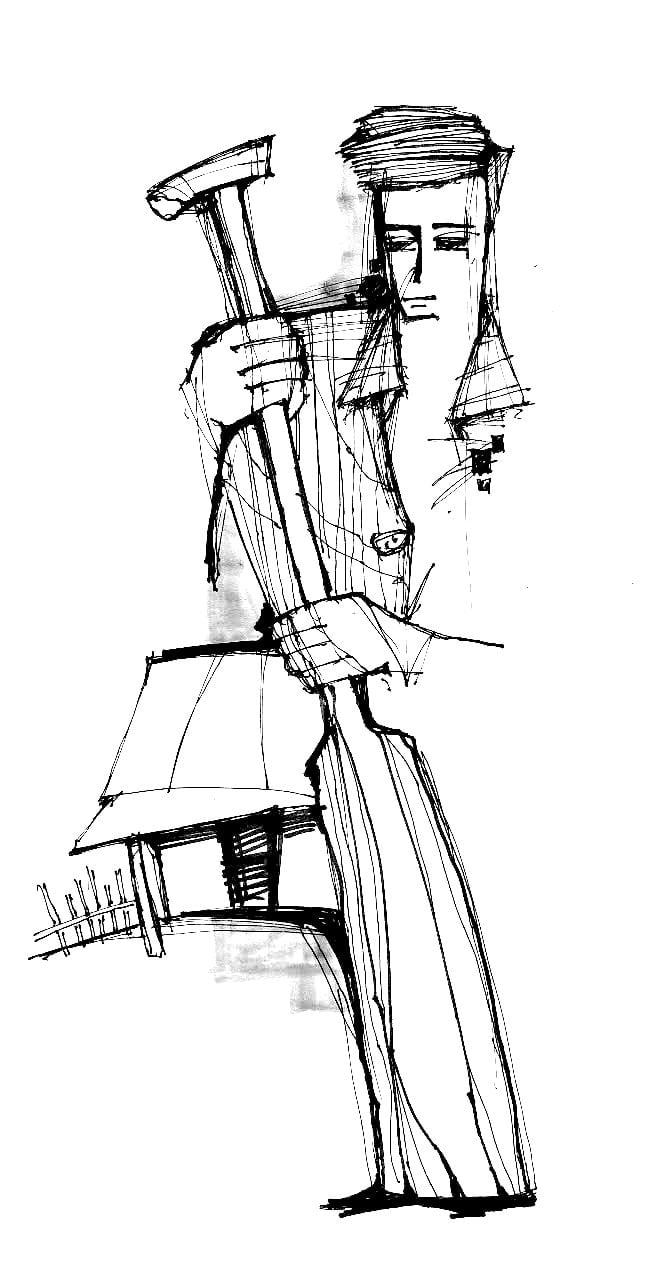
Illustration: Ly Long
Usually, only poor fishermen, those without large boats or the physical strength to accompany the boat on long voyages, choose this precarious profession of fishing. As dusk falls, the group loads their small boats onto the larger boat to hitch a ride out to sea. Whatever they catch, each boat contributes a portion to help pay for the boat owner's fuel. No one wants to work for free, but that's just how life is; neither the boat owner nor the fishermen feel guilty. After a quick dinner, checking their equipment, adding a thermos of hot tea and some pastries for a late-night snack, they all board the boat and head out, chatting idly until darkness falls. After a while, they reach the anchorage point. The larger boat unloads the boats one by one, and then everyone goes about their work. The larger boat circles around to check if the lights on the boats are on, counts the number of boats, and then moves on to attend to its own tasks. They would cast their nets and fish at night to earn extra income, returning to pick up their catch the next morning. Sometimes they would tie a bunch of fish to the back of the boat and then rush back home together.
For four days, incense burned brightly along the coastal beach, accompanied by the vacant, desperate, and tearful eyes of relatives on shore, still awaiting accurate news about their husbands and sons who had perished in the accident. Everyone advised each other to set up an altar for the deceased and pray, hoping for a miracle to happen to each family. Li's father had a slight disability in his legs, which is why he chose this profession. His mother bought and sold fish at the market at the sandbank, while his elderly grandmother diligently helped with cooking and other chores for the family. Before Li, there were two other children, but they couldn't raise them. Before he was born, the whole house was like a funeral home; no one wanted to talk. When he was born, there was overwhelming joy; his grandmother proudly showed him off to everyone in the neighborhood, while he simply grew up, carried along by the wind and waves of the sea. So, fate has been cruel. Today marks exactly one month since his death. His grandmother and mother have cried until their eyes are swollen. Every time she looks at the picture on the altar, she collapses. She wails, "Oh my God, my son, my son! You were only in your forties, why did you leave so soon?" She cries uncontrollably, hitting her head and chest, hugging Li tightly, and weeping incessantly. His mother also cries, but only to a limited extent. If they just hug each other and cry, what will they eat? They have to grit their teeth and live on. And what about Li? Who will raise him?! Li is only a few years old; he doesn't understand anything. Since his mother gave birth to him, he has practically lived with his grandmother, receiving her warmth, eating, playing, and everything else from her. He doesn't know anything about his father's death. Seeing his grandmother and mother cry, he cries too, but then he seems to remember something, wipes his nose, and runs to the beach to play in the waves. It just went on like that with time, without illness or pain, without fussing over stomach aches or headaches, just round and chubby, quietly growing with the years, which is why it was called "Stubborn." At six, its grandmother took it to school, and after school, it would rush to the sea. Its life seemed inextricably linked to the sea. It swam, it played with the waves, and a little older, I don't know who taught it, but it found a bamboo hook with a sharpened bicycle spoke attached to the end, and it would sneak around fishing boats to steal fish to sell for money. It was cursed and slapped many times, but it remained unfazed. Only the insults like "fatherless child," "disrespectful child," really affected it, and the more it affected it, the more stubborn it became. After finishing fifth grade, it stopped studying on its own. Its mother begged it to study, but it stubbornly turned its head to look out at the sea without answering. However, at this time, it noticed that its mother was acting a little strangely, paying more attention to it than usual. Sometimes he felt a warmth in his heart; he loved his grandmother ten times as much as he loved his mother eight or nine times. Now he was a grown man, twelve years old, not a child anymore. At twelve, he looked mature and neat; in the sea, he swam as fast as a fish, and on land, his legs moved lightly as if gliding on the sand. His tall, sturdy figure was pleasing to everyone's eye. Mother and son often chatted together, but he noticed that lately his mother was acting strangely, often sitting silently lost in thought, rarely talking to his grandmother. His grandmother also looked at his mother with the experienced eyes of an old person, as if there was something that neither he nor his grandmother had yet seen or suspected. He felt that his mother seemed younger, younger than her nearly forty years. After hours of toiling and meticulously counting every penny at the fish market, recently his mother had been hanging out with many new friends she had met there. Once his grandmother said, "Watch out for your mother," but he didn't know what he was supposed to watch out for.
Having dropped out of school, bored of idleness, he secretly went out to sea a few times on fishing boats. The people on the boats told him to go home and ask his family to let him join them as a crew member. He was thrilled, and ran home shouting to his mother and grandmother that he was going to sea. So he went, as if it were his destiny. Being a crew member on a fishing boat wasn't too hard, as long as he didn't get seasick. He did whatever he was told without complaint. Young and impulsive, he gradually became accustomed to the work of the vast sea. He felt delighted and fascinated by the boat, the nets, the fresh fish, the shrimp and squid caught in the nets and baskets. At sea, after deducting expenses, three-thirds of the income went to the boat owner, and seven-thirds were divided equally among the crew. The owner, who also served as the captain, received an extra share, but he, as a crew member, only got half. It was alright; it felt proud, honored to receive its first share of the harvest, earned through its own hard work. Every time the boat docked, it would grab its net bag of fish and run home to give it to its grandmother to take to the market for its mother to sell. It would then rush back to the boat to do odd jobs and guard it while others went home, even sleeping there at night. And so, its life fluctuated with the waves, with the boat's stern cutting through the water, with each net bag of fish growing heavier as it learned more about the seafaring trade. Since going out to sea, it had seen its mother less often. Once, missing her terribly, it took the bag of fish and went straight to the market to see her. Mother and child looked at each other in silence, tears welling up in its eyes, while its mother seemed somewhat awkward. The people at the market looked at it with sympathetic, wistful eyes. Until one day…
His grandmother was sitting on the doorstep. When she saw him, she said, "Take this to the market for your mother, and see where she is. She hasn't been home since yesterday." Sensing something was wrong, he rushed to the market, looking around but couldn't find his mother. Some of the other vendors, knowing him, called him over and whispered, "Your mother said she'd never been to Saigon before, so she went there by bus to see for herself. She'll probably be back in a few days." He was bewildered, wondering to himself, "Where did she go? There's no one home." Feeling dejected, he sold his fish and went straight to his boat after asking an acquaintance to take all the money back to his grandmother. It was strange, why did she leave without telling anyone? He carried this jumble of questions and resentment onto the boat and was like a lost soul. He was forgetful, forgetting everything he did. He returned from one fishing trip without seeing his mother, then two, and still no news. No one knew, or perhaps they knew but didn't say anything. One night, sitting at the bow of the boat, gazing out at the vast ocean, she suddenly burst into tears, whispering, "Mother, I'm only 15, how could you leave me?" Everyone on the boat gathered around to comfort and reassure her, saying, "It's alright, she'll be back in a few days!" She cried, then suddenly wailed, "But where did she go?" "Heavens, where did she go? How would we know?!" Time silently passed, everything seemed forgotten, quiet, but she couldn't forget. Now she only had her grandmother, who was also very old and frail. The recent shock seemed unbearable for her; every time she returned from sea, they would look at each other and she would cry. She was furious, but she didn't resent her mother. Her body felt numb, hardened, but she secretly hoped that one day her mother would return. She lit an incense stick and prayed to her father, asking him to somehow bring her mother back.
Days passed, and he no longer followed the old boat. Now he had become a true crew member, skilled in the trade, strong and healthy, a muscular young man with a handsome, slender physique like a bodybuilder. The boat owner once joked, but it sounded serious, "I have two daughters; whichever one you like, I'll marry her off to." He just smiled and walked away silently, still thinking a lot about his mother. His grandmother had passed away, and he was now all alone. His life was like that of a quail. Like the lullaby his grandmother used to sing him: "A tailless quail, who raised you? Yes, sir, I grew up all by myself." After each fishing trip, sitting on the boat, he watched the boat owner's daughter weighing fish for her customers, glancing at him and smiling sweetly. Thinking back on his life, he felt incredibly sad. Oh, little quail!
Source: https://baobinhthuan.com.vn/con-cut-cuc-duoi-130815.html














































![[Image] Ho Chi Minh City simultaneously commences construction and breaks ground on 4 key projects.](https://vphoto.vietnam.vn/thumb/1200x675/vietnam/resource/IMAGE/2026/01/15/1768472922847_image.jpeg)



































Comment (0)