

The goal is to equip students with digital skills, artificial intelligence application capabilities, and creative thinking, helping them gradually integrate and adapt to the Industry 4.0 era.
Do not disrupt the course.
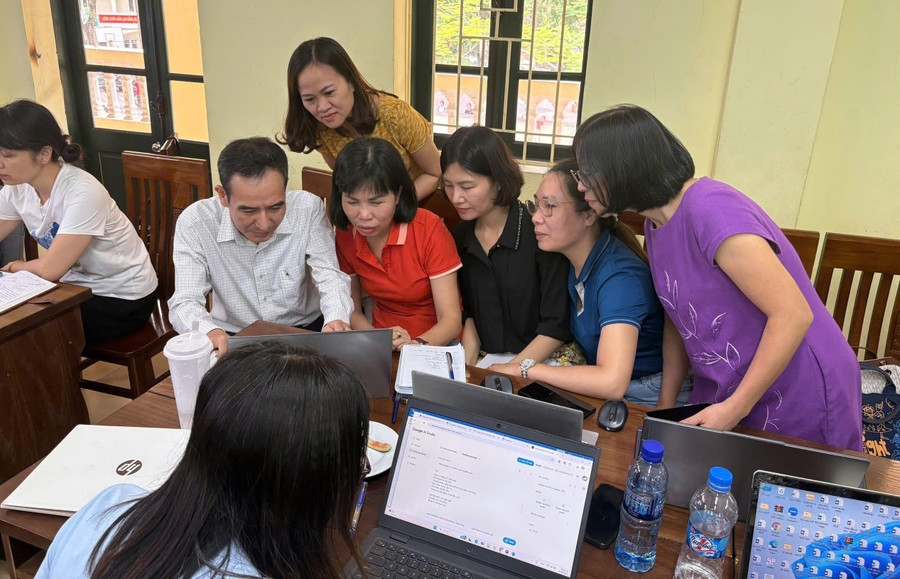
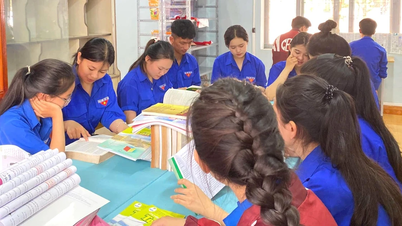
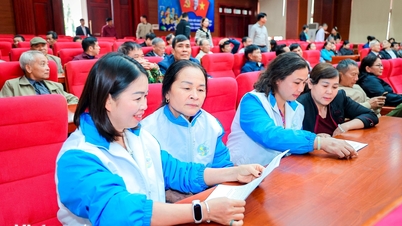
Ahead of the 2025-2026 school year, Vinh Hung Secondary School (Hanoi) organized a STEM - AI - Robotics Festival, where teachers and students experienced many modern technologies: programming artificial intelligence (AI) robots to overcome obstacles, assembling STEM Kits, exploring the world of virtual reality, and participating in creative challenges.
According to Ms. Truong Thi Mai Huong, the school principal, following the Ministry of Education and Training's guidelines for a two-session-per-day teaching schedule, the first session covers the main curriculum of general education , while the second session is dedicated to supplementary activities such as art education, physical education, STEM/STEAM, AI, etc. This is a comprehensive development orientation, suitable for the psychology and physiology of students at each educational level. Therefore, the STEM - AI - Robotics Festival is organized within the framework of the second session.
Vinh Hung Secondary School is developing a long-term plan, training its teaching staff, and collaborating with reputable professional organizations to implement AI and Robotics programs along with STEM experiential activities. "This is also a step in implementing the directives of the Party Committee, People's Council, and People's Committee of Vinh Hung ward regarding the comprehensive development of education and the creation of a modern and creative learning environment in the locality," Ms. Huong emphasized.
According to Ms. Quan Thi Van Anh, Vice Chairman of the People's Committee of Vinh Hung Ward, introducing STEM, AI, and Robotics into schools is the right direction, helping students to access advanced science and technology early on, and preparing a solid foundation to adapt to the rapid changes of the Industry 4.0 era.
Sufficient legal basis
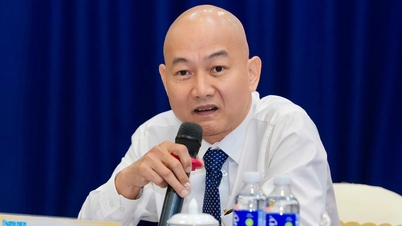
Associate Professor Tuong Duy Hai from Hanoi Pedagogical University cited: The Ministry of Education and Training has issued a Digital Competency Framework and guidelines for educational institutions to develop digital competencies for learners, including competency domain 6: Developing the ability to apply artificial intelligence for students. Students from grades 1 to 12 are given clear development targets regarding their ability to apply AI in learning and daily life.
This is a breakthrough in the continuous innovation of the education system, helping students gain a deep understanding and the ability to apply digital technology in their studies and work. At the same time, students are able to leapfrog and embrace the development of AI in education, life, and career guidance.
In implementation of Resolution 57-NQ/TW dated December 22, 2024, of the Politburo on the development of science, technology, innovation, and national digital transformation, and Decision 131/QD-TTg dated January 25, 2022, approving the Project "Strengthening the application of information technology and digital transformation in education and training in the period 2022-2025, with orientation to 2030," the Ministry of Education and Training is implementing the Digital Competency Framework and digital skills education according to Circular 02/2025/TT-BGDĐT.
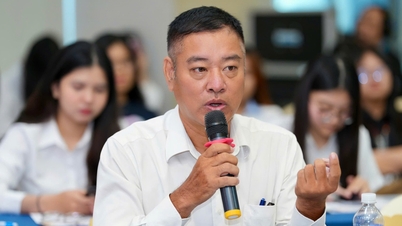
Mr. Thai Van Tai, Director of the Department of General Education, stated that in the past, the Department has incorporated appropriate content into the curriculum in an integrated or enhanced manner, without disrupting subjects and with sufficient legal basis for schools to easily implement.
The Department of General Education has analyzed the general education curriculum for Informatics and other subjects to determine the required level and achievement of digital competencies according to the Digital Competency Framework. It has developed a detailed description of digital competencies for each educational level from primary to high school, ensuring the objectives of the 2018 General Education Program are met, in line with international practices and Vietnamese realities. Simultaneously, it has reviewed the curriculum for each level, grade, subject/educational activity to identify opportunities for developing students' digital competencies.
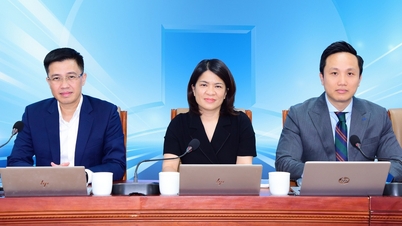
According to the draft report on the Digital Competency Framework for Teachers by Deputy Director Pham Tuan Anh of the Department of Teachers and Educational Management, the Department has collaborated with UNICEF and relevant units to establish research and survey teams in various localities. The draft divides competencies into two groups: foundational digital competencies and specialized digital competencies, reflecting teachers' ability to apply digital technology solutions and tools in their professional work.
Integrating STEM, AI, and digital skills into general education not only meets curriculum requirements but also lays the foundation for the nation's development aspirations. Training today's generation of students means shaping a class of digital citizens with global thinking, the ability to integrate, and creativity in the AI era.
This will be a key resource to help Vietnam achieve its national goal of high-income development by 2045 – the 100th anniversary of the country's founding. Education, taking a proactive approach and nurturing digital citizens from the school level, is the key to unlocking the future.
RMIT University Vietnam will collaborate with the Ministry of Education and Training in the process of educational reform. In the context of rapidly changing technology, the digital competency framework offers opportunities to integrate inclusive, flexible, and future-oriented learning approaches into teaching. - Professor Scott Thompson - Whiteside - CEO of RMIT University Vietnam
Source: https://giaoducthoidai.vn/cong-dan-so-tu-ghe-nha-truong-post750169.html




![[Photo] General Secretary and President To Lam receives Amazon's Senior Vice President David Zapolsky](https://vphoto.vietnam.vn/thumb/1200x675/vietnam/resource/IMAGE/2026/05/22/1779466547770_a1-bnd-3513-6601-jpg.webp)






















































































Comment (0)