

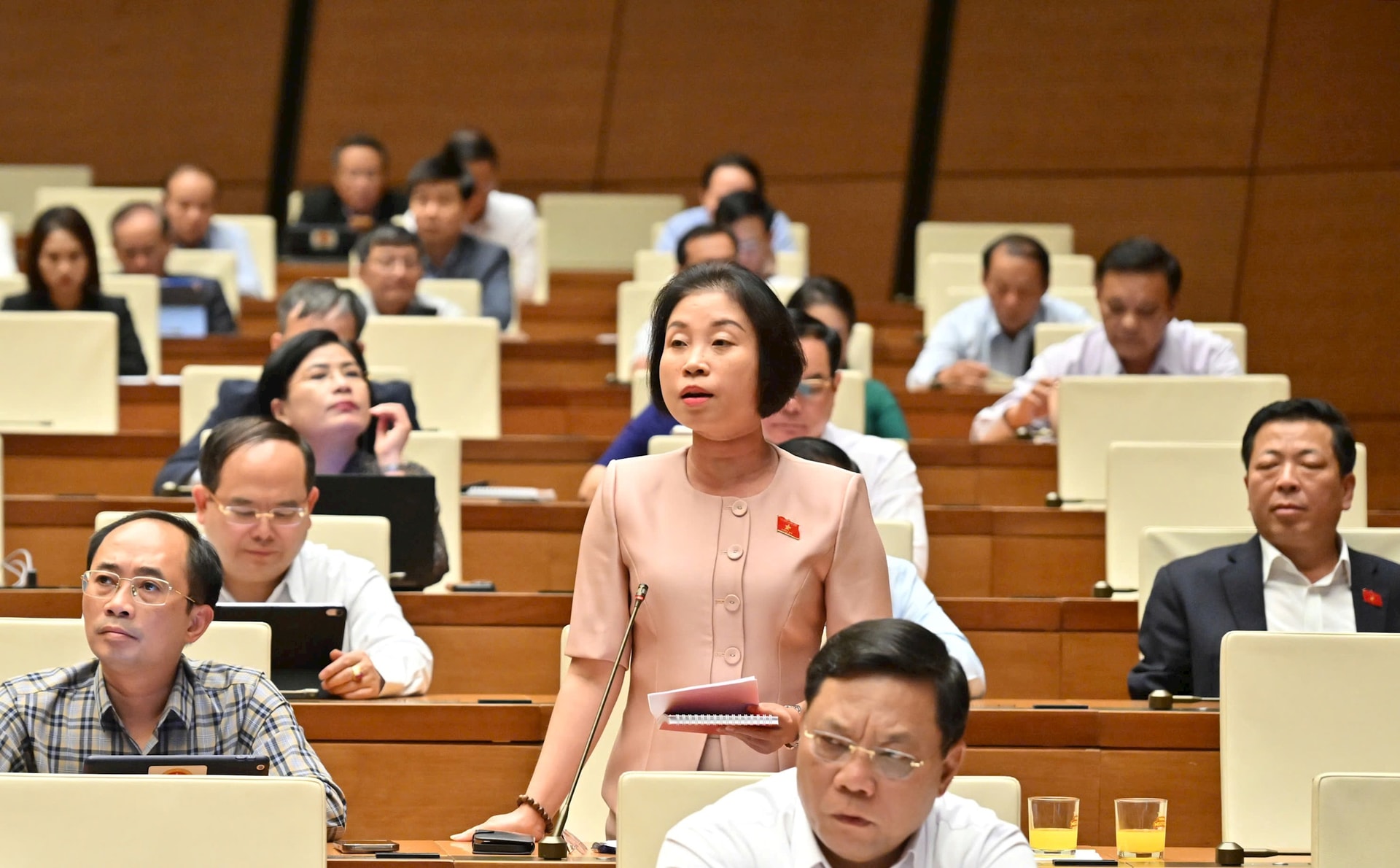
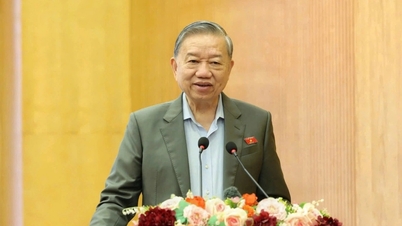
During the discussion in the assembly hall , the Vice Chairwoman of the Hanoi City People's Council and Deputy Head of the Hanoi City National Assembly Delegation, Pham Thi Thanh Mai, stated that according to the State Audit Office's report for the period 2021-2025, there is still a significant amount of outstanding tax debt; the total amount of domestic tax debt collected is estimated to reach 17% by September 30, 2025, an increase of 17.6% compared to December 31, 2024.
Meanwhile, the rate of debt recovery and settlement remains low, reaching only 21.4% of the total debt. Specifically, for the total tax debt in 2024, it is equivalent to 9.7% of the state budget revenue collected, a result that falls short of expectations.
Representative Pham Thi Thanh Mai stated that the National Assembly's resolution aims to reduce the rate of outstanding tax debt to below 5% of total state budget revenue. "One situation that we find very alarming is that tax evasion and fraud, leading to state budget revenue losses, are becoming increasingly sophisticated and complex," the representative said.
Representative Pham Thi Thanh Mai stated that, based on recent media reports and publications, delegates highly appreciate the government 's close guidance in strengthening the fight against tax fraud. However, one of the problems in e-commerce businesses, such as online sales, including those involving celebrities, is that counterfeit, fake, and substandard goods, as well as tax evasion, are only discovered when the police intervene.
“This situation affects not only budget revenue but also the economy, impacting trust and creating unfair competition among businesses. For legitimate businesses, we still propose that along with measures to combat revenue loss, we must address the root cause of the problem. That is, creating a healthy competitive environment. Goods must have clear origins and be properly assessed for their value,” Representative Pham Thi Thanh Mai suggested.
During the period 2026-2030, the proportion of state budget investment expenditure is expected to account for approximately 40% of total budget expenditure, with central government investment expenditure playing a leading role. This proportion is consistent with the development orientation in the coming period and aims to achieve double-digit growth.
However, delegate Pham Thi Thanh Mai argued that the structure of development investment expenditure and recurrent expenditure for some localities, especially those that are unlikely to be able to balance their budgets or contribute to the central government budget, even after recently reorganizing provincial-level administrative units to create new development space, cannot ensure budget balance in a short period of time.
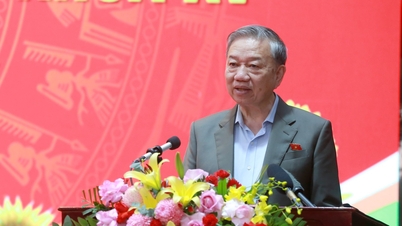
From there, the delegate suggested: "Regarding this proportion, the whole country should balance it separately for each locality in the allocation of funds for the 2026-2030 period, to ensure that for some provinces, expenditure tasks must ensure social welfare, protect the national borders, and ensure economic development and growth within our country." The delegate also suggested that the allocation of state budget, especially investment expenditure, should be calculated based on output results.
Representative Pham Thi Thanh Mai stated that, after implementing the two-tiered local government model, the district level has now transferred some tasks to the commune level. In Hanoi, the city has strongly implemented this decentralization and delegated authority to the commune level. However, on a national scale, the representative requested that the Government, especially the Ministry of Finance, pay attention to this issue.
The delegates emphasized that after comprehensive restructuring, consolidation, and reassessment, if any project, after investment monitoring, is found to be ineffective or unsuitable for the planning and local conditions after restructuring, it should be boldly stopped to avoid waste and the settlement procedures should be carried out. At the same time, it is necessary to prioritize combating outstanding debts in basic construction after the district level has completed the work and transferred it to the provincial or commune level for continued implementation.
Source: https://hanoimoi.vn/dai-bieu-quoc-hoi-pham-thi-thanh-mai-tinh-trang-gian-lan-tron-thue-dang-bao-dong-721551.html

![[Photo] Two flights successfully landed and took off at Long Thanh Airport.](/_next/image?url=https%3A%2F%2Fvphoto.vietnam.vn%2Fthumb%2F1200x675%2Fvietnam%2Fresource%2FIMAGE%2F2025%2F12%2F15%2F1765808718882_ndo_br_img-8897-resize-5807-jpg.webp&w=3840&q=75)





















































































Comment (0)