

"A gentleman has hairy legs, a scoundrel has a hairy belly" or "A gentleman has shallow legs, a scoundrel has a shallow belly" are both familiar sayings that have spread through folklore.
"Neither of these versions has been officially recognized," said Associate Professor Pham Van Tinh, Director of the Center for Vietnamese Studies.
The dictionary of proverbs lists "A gentleman has thick leg hair, a petty person has thick belly hair" and another variant, "A petty person has thick belly hair, a gentleman has thick leg hair," but does not recognize other versions.
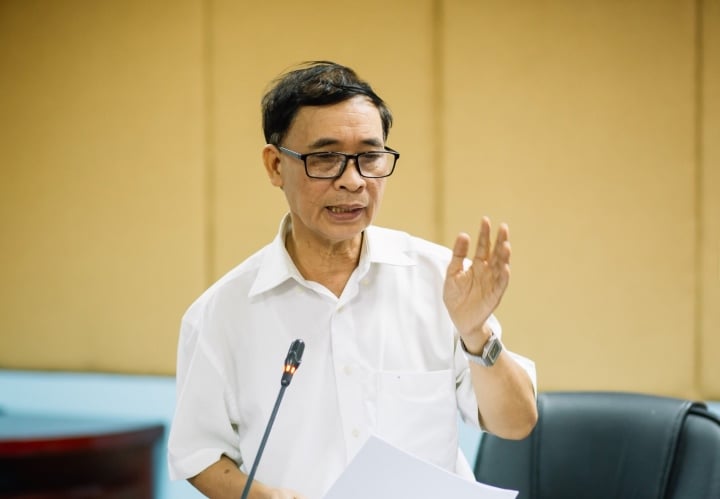
Associate Professor Pham Van Tinh, Director of the Center for Vietnamese Studies. (Photo: FBNV).
According to the dictionary, "thick belly hair" is a common trait among villains, while "thick leg hair" is a common trait among gentlemen.
The proverb above originates from the folk experience of physiognomy. People in the past often judged people's character through various outward appearances, such as facial features, gait, leg hair, and belly hair.
That saying is merely a notion, because the hair on one's belly or legs does not reflect a person's character. The distinction between a gentleman and a villain is a way of distinguishing them in Confucianism.
A gentleman is considered a respectable, upright person with knowledge and proper conduct. Conversely, a petty person is someone with a bad character, narrow-minded, and narrow-minded.
"The saying 'A gentleman is shallow-footed, a petty person is shallow-minded' is incorrect because there is no contradiction between the two. The phrase 'A gentleman is shallow-footed' is meaningless, while the phrase 'a petty person is shallow-minded' can still be interpreted as meaning narrow-mindedness," Mr. Tinh added.
THI THI
Beneficial
Emotion
Creative
Unique
Source

![[Image] Leaked images ahead of the 2025 Community Action Awards gala.](/_next/image?url=https%3A%2F%2Fvphoto.vietnam.vn%2Fthumb%2F1200x675%2Fvietnam%2Fresource%2FIMAGE%2F2025%2F12%2F16%2F1765882828720_ndo_br_thiet-ke-chua-co-ten-45-png.webp&w=3840&q=75)

![[Photo] Prime Minister Pham Minh Chinh receives Lao Minister of Education and Sports Thongsalith Mangnormek](/_next/image?url=https%3A%2F%2Fvphoto.vietnam.vn%2Fthumb%2F1200x675%2Fvietnam%2Fresource%2FIMAGE%2F2025%2F12%2F16%2F1765876834721_dsc-7519-jpg.webp&w=3840&q=75)
![[Live] 2025 Community Action Awards Gala](/_next/image?url=https%3A%2F%2Fvphoto.vietnam.vn%2Fthumb%2F1200x675%2Fvietnam%2Fresource%2FIMAGE%2F2025%2F12%2F16%2F1765899631650_ndo_tr_z7334013144784-9f9fe10a6d63584c85aff40f2957c250-jpg.webp&w=3840&q=75)
![[Photo] Prime Minister Pham Minh Chinh receives the Governor of Tochigi Province (Japan)](/_next/image?url=https%3A%2F%2Fvphoto.vietnam.vn%2Fthumb%2F1200x675%2Fvietnam%2Fresource%2FIMAGE%2F2025%2F12%2F16%2F1765892133176_dsc-8082-6425-jpg.webp&w=3840&q=75)








































![[Video] Independence and self-reliance linked with international integration through 40 years of reform](https://vphoto.vietnam.vn/thumb/402x226/vietnam/resource/IMAGE/2025/12/16/1765899635777_1-1-8054-png.webp)




















Comment (0)