

 |
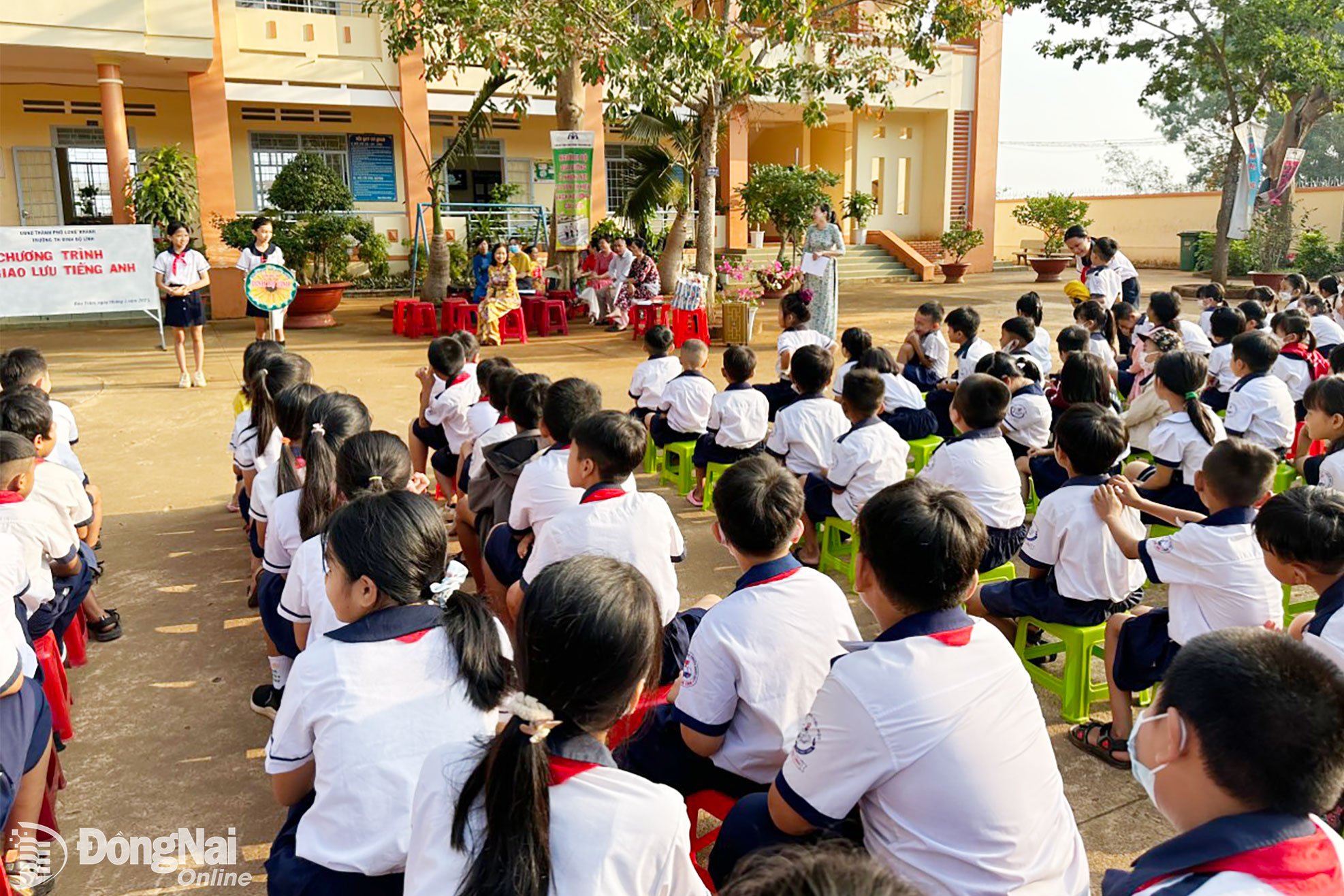
| English exchange program for students of Dinh Bo Linh Primary School (Bau Sam neighborhood, Long Khanh ward, Dong Nai province). Photo: Provided. |
To ensure fairness in teaching and learning in foreign languages for both learners and teachers, the Government has recently issued Decree No. 222/2025/ND-CP dated August 8, 2025, regulating teaching and learning in foreign languages in educational institutions (hereinafter referred to as Decree 222, effective from September 25, 2025).
Differences in nature
Mr. Nguyen Van Toan, an English teacher at a foreign language center in Tran Bien ward (Dong Nai province), said: According to the general education curriculum for foreign languages, schools and students will choose one of several foreign languages (English, French, Japanese, etc.) to teach and learn, just like other subjects in the textbook curriculum such as Math, Physics, Chemistry, etc., with the goal of creating conditions for students to develop a new communication tool. This will form and develop communication skills in the foreign language learned through listening, speaking, reading, and writing. Teaching in a foreign language means using a language other than the mother tongue of the country (for example, English, French, Japanese, etc.) to convey knowledge and lesson content to learners. This activity includes teaching subjects or the entire curriculum in that language.
According to Mr. Nguyen Van Toan, the General Education Program for Foreign Languages and the Program for Teaching in a Foreign Language are similar in that they are taught and learned in a foreign language, not Vietnamese, but they are fundamentally different. Therefore, Decree 222 stipulates that teaching and learning in a foreign language must stem from societal needs, the voluntary participation of learners, and the requirement to ensure the quality of education and training, contributing to the promotion of Vietnamese education, traditions, and culture. Meanwhile, the General Education Program for Foreign Languages is compulsory for all general education students.
To better understand the legal aspects of the concepts of the General Education Program for Foreign Languages and the Program for Teaching in a Foreign Language, lawyer Vu Duy Nam (Ho Chi Minh City Bar Association) noted: Clause 2, Article 1 and Article 2 of Decree 222 stipulate: It only applies to general education institutions, continuing education institutions, vocational education institutions, higher education institutions and schools of state agencies, political organizations, socio-political organizations, and armed forces (hereinafter referred to as educational institutions); teachers who teach in foreign languages, students who learn in foreign languages; and agencies, organizations, and individuals involved in teaching and learning in foreign languages. At the same time, Decree 222 does not apply to foreign-invested educational institutions that implement teaching programs entirely in foreign languages in general education, continuing education, vocational education, and higher education, and does not regulate the teaching and learning of foreign languages or foreign language modules.
Ms. Pham Thi Nguyet, Principal of An Hao Primary School (Tran Bien Ward): Decree 222 specifies the professional requirements. Decree 222 specifically outlines the professional and technical requirements for teachers teaching subjects in foreign languages. Accordingly, teachers must meet the professional and technical requirements, as well as the training and development standards prescribed for each educational level and training program. Regarding foreign language proficiency, primary and lower secondary school teachers must have a minimum foreign language proficiency level of 4 according to the 6-level Foreign Language Proficiency Framework for Vietnam or equivalent; upper secondary school teachers must have a minimum foreign language proficiency level of 5 according to the 6-level Foreign Language Proficiency Framework for Vietnam or equivalent. At An Hao Primary School, the school has been piloting the teaching of Mathematics and Science in English since the 2024-2025 school year. In the 2025-2026 school year, the school will implement it on a large scale for all five grades, based on the voluntary participation of parents. After implementation, more than 730 out of over 1,000 students registered to study. All teachers participating in teaching meet the standards according to Decree 222. Hai Yen (recorded) |
If I'm not good at foreign languages, can I still study in a foreign language?
Ms. Tuyet Hanh (residing in Bien Hoa ward, Dong Nai province) shared: Her child has been learning English from grade 1 to grade 12 and further honing listening and speaking skills at centers with native English-speaking teachers. Thanks to this, she confidently enrolled her child in an English-taught business administration program at a university in Ho Chi Minh City.
In contrast to Ms. Tuyet Hanh's confidence, Ms. HT (residing in Bu Gia Map commune, Dong Nai province) stated that her daughter's English score was only average after the high school graduation exam. This affects her choice of university based on her preferences, as well as her ability to choose a major related to her English exam score.
"Because my child attends a school in a remote area, their access to English is later than in urban schools, which start from kindergarten and the beginning of primary school. Furthermore, there are no language centers here for my child to take extra classes. Therefore, my child's English proficiency depends on school instruction and self-study," said Ms. HT.
Because students' foreign language proficiency varies from place to place, many parents have expressed concern about information circulating on social media suggesting that many public and private schools will soon make foreign language instruction compulsory.
Responding to this issue, lawyer Vu Duy Nam advised: Information suggesting that many schools will soon make teaching foreign languages compulsory for students is inconsistent with the voluntary nature of learning as stipulated in Decree 222. The decision to study in a foreign language for subjects or programs should be made by parents and students, depending on their economic conditions, academic ability, and especially their foreign language proficiency and competence...
Doan Phu
Source: https://baodongnai.com.vn/tin-moi/202509/day-va-hoc-tieng-nuoc-ngoai-tren-tinh-than-tu-nguyen-8a223fc/

![[Live] 2025 Community Action Awards Gala](/_next/image?url=https%3A%2F%2Fvphoto.vietnam.vn%2Fthumb%2F1200x675%2Fvietnam%2Fresource%2FIMAGE%2F2025%2F12%2F16%2F1765899631650_ndo_tr_z7334013144784-9f9fe10a6d63584c85aff40f2957c250-jpg.webp&w=3840&q=75)
![[Photo] Prime Minister Pham Minh Chinh receives the Governor of Tochigi Province (Japan)](/_next/image?url=https%3A%2F%2Fvphoto.vietnam.vn%2Fthumb%2F1200x675%2Fvietnam%2Fresource%2FIMAGE%2F2025%2F12%2F16%2F1765892133176_dsc-8082-6425-jpg.webp&w=3840&q=75)
![[Image] Leaked images ahead of the 2025 Community Action Awards gala.](/_next/image?url=https%3A%2F%2Fvphoto.vietnam.vn%2Fthumb%2F1200x675%2Fvietnam%2Fresource%2FIMAGE%2F2025%2F12%2F16%2F1765882828720_ndo_br_thiet-ke-chua-co-ten-45-png.webp&w=3840&q=75)

![[Photo] Prime Minister Pham Minh Chinh receives Lao Minister of Education and Sports Thongsalith Mangnormek](/_next/image?url=https%3A%2F%2Fvphoto.vietnam.vn%2Fthumb%2F1200x675%2Fvietnam%2Fresource%2FIMAGE%2F2025%2F12%2F16%2F1765876834721_dsc-7519-jpg.webp&w=3840&q=75)
































































Comment (0)