

A suitable salary mechanism is needed soon to incentivize commune-level civil servants.
On the morning of October 29th, the National Assembly discussed and evaluated the results of the implementation of the socio- economic development plan for 2025; and the projected socio-economic development plan for 2026.
At the National Assembly session, delegate Duong Van Phuoc ( Da Nang delegation) affirmed that the period 2021-2025 was a very successful term with many outstanding, superior, and comprehensive results.
Mr. Phuoc emphasized that we have overcome unprecedented challenges and achieved very important feats, creating a solid foundation for growth in the new development phase.
However, delegates also pointed out that the staff has not been assigned uniformly and according to their expertise. Many officials have to "shoulder" the work of 4-5 specialized departments at the district level, despite lacking in-depth expertise and not receiving timely professional training. The determination of staffing levels has not taken into account the specific characteristics of different regions, leading to a severe situation of surplus staff in some areas and shortages in others.
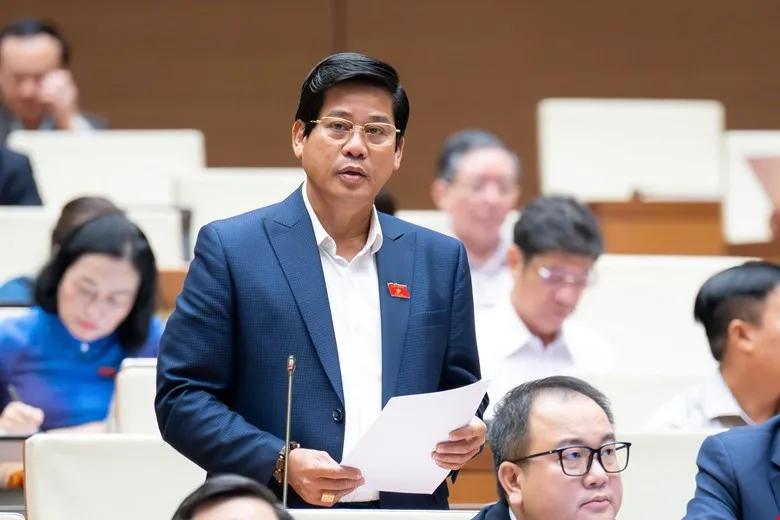
Representative Duong Van Phuoc (Da Nang delegation)
"Many communes in mountainous, border, and island areas are lacking 7 to 14 officials, making it very difficult to carry out assigned tasks," the delegate emphasized.
While the workload of commune-level officials and civil servants has increased two to three times, their remuneration and benefits remain unchanged, very low, and insufficient to motivate and encourage them to work with peace of mind and dedication.
Based on the above analysis, delegate Duong Van Phuoc proposed that the Ministry of Interior conduct a field survey soon to establish job positions and minimum staffing levels as a basis for determining staffing for communes. He also suggested advising the Government to promptly issue appropriate salary mechanisms to encourage commune-level officials and civil servants to work with peace of mind and attract personnel to work in difficult areas.
Improving the living standards of officials means improving the quality of the administrative apparatus.
Also speaking about the issue of salary policy and living conditions for officials and civil servants, delegate Tran Quoc Tuan (Vinh Long delegation) said that after nearly 4 months since the official implementation of the two-tiered local government model, our administrative apparatus has become "lighter" in terms of organizational structure, but "heavier" in terms of workload.
"Officials and civil servants in many localities, especially at the grassroots level, have to travel further to work and do more tasks, but their income remains… not much better," Mr. Tuan said.
Representative Tuan stated that, according to the summary report of voter recommendations submitted to this session, voters in many localities such as Quang Tri, Binh Thuan, and Vinh Long reflected that after the merger of administrative units, many commune officials have to travel further, in some places from 10 to 15 km to reach the new headquarters, while travel allowances and public service allowances have not been adjusted.
Voters in Nghe An, Lam Dong, and Dong Thap provinces have requested that the government implement policies to support and encourage officials in merged areas, as their lives are facing many difficulties, with increased travel, housing, and living expenses, resulting in a 10-12% reduction in real income compared to before.
Many localities, such as Bac Kan, Can Tho, and some provinces in the Mekong Delta, have also reported that grassroots officials are having to shoulder more work due to downsizing, but their income has not improved, affecting their morale, motivation, and work efficiency.
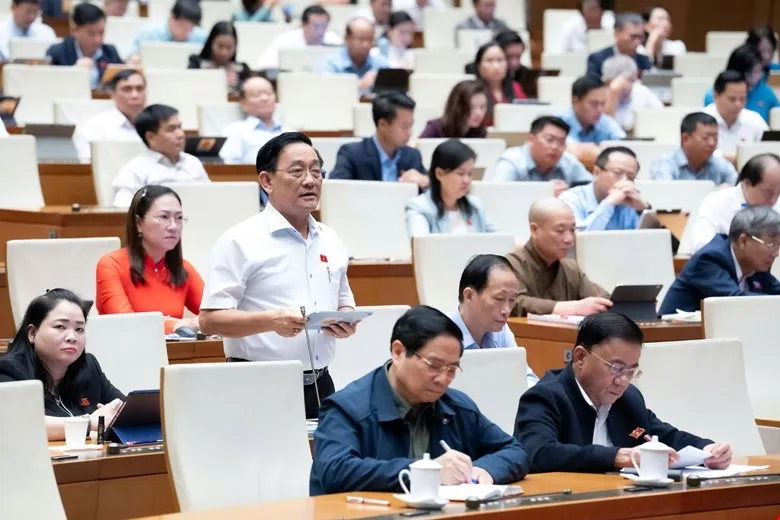
Delegate Tran Quoc Tuan (Vinh Long delegation)
The delegates also pointed out that the prices of many essential goods and services such as food, housing, electricity, water, tuition fees, gasoline, and rent have all increased, putting great pressure on people's lives.
Meanwhile, the basic salary of 2.34 million VND/month has been in effect since July 1, 2024, and compared to the current cost of living, it is clearly no longer appropriate.
On average, the minimum living expenses alone (food, transportation, utilities, children's school fees) in urban areas exceed 4.5-5 million VND per person per month.
With a base salary of 2.34 million VND, even with a higher multiplier, the actual income of many young civil servants is only enough… “from the beginning of the month to the 20th day,” while for the last 10 days of the month, they have to “live on hope and instant noodles.”
"We all agree that improving the living standards of officials is about improving the quality of the administrative apparatus. Therefore, I earnestly propose that the National Assembly and the Government consider adjusting the basic salary increase starting from January 1, 2026 - not waiting until mid-year as in previous periods," the representative said.
According to the delegates, this is not just a "story about salaries," but a reflection of the people's sentiments and the common heartbeat of a system that needs renewed vitality. Officials can only serve with peace of mind if they have enough to live on; civil servants can dedicate themselves more easily without the burden of making ends meet.
Source: https://vtv.vn/de-nghi-tang-luong-co-so-tu-1-1-2026-100251029094328592.htm
![[Photo] Prime Minister Pham Minh Chinh receives the Governor of Tochigi Province (Japan)](/_next/image?url=https%3A%2F%2Fvphoto.vietnam.vn%2Fthumb%2F1200x675%2Fvietnam%2Fresource%2FIMAGE%2F2025%2F12%2F16%2F1765892133176_dsc-8082-6425-jpg.webp&w=3840&q=75)

![[Photo] Prime Minister Pham Minh Chinh receives Lao Minister of Education and Sports Thongsalith Mangnormek](/_next/image?url=https%3A%2F%2Fvphoto.vietnam.vn%2Fthumb%2F1200x675%2Fvietnam%2Fresource%2FIMAGE%2F2025%2F12%2F16%2F1765876834721_dsc-7519-jpg.webp&w=3840&q=75)
![[Image] Leaked images ahead of the 2025 Community Action Awards gala.](/_next/image?url=https%3A%2F%2Fvphoto.vietnam.vn%2Fthumb%2F1200x675%2Fvietnam%2Fresource%2FIMAGE%2F2025%2F12%2F16%2F1765882828720_ndo_br_thiet-ke-chua-co-ten-45-png.webp&w=3840&q=75)

![[Live] 2025 Community Action Awards Gala](/_next/image?url=https%3A%2F%2Fvphoto.vietnam.vn%2Fthumb%2F1200x675%2Fvietnam%2Fresource%2FIMAGE%2F2025%2F12%2F16%2F1765899631650_ndo_tr_z7334013144784-9f9fe10a6d63584c85aff40f2957c250-jpg.webp&w=3840&q=75)

































































Comment (0)