

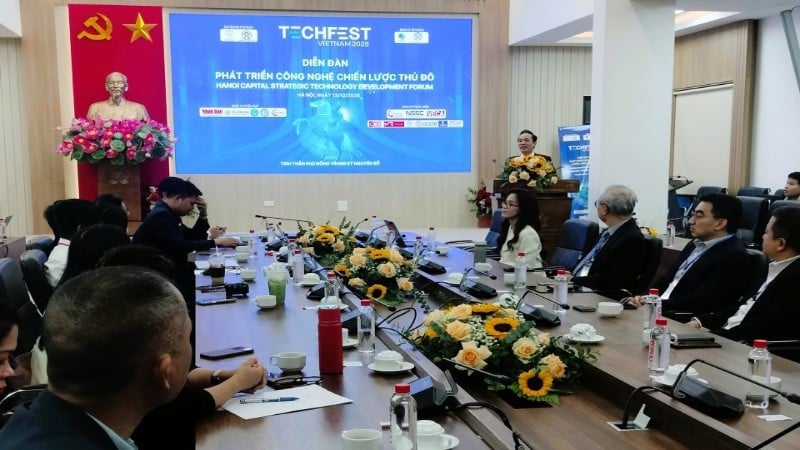
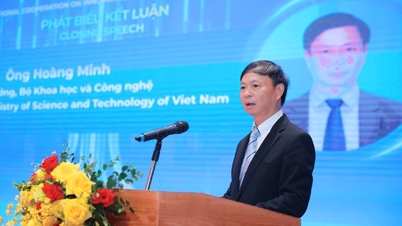
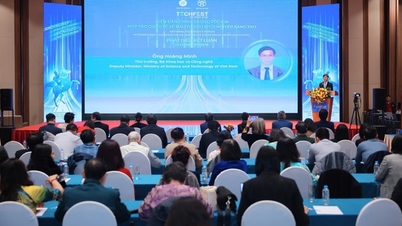
The forum attracted representatives from investment funds, technology corporations, deep-tech startups, Vietnamese experts abroad, and representatives from several international innovation centers.
Based on discussions and analyses of global technology trends and the advantages of the capital city, delegates, experts, and businesses proposed that Hanoi consider selecting seven strategic technology groups that could act as drivers of growth in the period 2026-2035, with a vision to 2045.
The technology groups mentioned include: artificial intelligence and machine learning; semiconductor and integrated circuit industry; robotics and intelligent automation linked to the Internet of Things, smart homes and smart factories; digital mirroring technology; smart cities, digital infrastructure and big data; clean energy and sustainable technologies; virtual reality, augmented reality and scalable platforms serving digital transformation, cultural industry development and cultural tourism .
These are areas considered suitable for Hanoi's advantage of high-quality human resources, capable of generating significant added value, while also meeting Vietnam's long-term development orientation towards a digital economy , knowledge-based economy, and green economy. Many delegates also emphasized combining technology with cultural industries and cultural tourism, exploiting the value of the capital's thousand-year-old cultural heritage as a different approach to create sustainable growth momentum.
Businesses and experts also proposed three groups of experimental mechanisms and policies for Hanoi. These include a proposal to establish a deep technology sandbox, allowing for the piloting of new technologies without a legal framework for 36 to 48 months in certain areas such as Hoa Lac, Dong Anh, and along the Red River; a proposal to establish a Hanoi Technology Venture Capital Fund with a target size of $300-500 million by 2030, operating under a public-private partnership model; and a public-private partnership mechanism for deep technology, allowing businesses to invest in public research infrastructure in exchange for priority commercialization of research results.
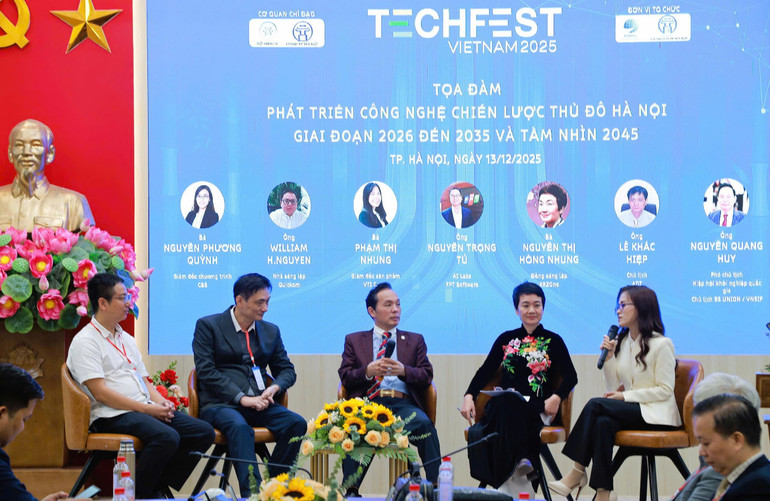
At the seminar, delegates made specific proposals for Hanoi's technological development process. Ms. Pham Thi Nhung, representing VTI Group, argued that smart factories will be a vital element if Hanoi wants to lead the next generation of industry, while emphasizing the necessity of developing industrial artificial intelligence infrastructure, supporting businesses in digitally transforming their production lines, and deploying smart factory pilot clusters.
Mr. Nguyen Trong Tu, representative of AI Labs, FPT Software, affirmed that data is a strategic asset and that it is impossible to build a truly smart city without a data strategy. He proposed that Hanoi needs to build a shared data platform and pilot the application of artificial intelligence in traffic management, public administration, construction permits, and handling urban complaints.
From the perspective of the semiconductor industry, Mr. Tan Teong Wei, representative of Infineon Technologies, believes that Hanoi has great opportunities to participate more deeply in the global semiconductor value chain. He suggested training 20,000 electrical and electronics engineers in the next 10 years, building a regional research and development center for chips and the Internet of Things, and providing preferential tax mechanisms and specific infrastructure for this industry.
Regarding the cultural and creative technology industries, Ms. Nguyen Hong Nhung, representative of XRZone, believes that virtual reality technology will open up a new economic sector for Hanoi. According to her, creative startups need to be provided with opportunities to test and expand technology applications in tourism, education, and heritage, with policies for ordering technology from government agencies and funds to support the commercialization of cultural and technological products.
Sharing his experience in international connectivity, Mr. Le Khac Hiep, representative of ADT, emphasized that to progress quickly, Hanoi needs stronger connections with the global innovation ecosystem. He proposed coordinating the establishment of a digital technology academy in Hanoi in an online format, aiming to train 100,000 high-quality technology engineers by 2030-2035, while also implementing exchange programs for Vietnamese technology experts abroad.
From a financial and entrepreneurial perspective, Mr. Nguyen Quang Huy, Chairman of 9S Union and VNSIF, believes that to foster the development of advanced technology startups, Hanoi needs a specific venture capital fund mechanism and policies that allow for faster technology testing. He proposed that the city allocate land and infrastructure to private innovation centers, grant the authority to pilot the operation of venture capital fund models according to international standards, and develop policies to attract intellectual capital, technology, and financial resources from the Vietnamese community abroad.
Source: https://nhandan.vn/de-xuat-7-nhom-cong-nghe-chien-luoc-cho-thu-do-ha-noi-post930029.html


![[Photo] Prime Minister Pham Minh Chinh attends the Conference summarizing and implementing tasks of the judicial sector.](/_next/image?url=https%3A%2F%2Fvphoto.vietnam.vn%2Fthumb%2F1200x675%2Fvietnam%2Fresource%2FIMAGE%2F2025%2F12%2F13%2F1765616082148_dsc-5565-jpg.webp&w=3840&q=75)














![[Photo] Prime Minister Pham Minh Chinh attends the Conference summarizing and implementing tasks of the judicial sector.](https://vphoto.vietnam.vn/thumb/402x226/vietnam/resource/IMAGE/2025/12/13/1765616082148_dsc-5565-jpg.webp)




























































Comment (0)