

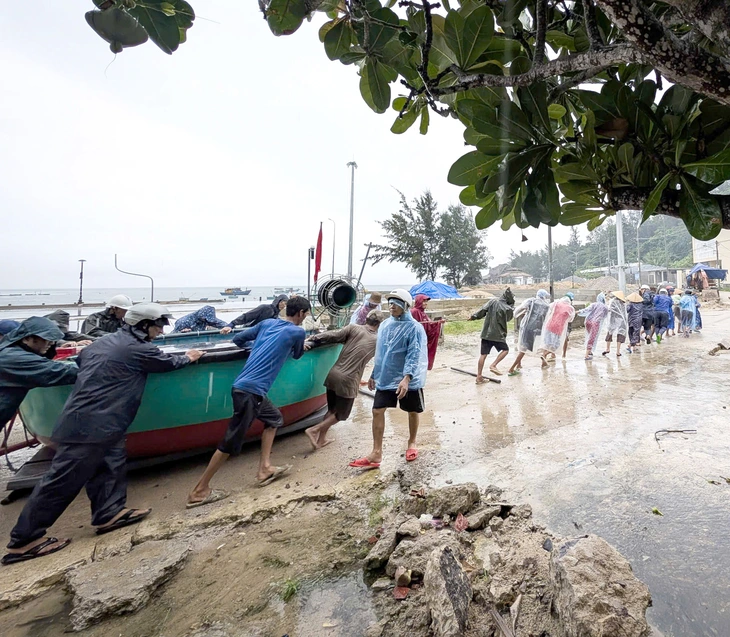
Residents of Nhon Chau island commune ( Gia Lai province ) help each other pull boats ashore to avoid the storm - Photo: Hiep Hung
Having lived more than half their lives and witnessed numerous major storms, the courageous fishermen of Nhon Ly coastal area (Quy Nhon Dong ward, Gia Lai province) say they are now afraid of the news about typhoon number 13.
Terrified by the extreme intensity of the storm.
On the sun-tanned face of Mr. Nguyen Cu (54 years old), a resident of Ly Luong neighborhood, anxiety was clearly visible as the super typhoon's path was heading directly towards this coastal area. Having lived his whole life off the sea, waking up to the sea every morning, his eyes today held a mixture of fear and apprehension.
On the embankment, the local fishermen brought their basket boats ashore, tying them tightly together with ropes. Not far away, more than a dozen floating houses, formerly used for tourism businesses, were also pulled onto the sand and carefully secured with supporting beams. In the houses facing the sea, the main doors and windows were locked tightly with ropes and bars.
People carefully covered their houses with plastic sheets to prevent seawater from directly hitting them. Televisions, refrigerators, and other valuable household items were dismantled and moved to higher ground for safekeeping. Houses were locked inside, awaiting the arrival of the raging storm.
Mr. Cu said that no one dared to stay in the houses near the sea during the storm's landfall. Therefore, from the evening of November 5th, they had evacuated to relatives' homes or designated evacuation centers set up by the authorities.
Not far away, throughout the day on November 5th, the people of Nhon Hai coastal village (Quy Nhon Dong ward) hurried to protect their homes from the strong storm. The banyan and flamboyant trees along the village roads, in offices, and schools were pruned bare, leaving only their trunks to withstand the storm.
On the rooftops, people were calling out to each other, pulling sandbags, bringing in rocks, and using car tires to brace the corrugated iron roofs.
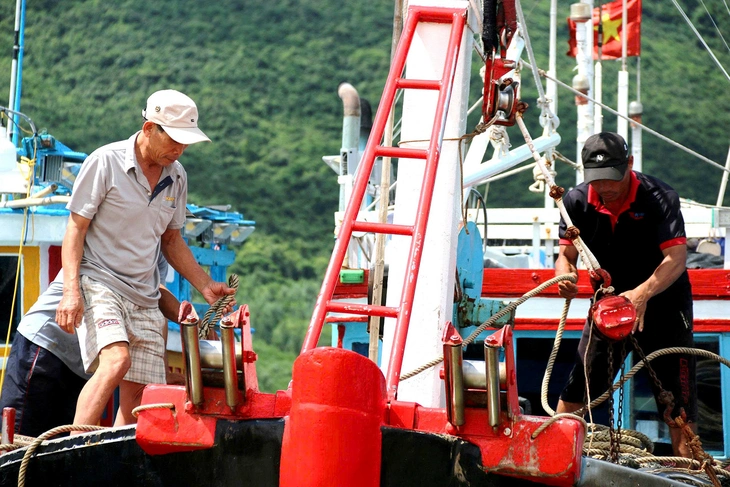
Fishermen anchor their boats to avoid Typhoon No. 13 in a sheltered area of Dam Mon village (Dai Lanh commune, Khanh Hoa province) - Photo by Nguyen Hoang.
In the flood-stricken areas, there is a flurry of activity involving reinforcement and relocation.
As the storm approaches, those in the flood-prone areas are just as worried as those on the front lines. Even the experienced residents of Tuy Phuoc Dong (Gia Lai), a flood-prone area, dare not speak confidently about the approaching storm.
Under the golden afternoon sun shining on the pile of stones at the edge of the village, Mrs. Nguyen Thi Ngoc Bich (48 years old) and her neighbor quickly shoveled crushed stone into prepared burlap sacks. They hurriedly carried them back home in batches, handing them over to the men to use as roof reinforcements.
Recalling the previous flood where the water rose to window-level, Mrs. Bich shuddered when the authorities warned that this storm could bring floods surpassing all previous historical peaks. This meant the water could completely submerge the windows, or even reach the rafters, or even the corrugated iron roof of her house in the middle of the field. Thinking this, she didn't hesitate, telling her family of six to evacuate immediately when the commune officials arrived to request it.
Along the village road, militia members on motorbikes fanned out in groups, transporting the elderly and disabled to early evacuations. With two militia members helping her up the hill on a motorbike, Mrs. Nguyen Thi Loi (80 years old), residing in Lac Dien village, Tuy Phuoc Dong commune, breathed a sigh of relief, having escaped the danger of her house being submerged by floodwaters in the middle of the night.
At the storm response meeting on the afternoon of November 5th, Mr. Pham Anh Tuan, Chairman of the Gia Lai Provincial People's Committee, could not hide his concern. Despite extensive media coverage and decisive action from all levels of government, some residents remained complacent and hesitant to evacuate. The provincial chairman stated that at all costs, people in low-lying and landslide-prone areas must be evacuated from their homes, even if coercive measures are necessary. He emphasized that people should not be allowed to climb onto their rooftops to call for help only after the storm hits. Rescue efforts at that point would be dangerous for both sides.
Mr. Tuan said that to avoid successive floods, the province has directed reservoirs to increase discharge to the maximum extent to create capacity to receive floodwaters, helping to reduce downstream flow during this storm. Gia Lai leaders estimate that with the super typhoon scenario just activated, the province will evacuate more than 100,000 households with 350,000 people, mainly those temporarily relocated to safe shelters and some evacuated to sturdy facilities.
The main military units, the people's pillar of support, are also ready for battle. Military Region 5 and the 34th Corps have pledged to deploy divisions and regiments, along with vehicles and equipment, to the affected areas to coordinate efforts in helping people cope with the storm.
The Deputy Prime Minister is in direct charge.
Given the dangerous developments of the storm, the Government has decided to establish a command center in Gia Lai province to direct storm response efforts in the region. According to Mr. Pham Anh Tuan, Chairman of the Gia Lai Provincial People's Committee, it is expected that today (November 6th), Deputy Prime Minister Tran Hong Ha and leaders of the Ministry of Agriculture and Environment will arrive in Gia Lai to directly assist the people in combating the storm. Gia Lai province has also decided to establish a forward command center in An Nhon ward, headed by the Provincial Chairman, to direct storm response efforts in the area.
Additionally, there are regional command centers located in the Quy Nhon, An Lao, Hoai An, Phu Cat, Tay Son, Vinh Thanh, Hoai Nhon, Phu My, Tuy Phuoc, Van Canh areas, and the western Gia Lai region.
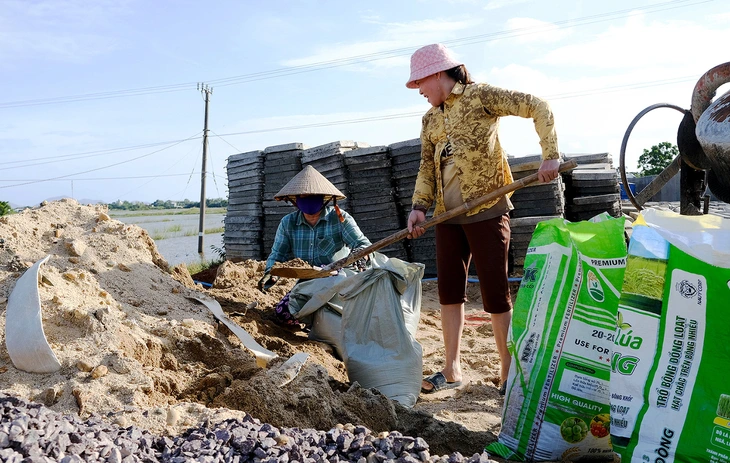
Ms. Nguyen Thi Ngoc Bich (48 years old), a resident of Tuy Phuoc Dong, Gia Lai, the epicenter of the flooding, and her neighbors are shoveling crushed stone into sacks to reinforce their roofs - Photo: TAN LUC
Dak Lak brings people ashore earlier than expected.
Chairman of the People's Committee of Dak Lak province, Ta Anh Tuan, affirmed that all households in areas at risk of flooding and landslides will be relocated to safe places.
On the afternoon of November 5th, Mr. Tuan stated that Typhoon No. 13 (international name Kalmaegi) is strong and moving rapidly, so the period from now until the typhoon makes landfall is a "golden time" to prepare for its response.
"The province is focusing on mobilizing people, especially aquaculture farmers, to harvest early to minimize losses. All vessels in the dangerous zone have been ordered to leave the area, return to shore, or seek safe shelter. Some vessels in the Truong Sa area are urgently returning," Mr. Tuan said.
In Song Cau and Xuan Dai wards, two key coastal areas for aquaculture, especially lobster farming, storm prevention efforts were urgently implemented from the morning of November 5th. Militia, police, and soldiers were mobilized to assist residents in reinforcing houses, trimming trees, and moving property and vehicles to safe locations. Mr. Nguyen Quang Hung (55 years old, Dan Phu 2 village, Song Cau ward) said that his family received assistance from the soldiers in pulling boats ashore, and were given buckets and plastic bags to pump water and reinforce their corrugated iron roofs before evacuating along with 91 other households in the village on the afternoon of November 5th.
According to Mr. Ta Anh Tuan, the process of bringing all residents on boats and rafts ashore will be completed before 3 PM on November 6th, earlier than the central government's regulations. The province is also reviewing areas at risk of tidal surges, landslides, and deep flooding to relocate residents to safe places.
Khanh Hoa responds to Typhoon Kalmaegi at the highest level.
In Khanh Hoa province, on November 5th, working groups led by provincial leaders conducted on-site inspections of all vulnerable areas at risk of landslides, flooding, and flash floods throughout the province before Typhoon Kalmaegi made landfall.
Inspecting storm prevention efforts in northern Khánh Hòa province, Chairman of the Khánh Hòa Provincial People's Committee Nguyễn Khắc Toàn said that drawing on the painful lessons from Typhoon Damrey in 2017, the province proactively developed plans and scenarios to respond to Typhoon Kalmaegi at the highest level.
How dangerous is Typhoon Kalmaegi?
Mr. Mai Van Khiem, Director of the National Center for Meteorological and Hydrological Forecasting, said that Typhoon Kalmaegi is particularly dangerous with its strong intensity in the East Sea and could maintain its very strong intensity when it makes landfall.
Forecasts indicate that around this afternoon (November 6th), Typhoon Kalmaegi will enter the sea area between Da Nang and Khanh Hoa. Around the night of November 6th (after 9 PM) to early morning of November 7th, the typhoon will move inland to the provinces from Quang Ngai to Dak Lak, then move into Laos, weaken into a tropical depression, and gradually dissipate.
Mr. Khiem warned that Typhoon Kalmaegi could cause significant impacts, including strong winds, high waves, heavy rain, flash floods, landslides, and widespread flooding in the central provinces.
First, in the South China Sea and coastal waters, with winds reaching level 14 and gusts up to level 17, waves around the storm's center could reach 8-10 meters, posing a danger to all ships and boats. Attention should also be paid to the impacts on the Spratly Islands and offshore structures.
In coastal areas, storm winds could reach level 12, with waves 4-6 meters high. Tomorrow, high tides combined with storm surge could reach 0.9-1.2 meters. Extreme caution is needed regarding preparedness measures, especially in the Ly Son Special Economic Zone, and for anchoring vessels and aquaculture farms in Gia Lai, Dak Lak, and Quang Ngai provinces.
Regarding the mainland, Mr. Khiem warned that the circulation of Typhoon Kalmaegi could cause strong winds from Quang Tri to Khanh Hoa, especially around the storm's center – the central area of Quang Ngai, Gia Lai, and Dak Lak provinces could experience winds of level 10-12, gusting to level 15, or even higher.
"The strong winds of the storm are also extending north of the storm's center due to interaction with cold air, so winds could reach levels 8-9, with gusts up to level 10. The Central Highlands provinces also need to be wary of strong winds; for example, at An Khe Pass, winds could reach level 9, even level 10, with gusts up to level 12, posing a danger to wind power plants and houses," Mr. Khiem noted.
Regarding rainfall, Mr. Khiem stated that although the cold air and easterly winds at high altitudes have weakened, the storm's circulation is still causing heavy rain in the Central and Southern Central regions, ranging from 200 to 300mm, with some areas receiving over 600mm, concentrated on November 6th and 7th, especially in the provinces and cities of Hue, Da Nang, Quang Ngai, Gia Lai, and Dak Lak.
"With such heavy and concentrated rainfall over such a period, it is particularly dangerous for medium and small reservoirs in the Central, South Central, and Central Highlands regions. Along with that, there is a risk of major flooding on rivers from Hue City to Dak Lak, with some rivers reaching flood warning levels 2 to 3, and some exceeding level 3. There is a very high risk of flash floods and landslides in the mountainous areas of the Central and Central Highlands regions," Mr. Khiem warned.
Source: https://tuoitre.vn/doc-toan-luc-chong-bao-kalmaegi-20251106073705882.htm













![[Infographic] Vietnam's Economic Situation Report, Q1 2026: Strong Growth Momentum](https://vphoto.vietnam.vn/thumb/402x226/vietnam/resource/IMAGE/2026/04/04/1775298512042_tang-truong-kinh-te-viet-nam.jpeg)

![[Image] Close-up view of the 10-lane road connecting to Long Thanh Airport](https://vphoto.vietnam.vn/thumb/402x226/vietnam/resource/IMAGE/2026/04/04/1775291871988_ndo_br_1-resize-5690-jpg.webp)








































































Comment (0)