

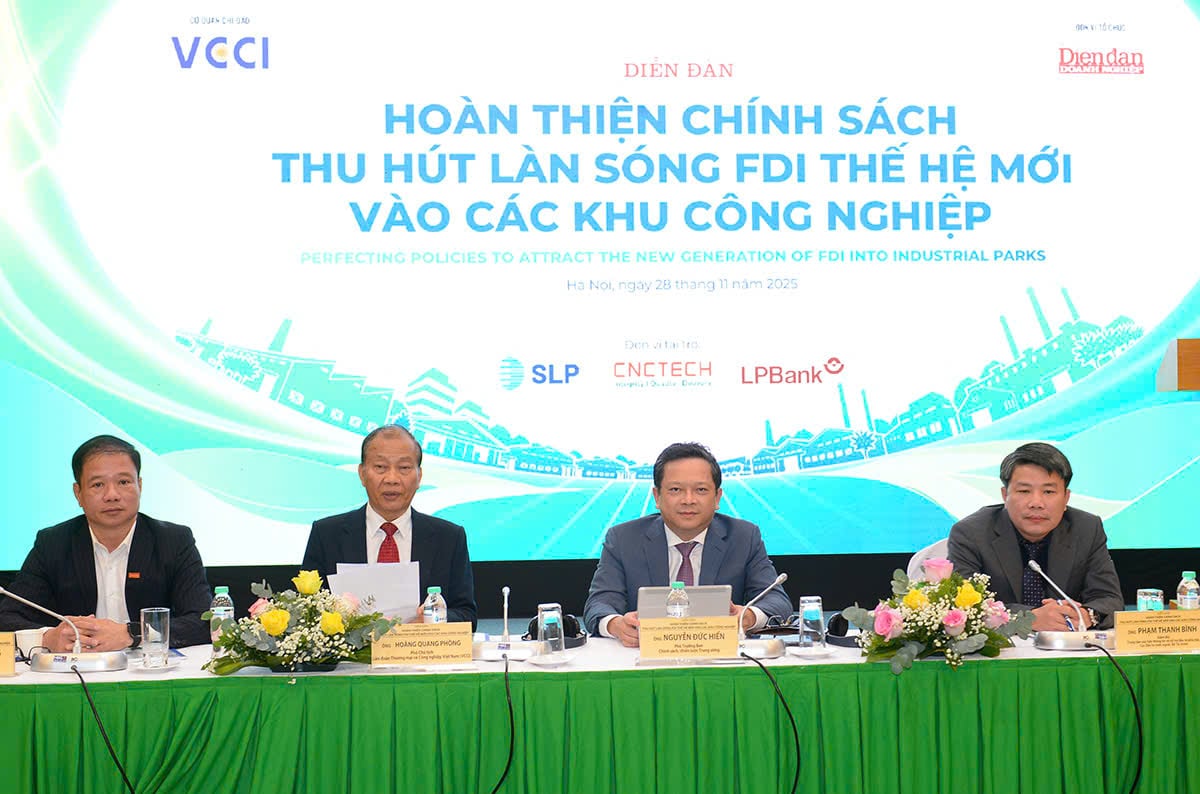
On November 28, in Hanoi , Business Forum Magazine (under the Vietnam Federation of Commerce and Industry (VCCI) organized the Forum "Improving policies to attract new generation FDI waves into industrial parks".
The Forum is a multi-dimensional dialogue space between policymakers, local leaders and leading experts with the overarching goal of jointly creating an effective policy framework, creating a foundation to enhance competitiveness and attract new-generation FDI for industrial parks (IPs).
Sharing at the Forum, Mr. Hoang Quang Phong, Vice President of VCCI, said that new generation FDI not only aims at profit but also promotes standards of high technology, knowledge transfer, green development, corporate governance, social responsibility and sustainable labor.
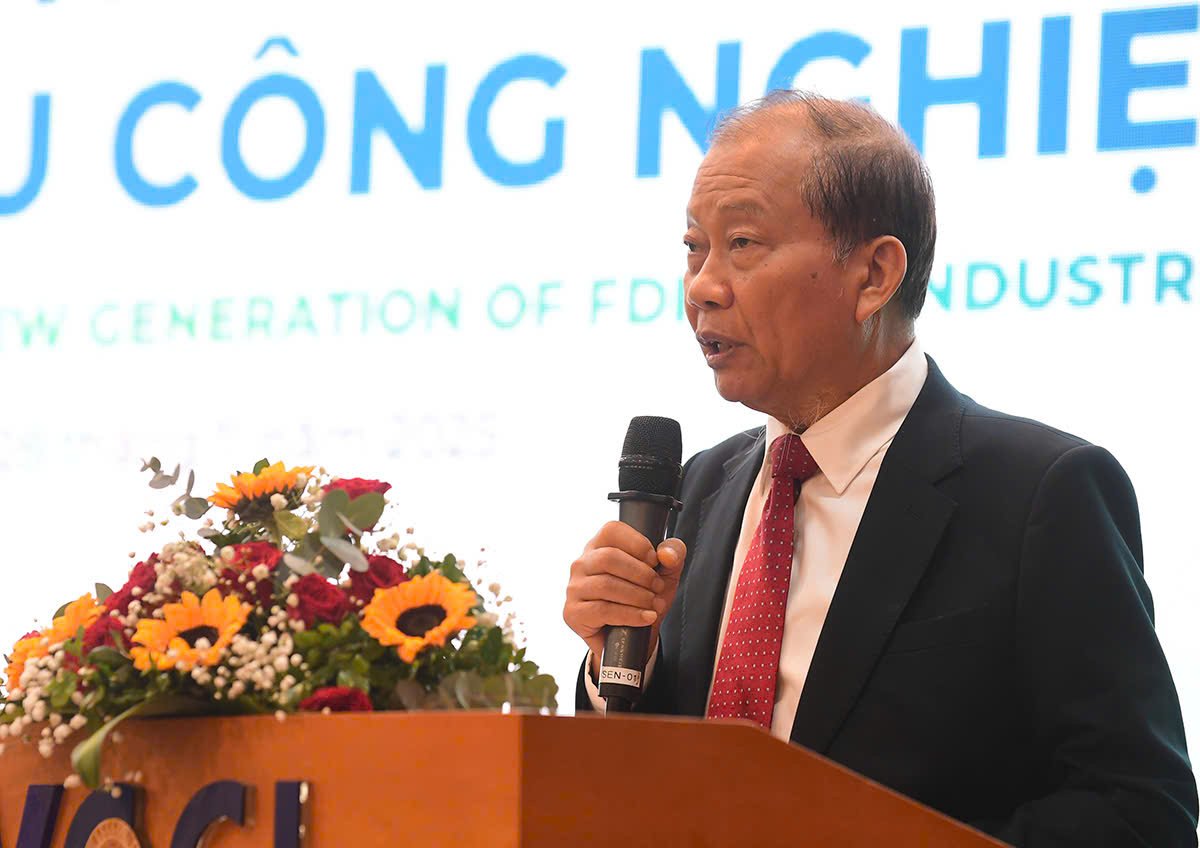
According to the Vice President of VCCI, in terms of attracting investment into industrial parks, 29 years have passed since the Government issued specific regulations on industrial parks in the 1996 Foreign Investment Law (Law No. 52-l/CTN, dated November 11, 1996), up to now, the number of industrial parks has increased and played a key role in the country 's economic growth. He emphasized that FDI capital has always held an important position, contributing greatly to the sustainable development of Vietnam's industrial parks over the past time.
The Vice President of VCCI said that in the context of the economy shifting towards green growth, circular economy and aiming for net zero emissions by 2050, reviewing and perfecting investment incentive policies for industrial parks and economic zones (EZs) has become extremely urgent. Currently, the Ministry of Finance is organizing to collect comments on the draft Decree on the management of industrial parks and economic zones, in which it proposes to strongly amend regulations on investment incentives to create more favorable conditions for investors.
Vice Chairman Hoang Quang Phong said that the most important and directional highlight of the draft Decree is the addition of regulations related to costs for activities to reduce greenhouse gas emissions and develop industrial symbiosis models. He emphasized that this mechanism will create strong financial incentives, encouraging businesses to switch to clean technology, save energy and apply environmentally friendly solutions.
In that spirit, Vice Chairman Hoang Quang Phong expects this change to expand the space for regional economic development, attract strategic investors with modern technology, and accelerate the green transformation process. This is an important step in the process of perfecting institutions, towards developing a green economy, a circular economy and achieving the goal of net zero emissions by 2050, helping Vietnam become an attractive and sustainable destination on the global investment map.
Sharing the same view, Mr. Nguyen Duc Hien, Deputy Head of the Central Policy and Strategy Committee, said that in nearly 40 years of innovation, the FDI sector has carried out an important mission, bringing Vietnam to participate more widely, becoming an important link in the global value chain, contributing significantly to GDP, investment capital, industrial production, export and employment.
Accordingly, this sector has contributed more than 20% of GDP; 15%-18% of total social development investment capital; about 25.4%-28% of total budget revenue; created more than 5.1 million jobs; contributed more than 70% of export value and more than 50% of industrial production value of Vietnam.
In the 2021-2025 period alone, total realized FDI reached more than 158 billion USD, exceeding the target of 100-150 billion USD set in Resolution 50-NQ/TW. In the first 10 months of 2025, Vietnam attracted 31.52 billion USD in registered FDI capital, up 15.6% over the same period last year; disbursement reached 21.3 billion USD, the highest level in 5 years, mostly concentrated in the processing and manufacturing sector.
In particular, industrial zones are increasingly playing a central role in attracting FDI capital, especially new-generation FDI capital flows, thanks to the provision of synchronous infrastructure and a controlled business environment. The new model of industrial zone management mechanism has played a role, contributing to promoting administrative procedure reform and creating a more favorable investment environment in the locality. Therefore, FDI capital in industrial zones and economic zones accounts for an average of 40% of the total registered FDI capital annually and has been on an increasing trend in recent years.
In general, Vietnam has had many favorable conditions to promote FDI attraction. However, Mr. Hien commented that there are still limitations and major problems that need to be frankly acknowledged in attracting FDI capital flows. Specifically, although FDI capital flows have increased sharply, the contribution of the FDI sector to total social investment capital is still relatively modest and on a downward trend, especially from 2018 to now, the decrease from 17.9% in 2018 to 16.5% in 2024. The advantage of low cost/cheap labor is gradually losing its competitive position...
Entering a new phase, Mr. Hien said that the draft Resolution of the 14th Party Congress has a more comprehensive orientation on FDI attraction, which is "selectively attracting FDI projects; focusing mainly on developing high-tech, low-emission industries; promoting the connection of the FDI sector with the domestic economic sector, effectively implementing the process of technology transfer, management skills and human resource training; forming an ecosystem and strengthening the chain of links between FDI enterprises and domestic enterprises".
To realize that requirement and continue to effectively attract new-generation FDI capital flows in the spirit of Resolution No. 50-NQ/TW, especially attracting high-quality FDI into industrial parks and economic zones, and at the same time, contributing to completing the content of the Project on Orientation to Attract New-Generation FDI Capital Flows that the Ministry of Finance is building; Mr. Hien emphasized that a new, more synchronous and drastic approach is needed.
Similarly, Mr. Pham Thanh Binh, Director of the Northern Investment Support Information Promotion Center, Foreign Investment Agency, Ministry of Finance, said that Vietnam has become a destination for many large corporations and companies in the fields of manufacturing, electronics, energy, and services.
However, according to him, with the world context changing dramatically, from supply chain shifts, digital transformation to green growth commitments, Vietnam is required to reposition its strategy, aiming to attract higher quality and more valuable FDI capital.
According to Mr. Binh, in the coming time, Vietnam will focus on priority orientations to attract high-tech and innovative FDI; especially in the fields of semiconductors, artificial intelligence, biotechnology and R&D centers; Promote investment in green transformation, sustainable development, renewable energy and circular energy...
To realize the above orientations, according to Mr. Binh, Vietnam needs to have specific solutions and actions such as perfecting investment institutions and policies, increasing stability and confidence for investors; promoting administrative procedure reform, creating maximum convenience in the project implementation process; upgrading infrastructure, especially logistics, energy and industrial park infrastructure in the direction of modern - green - smart; enhancing training of high-quality human resources to meet modern technology requirements; enhancing key investment promotion, targeting multinational corporations in the fields of high technology and clean energy.
Source: https://baotintuc.vn/kinh-te/go-diem-nghen-the-che-hoan-thien-chinh-sach-thu-hut-dong-von-fdi-the-he-moi-20251128161741377.htm















































































Comment (0)