


MANY EFFECTIVE PRODUCTION MODELS
Mr. Huynh Vinh Vo, residing in Binh An commune, Chau Thanh district ( Kien Giang province), is one of the households that have prospered from the "three-tiered" model of pineapple, betel nut, and coconut cultivation on the same plot of land along the Cai Be river. The combined cultivation of these three crops brings him a profit of approximately 150 million VND/hectare/year. Since the Cai Lon - Cai Be irrigation system was installed to control water resources, Mr. Vo and many other households in Binh An commune no longer worry about saltwater intrusion killing their crops.
Mr. Vo said: “Water is the most important factor, followed by fertilizer, then care, and finally seeds. Water is the first and most crucial element. Previously, in October and November each year, this area was affected by saltwater intrusion. Due to the lack of freshwater for irrigation, the pineapples produced small fruits, and the betel nut trees were not productive. Since the sluice gate was built, people no longer worry about saltwater intrusion, reducing production costs and increasing profits.”
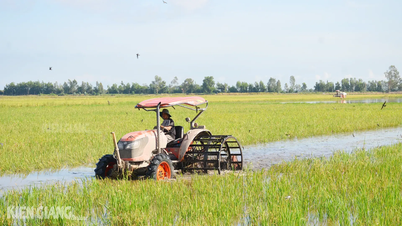
For areas planned for two-crop rice cultivation, shrimp-rice farming, rice-fish farming, livestock breeding, and freshwater and brackish water aquaculture in Go Quao district and parts of An Bien and Vinh Thuan districts (Kien Giang province), the worry about freshwater shortages and saltwater intrusion is now less. Previously, this region sometimes lacked brackish water for shrimp farming, and at other times suffered from severe and deep saltwater intrusion (such as the drought and salinity intrusion in 2015-2016).
Mr. Le Quoc Khanh (48 years old), residing in Dong Yen commune, An Bien district (Kien Giang province), cultivates 2 hectares of rice but struggles every year due to saline soil, especially during the winter-spring rice crop. Since the Cai Lon - Cai Be irrigation system was built, providing a reliable source of freshwater, people in Dong Yen commune are considering planting two rice crops and one cash crop to help increase their income.

The Cái Lớn sluice gate is part of the Cái Lớn - Cái Bé irrigation system.
According to the Department of Agriculture and Rural Development of Go Quao District (Kien Giang Province), the Cai Lon - Cai Be irrigation system has helped people minimize the negative impacts of climate change and proactively control water resources optimally. Currently, Go Quao District is implementing the project "Building livelihood models adapted to climate change and controlled water resources when constructing the Cai Lon - Cai Be sluice gate" with a total investment of nearly 4.5 billion VND.
Specifically, the shrimp-rice farming model involves farmers planting rice from the middle to the end of the rainy season and raising tiger shrimp during the dry season. This model has been implemented in several communes along the Cai Lon River where a portion of the land is affected by salinity during the dry season. As a result, households applying this model have achieved an average profit of over 60 million VND/hectare/crop, higher than the shrimp-rice farming model of farmers outside the project (which only achieved over 50 million VND/year).
Currently, the livelihood models and non-construction activities in Kien Giang province, under the Cai Lon - Cai Be irrigation system, phase 1, implemented in 7 districts, have yielded very good results, helping farmers in the project area gradually shift from an agricultural production mindset to an agricultural economic mindset. Suitable livelihood models help reduce production costs by 10-15% and increase economic efficiency by over 20% compared to traditional farming.
| Phase 1 of the Cai Lon - Cai Be irrigation system has a total investment of over 3,300 billion VND, including the two "super sluices" Cai Lon and Cai Be, which are currently the largest sluices in Vietnam. The project, which commenced in October 2019 and was completed in November 2021, functions to control water sources (saline, brackish, and freshwater), creating conditions for stable and sustainable production for production models based on corresponding ecosystems. |
Assessments after more than a year of operation of the Cai Lon - Cai Be irrigation system show that water resources are basically controlled, serving production well and supporting stable production arrangements for the beneficiary localities. Notably, the completely freshwater ecological zone of approximately 145,000 hectares is controlled, preventing saltwater intrusion. In the brackish ecological zone, mainly the shrimp-rice farming model, water resources are basically controlled with salinity levels suitable for aquaculture.
Furthermore, Kien Giang province avoids having to build temporary dams during the two dry seasons, saving tens of billions of dong, reducing environmental pollution, and preventing disruption to waterway traffic caused by temporary dam construction.
FLOODING STILL OCCURS DURING HIGH TIDE
Besides its effectiveness, the Cai Lon - Cai Be irrigation system, after one year of operation, has encountered several problems that need to be addressed to better meet the growing production needs of the people in the project area. Residents of Binh An commune, Chau Thanh district (Kien Giang province) reported that during high tides, low-lying areas downstream of the Cai Be and Cai Lon sluices experience flooding. Water overflows onto rural roads, inundating houses, fields, and orchards.
Mr. Le Thanh Nam, a resident of Binh An commune, said that during the high tide from July 10th to 12th, 2022, the Cai Be sluice gate was fully open, but the river water still rose high, flooding his family's entire pineapple plantation. However, no major damage has been recorded. "I and the people here hope that the government will soon invest in upgrading rural roads and building embankments to prevent flooding during the rainy season and limit the impact of high tides," Mr. Nam said.
Furthermore, during the operation of the Cai Lon - Cai Be irrigation system, several other problems have arisen. For example, the embankments downstream of the project were not built to technical standards and are frequently overflowed during high tides. Households living outside the dike are frequently flooded due to high tides, with the flooding worsening when the sluice gates are closed. In the western coastal area and along the Cai Lon and Cai Be rivers, the sluice gate clusters are not synchronized or fully enclosed, thus hindering the effective operation of the Cai Lon - Cai Be irrigation system…
Comrade Lam Minh Thanh - Deputy Secretary of the Provincial Party Committee and Chairman of the People's Committee of Kien Giang province - assessed that the Cai Be - Cai Lon irrigation system is very large in scale, impacting inter-provincial areas producing rice, aquatic products, and fruit trees. Practical operation has yielded significant results, effectively protecting production and reducing costs compared to before due to the elimination of temporary dam construction. However, because it operates to meet multiple objectives (freshwater, saline, and brackish water), it faces certain difficulties. Localized flooding occurs in the downstream area due to inadequate infrastructure; the sluice gate system in the beneficiary area has not been fully and comprehensively invested in.
To maximize the effectiveness of the project, the Chairman of the People's Committee of Kien Giang province, Lam Minh Thanh, instructed the Department of Planning and Investment of Kien Giang province to balance and proactively utilize local resources to invest in projects that ensure a closed loop system to meet the needs of production development.
Text and photos: LE VINH
Source link




































































Comment (0)