

In 2012, the Oc Eo - Ba The Archaeological Site was recognized by the Government of the Socialist Republic of Vietnam as a Special National Monument. Currently, the dossier is being finalized to propose its inclusion in the UNESCO World Heritage list. The site has a total protected area of 433.2 hectares, divided into Zone A on the slopes and foot of Ba The mountain (143.9 hectares) and Zone B in the Oc Eo plain (289.3 hectares).
Several notable archaeological sites have been excavated and preserved, such as: the site within Linh Son Pagoda area, the Nam Linh Son Temple site, the Go Cay Me (Go Sau Thuan) site, the Go Ut Tranh site, etc. Today, Oc Eo has become a special national historical and cultural site, preserved and its value promoted. Visitors can visit the Oc Eo Culture Exhibition House, which displays valuable archaeological artifacts and explore the remaining relics of the ancient city.
Typically, the Gò Cây Thị site is located approximately 500m southwest of the Gò Óc Eo site, 500m northeast of the Gò Giồng Cát site, and 2,000m northwest of the Linh Sơn Pagoda archaeological site. The site was classified as a national heritage site in 2002 and has a sturdy protective roof covering the entire excavated area. It was discovered in 1942 and excavated in 1944 (designated as Structure A). In 1999, open-air excavations revealed two separate structures within the same area, leading archaeologists to name them Gò Cây Thị A and B.
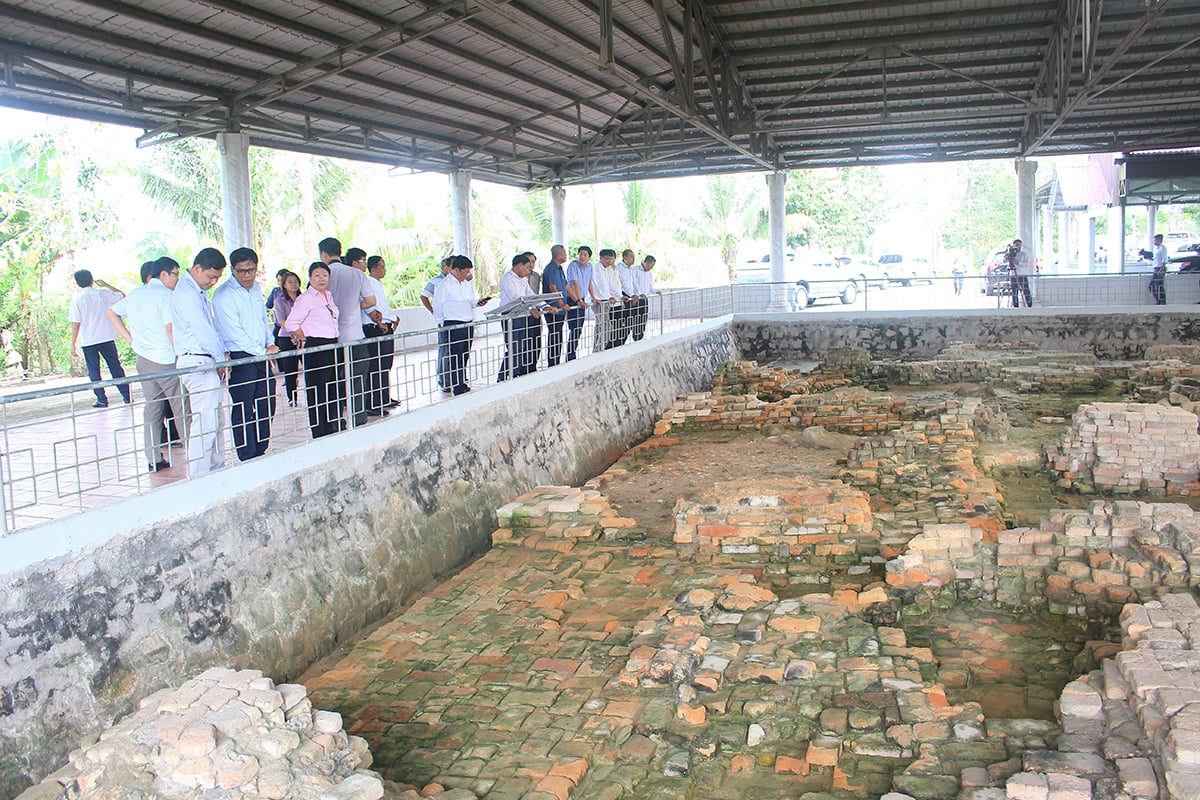
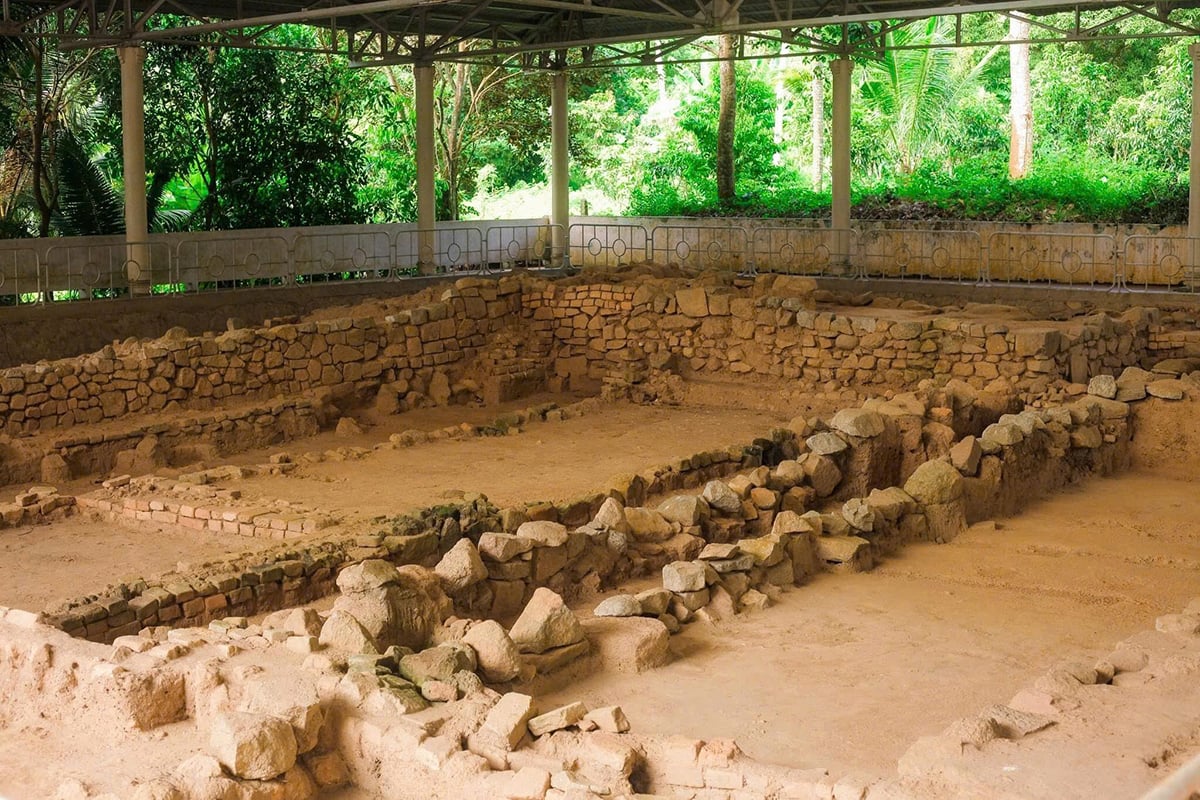
Preserving and promoting the value of the Oc Eo - Ba The archaeological site.
One of the most popular tourist attractions is Linh Son Pagoda. Located on the eastern slope of Ba The Mountain, Linh Son Pagoda currently houses two unique artifacts of the Oc Eo culture: two ancient stone steles and a statue of the god Vishnu, dating back to approximately the 5th century AD. The pagoda was classified as a national heritage site in 1988. The two ancient stone steles, made of black slate, were discovered in 1879 at the site of Linh Son Pagoda; only one of them still bears Sanskrit inscriptions. The statue, discovered in July 1912, is a four-armed Vishnu statue made of dark gray sandstone, approximately 3.3 meters tall, with a cylindrical headdress. After being placed between the two steles, the local people transformed it into a seated Buddha statue for worship according to Vietnamese customs, hence Linh Son Pagoda is also known as the Four-Armed Buddha Pagoda.
Through numerous investigations, explorations, surveys, and archaeological excavations by French and Vietnamese scholars, especially the excavations in 1998-2001 and 2017, it has been revealed that the ground beneath Linh Son Pagoda contains many architectural relics from various periods. Particularly noteworthy is the discovery of a system of surrounding walls dating from the 5th to the 9th centuries, built of brick, with a tendency to continue developing towards the center beneath the pagoda's foundation. This is evidence of a large, solid structure that once existed and is now buried. Within the pagoda grounds, many types of artifacts have also been found, such as: ceramic vases, pottery jars, various types of decorative architectural tiles with distinctive decorative border art; grinding stones, rollers, column bases, slabs, steps, door pillars… made of stone, dating back to the architecture.
In addition, visitors to this area can visit the Gò Cây Me site, also known as Gò Sáu Thuận, which is connected to the central architecture of Linh Sơn Pagoda to the west. In 2001, excavations at the site named Gò Cây Me uncovered a complex collection of structures, including walls built with recycled bricks, mostly on granite foundations, along with fragments of cooking pots, jars, pottery, and many animal bones, indicating a residential site.
In particular, the comprehensive excavation from 2017 to 2020 uncovered brick and stone embankment walkways and numerous brick structures spread out around the site. Based on the layout and shape of the remaining architectural foundations, the initial assessment is that this was an outer structure functioning as a gateway and access route to the central structure of Linh Son Pagoda. Along with previously discovered residential sites, the Go Sau Thuan site is estimated to date from the beginning of the Common Era to the 10th-12th centuries.
The remaining physical evidence of the Oc Eo - Ba The Archaeological Site proves the existence of a culture associated with the Funan Kingdom - a wealthy and powerful nation in Southeast Asia from the beginning of the Common Era to the 7th century. With its immense historical, cultural, and archaeological value, Oc Eo - Ba The has enormous tourism development potential. Investing in and developing tourism here will not only contribute to the preservation and promotion of heritage values but also create opportunities for local socio-economic development.
Source: https://baoangiang.com.vn/kham-pha-oc-eo-a417859.html
![[Photo] Standing Committee member of the Party Central Committee Tran Cam Tu presides over the preliminary review of the organization of the 14th Party Congress.](/_next/image?url=https%3A%2F%2Fvphoto.vietnam.vn%2Fthumb%2F1200x675%2Fvietnam%2Fresource%2FIMAGE%2F2026%2F01%2F13%2F1768292063355_anh-man-hinh-2026-01-13-luc-15-14-10.png&w=3840&q=75)
![[Photo] Final preparations underway for the organization and service of the 14th National Congress of the Party.](/_next/image?url=https%3A%2F%2Fvphoto.vietnam.vn%2Fthumb%2F1200x675%2Fvietnam%2Fresource%2FIMAGE%2F2026%2F01%2F13%2F1768315558336_ndo_br_bnd-4068-jpg.webp&w=3840&q=75)
![[Photo] National Assembly Chairman Tran Thanh Man receives the Ambassadors of Cambodia, the Philippines and the United States for a farewell visit.](/_next/image?url=https%3A%2F%2Fvphoto.vietnam.vn%2Fthumb%2F1200x675%2Fvietnam%2Fresource%2FIMAGE%2F2026%2F01%2F13%2F1768303256862_tiep-ds-5658-jpg.webp&w=3840&q=75)


![[Photo] Hanoi, the capital city, brilliantly welcomes the 14th National Congress of the Party.](/_next/image?url=https%3A%2F%2Fvphoto.vietnam.vn%2Fthumb%2F1200x675%2Fvietnam%2Fresource%2FIMAGE%2F2026%2F01%2F13%2F1768271572243_image-1.jpeg&w=3840&q=75)






















































Comment (0)