

In Ho Chi Minh City, Mr. Dung, 41 years old, suffered from left-sided facial pain, left-ear deafness, and inability to close his eye completely. Doctors discovered a tumor 13 cm from the cerebral cortex and successfully performed surgery using robotic guidance.
Eight months ago, Mr. Dung, residing in Nghe An province, underwent brain tumor surgery at a hospital in Hanoi . The tumor was approximately 4-5 cm in size at the time. After the surgery, he experienced pain on the left side of his face and deafness in his left ear, so he went to Tam Anh General Hospital in Ho Chi Minh City for examination.
The patient's brain MRI results showed a remaining tumor, approximately 2.5 cm in size, located almost in the center of the brain, compressing the trigeminal nerve (cranial nerve V) and displacing it outwards, causing pain on the left side of the face. The tumor was located in the cerebellopontine angle, consisting mostly of keratinocytes, with a soft capsule.
On November 4th, Dr. Chu Tan Si, Head of the Neurosurgery Department at the Neuroscience Center, stated that the patient experienced facial pain and deafness due to damage to cranial nerves 7 and 8. The tumor in the cerebellopontine angle region is a difficult type of tumor to treat. This area contains numerous nerves, directly affecting the patient's life and daily activities. During surgery, if the surgeon lacks experience and does not apply modern surgical techniques, there is a risk of damaging these nerves.
For example, if a surgeon manipulates the seventh cranial nerve, the patient risks facial asymmetry. Damage to the eighth cranial nerve can lead to dizziness, vomiting, or complete hearing loss. Cranial nerves 9, 10, and 11 run together; if the surgeon touches them, the patient may experience difficulty swallowing or choking. The tongue is also more likely to twist to one side if surgery touches the twelfth cranial nerve.
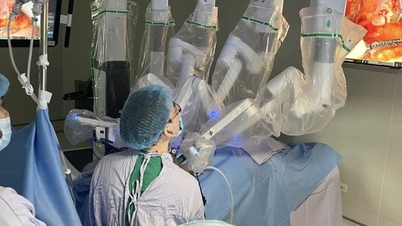
Dr. Tan Si and his team decided to use an artificial intelligence (AI) robot to help locate and visualize the brain structure and nerve fiber bundles, and to remove the remaining tumor, avoiding post-operative complications.
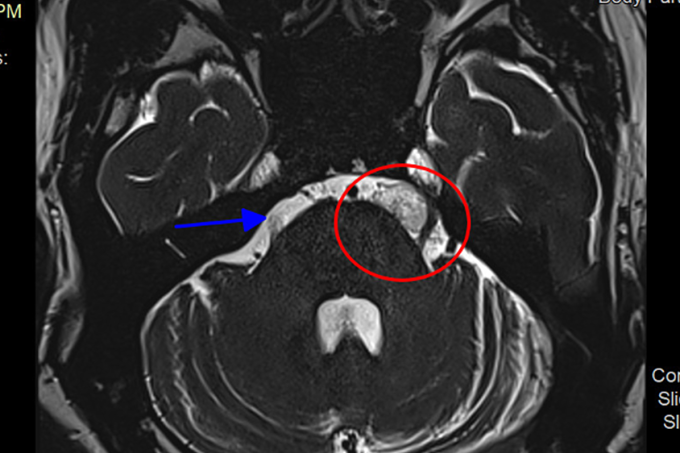
The tumor (red circle) is pressing on and displacing the trigeminal nerve (blue arrow). Photo: Provided by the hospital.
The surgical approach to the tumor starts from the suboccipital region, behind the sigmoid sinus (located in the inner part of the mastoid bone where the transverse venous sinus of the brain is located). The surgeon opens the skull wide enough to retract the cerebellum and access the cerebellopontine angle. The depth relative to the surface of the cerebral cortex is approximately 13 cm.
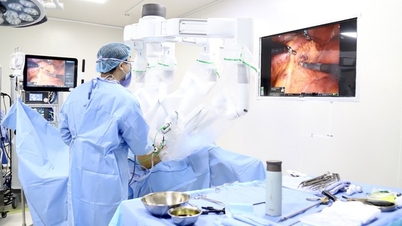
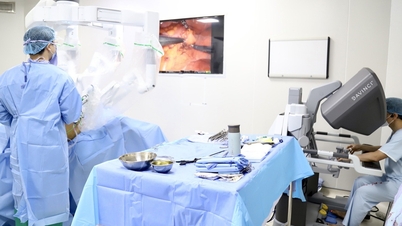
The robotic system, connected to the Kinervo 900 microsurgical microscope and Neuro-Navigation BrainLab, utilizes artificial intelligence (AI) to help doctors clearly identify the path of nerves, re-examine brain structures, and successfully access tumors. Using a Cusa ultrasound machine, doctors break down the tumor into smaller pieces and remove them individually, avoiding damage to surrounding tumor tissue, nerves, and brain structures.
According to Dr. Tan Si, the neurophysiological potential monitoring system, when applied to the nerves, generates a warning signal, allowing the surgical team to stop in time without damaging the nerves, thus preserving maximum function for the patient after surgery.
After three hours of surgery, the tumor was completely removed, freeing the trigeminal nerve (cranial nerve V). The patient was free from pain and facial spasms, could close their eyes completely, swallowed without pain, and ate and drank normally. However, the weakness on the left side of the face and hearing loss in the left ear did not recover due to previous damage to cranial nerves VII and 8 from the previous surgery.
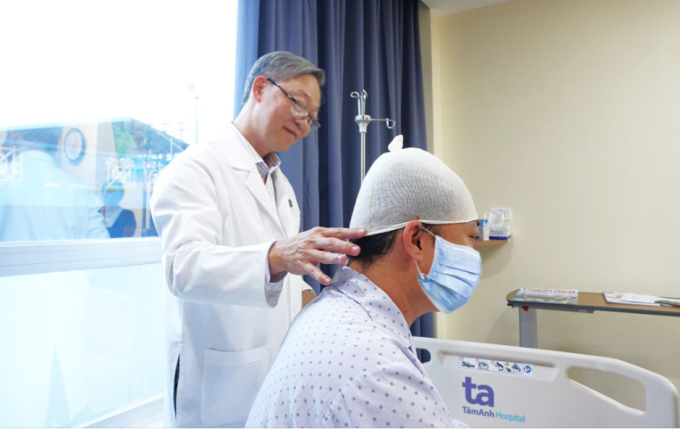
Doctor Tan Si examines Mr. Dung after surgery. Photo: Provided by the hospital.
Mr. Dung was able to walk one day after surgery and is expected to be discharged from the hospital in 5 days.
Peace of Mind
* The patient's name has been changed.
| Readers can ask questions about neurological disorders here for doctors to answer. |
Source link
![[Photo] Solemn bathing ceremony and Buddha procession in Hue](https://vphoto.vietnam.vn/thumb/1200x675/vietnam/resource/IMAGE/2026/05/31/1780228263543_1-jpg.webp)
![[Image] Hanoi Police officially crowned champions of V-League 2025/2026](https://vphoto.vietnam.vn/thumb/1200x675/vietnam/resource/IMAGE/2026/05/31/1780244769054_ndo_br_039d561b692be875b13a-jpg.webp)
![[Photo] The General Secretary, President and his wife begin their state visit to the Philippines.](https://vphoto.vietnam.vn/thumb/1200x675/vietnam/resource/IMAGE/2026/05/31/1780230559452_anh-man-hinh-2026-05-31-luc-19-28-11.png)
![[Photo] Admire the coral "masterpiece" amidst the million-year-old heritage of Dak Lak province.](https://vphoto.vietnam.vn/thumb/1200x675/vietnam/resource/IMAGE/2026/05/31/1780221235105_anh-man-hinh-2026-05-31-luc-16-53-27.png)



















![[Video] Sunset at Lap An Lagoon – Where the sun sets over the fishing nets](https://vphoto.vietnam.vn/thumb/340x192/vietnam/resource/IMAGE/2026/05/31/1780192137701_beach-landscape-sea-water-nature-grass-745871-pxhere-com.jpeg)






































![[Photo] Admire the coral "masterpiece" amidst the million-year-old heritage of Dak Lak province.](https://vphoto.vietnam.vn/thumb/402x226/vietnam/resource/IMAGE/2026/05/31/1780221235105_anh-man-hinh-2026-05-31-luc-16-53-27.png)


































Comment (0)