

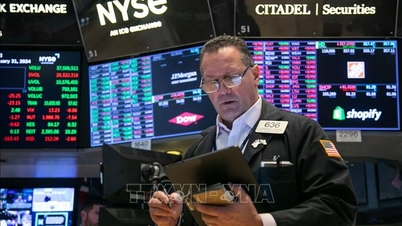
The stock market experienced weak liquidity in September and October, lacking clear drivers to attract investor capital.
The stock market experienced weak liquidity in September and October, lacking clear drivers to attract investor capital.
 |
Money flowing into the stock market is trickling in.
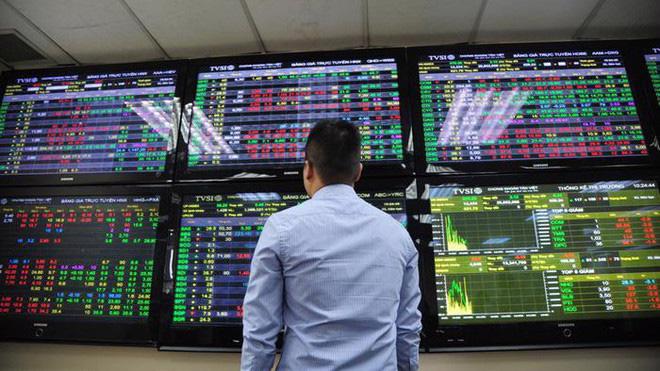
Cash flow into the stock market is at a low level, with sessions experiencing a significant drop in liquidity. On November 5th, the trading volume on the HoSE exchange fell to 8,200 billion VND, the lowest since mid-May 2023, with foreign investors increasing their net outflow to 853 billion VND.
Even though the VN-Index rose more than 15 points on November 6th following President Donald Trump's re-election, the inflow of capital into the market did not improve. In the two subsequent sessions, there was no significant breakthrough in capital flow, and liquidity continued to remain low, with trading values around 11,000 - 12,000 billion VND.
Liquidity for the entire month of October 2024 reached only 17,764 billion VND, equivalent to September 2024 and also the lowest level since the beginning of the year. Over the past few months, the VN-Index has been in a state of continuous fluctuation, fluctuating without breaking through; foreign investors have been consistently net sellers, while individual investors have continued to open fewer new accounts.
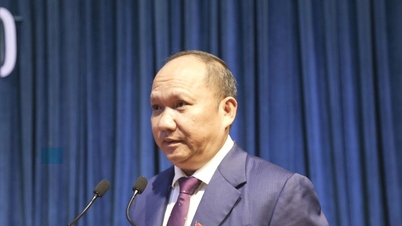
Mr. Truong Hien Phuong, Senior Director of KIS Vietnam Securities Joint Stock Company, said that the geopolitical situation in the world, the US presidential election, and the tendency for geopolitical conflicts to spread are causing investors to be more concerned and cautious in disbursing funds.
Meanwhile, the domestic situation has not seen much positive news. The Q3 2024 earnings reports are almost complete, and the market upgrade has not yet been achieved. Rising exchange rates, rising gold prices, or the surge in land prices in some localities, although only localized, are causing stock market investors to consider other investment channels. The continuous net selling by foreign investors is significantly impacting the sentiment of domestic investors.
Non-prefunding needs more time to become effective.
In early November 2024, new regulations freeing up pre-funding officially came into effect, allowing foreign institutional investors to buy shares without requiring sufficient funds at the time of placing an order. This is one of the final hurdles that will help the Vietnamese stock market get upgraded and is expected to attract a large amount of foreign capital. However, experts agree that the positive impact of this regulation will take time to fully permeate the market.
"Foreign funds investing in Vietnam have been investing for many years and are familiar with previous regulations, so they are not significantly affected. Other foreign organizations also need time, careful consideration, research, and thorough valuation before entering the market," Mr. Truong Hien Phuong commented.
Sharing the same view, Vicente Nguyen, Investment Director of AFC Vietnam Fund, believes that the non-prefunding regulation has not had any significant direct impact. Thanks to this regulation, the upgrade of the market by FTSE Russell has a chance to be realized, and if the Vietnamese stock market is upgraded, that could help attract foreign capital.
How can we stimulate liquidity?
Regarding the outlook for market liquidity from now until the end of the year, experts remain apprehensive due to a lack of positive information. However, in the long term, the Investment Director of AFC Vietnam Fund believes there are many options to improve the stock market and attract both domestic and foreign capital. Besides the non-prefunding regulation, improving trading processes and shortening the transaction timeframe from T+2.5 to T0 are measures that could be considered.
Mr. Vicente Nguyen emphasized: "If you pay attention, you'll see that in the past three years, there have been almost no IPOs on the market to add new products. The market is still dominated by the same companies, without new products, so how can it attract more interest? Therefore, promoting IPOs, or the privatization of state-owned enterprises, and encouraging private companies to list are ways to boost the stock market and attract more capital from investors."
The most fundamental aspect remains that businesses themselves must continuously grow stronger to attract investor interest.
Offering further policy suggestions, Mr. Truong Hien Phuong expressed his hope that regulatory agencies would continue to strengthen efforts to combat and punish those who manipulate stock prices, review and establish mechanisms for dealing with groups that spontaneously solicit stock market advice without basis, distorting the market and affecting investor sentiment.
In particular, Mr. Phuong hopes that the relevant agencies will further promote and accelerate the process to meet the requirements of the assessment organization, so that the stock market can be upgraded as soon as possible.
Efforts from only one side cannot promote the overall development of the entire market. Only joint efforts from government agencies and listed companies can stimulate positive investor sentiment and attract capital back into the market, both from domestic and foreign investors.
Source: https://baodautu.vn/kich-thich-thanh-khoan-cho-thi-truong-chung-khoan-d229646.html

![[Photo] Admire the coral "masterpiece" amidst the million-year-old heritage of Dak Lak province.](https://vphoto.vietnam.vn/thumb/1200x675/vietnam/resource/IMAGE/2026/05/30/1780107638639_y25-jpg.webp)


































































































Comment (0)