

08:26, 27/10/2023
There are many places called "Heaven's Gate." In the northern mountainous provinces like Ha Giang and Lai Chau , as well as in the highlands of Central Vietnam and the Central Highlands, there are numerous such places. The "Heaven's Gate" I just visited is located in An Lao district, a mountainous area of Binh Dinh province.
The road to the Heavenly Gate
From An Lao town to the Heaven's Gate is about 40 km. This is a relatively pristine mountainous area with many primeval forests. The paved road, while not as good as in the lowlands, is still quite convenient for tourists. At the Heaven's Gate, the paved road ends, and from there you can only see the lush green of the high mountains and deep forests.
The car sped along the winding mountain pass. Tall trees lined both sides of the road. After only ten or fifteen minutes, the air turned cold. Another ten or fifteen minutes, hazy clouds drifted across the windshield. The atmosphere and the cold were similar to the highlands of Sa Pa and Da Lat… There were so many clouds that the car had to slow down and turn on the headlights in many places. At an altitude of less than 700 meters, we saw a large rock by the roadside with the words "Heaven's Gate" carved on it. Not far away was a sign indicating "Cloud-watching spot." I got out of the car and took a few photos. Indeed, this cloud-watching spot was very interesting. Looking down, we saw a colorful forest; at the end of the dry season, yellow and red leaves mingled with green. Clouds drifted across like silk ribbons, swirling around the trees when the wind blew strongly, and when the wind died down, they intertwined with the foliage.
The car continued for a short but very steep stretch. Mr. Phan Hoai Son, Chief of the An Lao District Party Committee Office, explained that this was Hamlet 3, and further on would be Hamlet 2 and Hamlet 1, all three belonging to the mountainous An Toan commune. However, Hamlet 3 is the highest point, located at an altitude of 1,200 meters above sea level. Hamlet 3 is the administrative name; it's a Bana village with fewer than 30 houses, perched precariously on a flat piece of land right in the middle of the mountain peak.
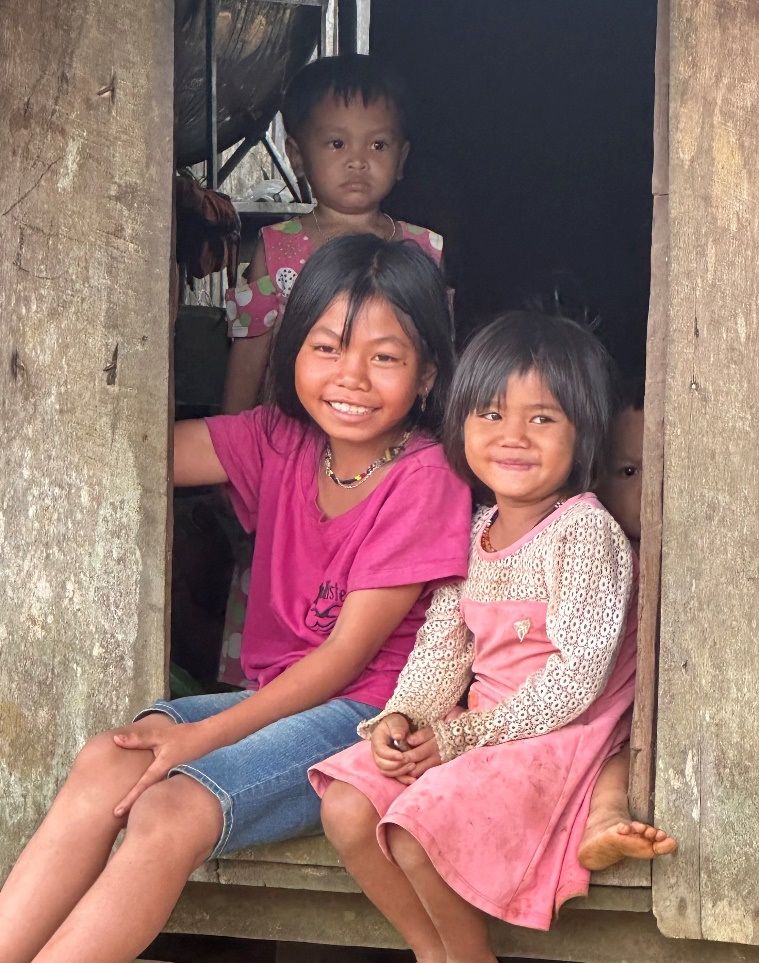 |
| Bana children at the Gate of Heaven. |
The colorful Bana village
As soon as I stepped through the village gate, I was surprised by the stilt houses covered in murals. Although I had seen many mural villages before, such as Canh Duong village (Quang Binh province), Man Thai village ( Da Nang city), Tam Thanh village (Quang Nam province), etc., this was the first time I had seen a minority ethnic village with large-scale murals covering the entire facades of the stilt houses.
Seeing me gazing in fascination, Mr. Son explained that the idea for this mural painting originated from a group of teachers living in the remote village. Living here with the Bana people, they witnessed the beauty of the mountains, rivers, and the rich cultural traditions of the indigenous inhabitants. They then pondered how to make this place known to others. Their idea for painting was approved and financially supported by the local government. So, with the help of artists, the group of teachers in An Lao district proceeded to paint murals on the walls of the stilt houses.
I counted a total of 15 large murals, covering the walls of the stilt houses. The themes focused on mountain landscapes and daily life in the Bana village. The vibrant colors and realistic depictions made the paintings come alive amidst the mountains and forests. I stopped on the road leading into the village and chatted with the locals. Many people I only managed to ask by name, like Ms. Dinh Thi Huong and Mr. Dinh Van Coong, said that the owners of the houses with murals were very happy. They said that the beautiful paintings made the village look like it was dressed in new clothes for a festival. Old and young alike enjoyed it. Mr. Dinh Van Lay, an elderly Bana farmer, added: “Before, it was very quiet and lonely here; the adults went to the fields, and only the children stayed home. Now it’s different; many people come to visit. The village always has visitors from far away.”
I looked around the main road leading into the village and the smaller paths leading to the stilt houses. It was quite surprising, because everything was very clean, and many flowerbeds clearly showed that the homeowners had planted and cared for them themselves. Perhaps, as Mr. Dinh Van Lay said, the influx of visitors has made the residents here more conscious of protecting the environment, preserving greenery, and planting more flowers. The Bana people here also still maintain and preserve their traditional cultural values intact, such as their architecture, clothing, handicrafts, cuisine , and especially their annual festivals.
From the unique mural village in Hamlet 3, we continued our journey to Hamlets 2 and 1. The further we went, the more the vast forest captivated our steps. Like Hamlet 3, the Bana villages here, although lacking murals, were still charming with the beauty of their stilt houses and the clusters of flowers lining the paths leading into the village. Along the way, there were also public trash cans, a rare sight in other highland areas. Many Bana children greeted us with smiles and natural greetings, unlike the shyness often seen elsewhere.
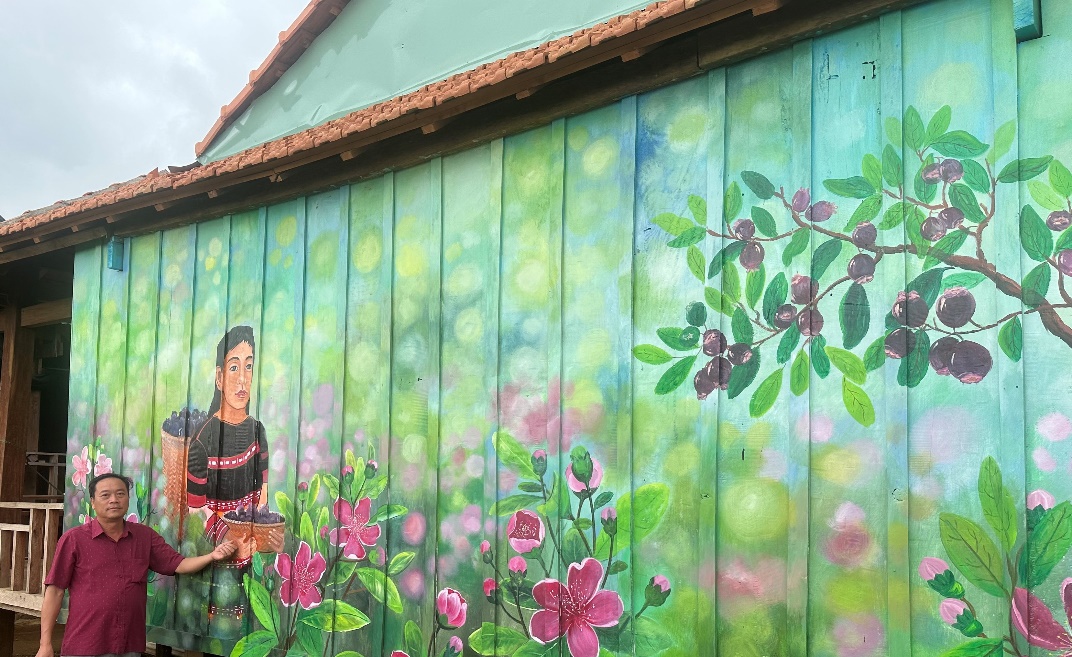 |
| Murals on the walls of stilt houses. |
The path runs right through the middle of the village.
The afternoon sky in the highlands was dotted with a few raindrops. The air was cool and crisp. Son took me on a tour and continued the story. It turned out that all the changes in An Toan commune, a highland area, had only begun less than five years ago. In 2019, Binh Dinh province adopted a policy to develop tourism based on the geographical and tourism resources of each locality. Accordingly, for highland communes like An Toan, the Department of Tourism, in collaboration with the local government, organized training courses on tourism skills for each household, paying particular attention to skills for participating in and implementing community tourism activities.
Thanks to appropriate policies, measures, and even creative initiatives like painting murals on the walls of stilt houses, An Toan commune has become an attractive tourist destination. Many households have renovated their houses, gardens, and fish ponds into homestays. Many families here also sell mountain specialties such as wild bananas used for making wine, bamboo shoots, mushrooms, etc. Ms. Dinh Thi Thu (from Hamlet 2) happily shared: “Tourists love it. We sell products we make ourselves, such as hand-woven brocade fabrics, smoked buffalo meat, honey… Life is much better now than before. Tourism brings income and is more enjoyable than farming.”
On the way back, we stopped at a small roadside "restaurant." It's called a "restaurant," but it was really just a small eatery by the stream. The flowing water and cool breeze seemed to instantly dispel the heat of the harsh Central Vietnamese summer. The food and drinks here, though simple—grilled chicken, stir-fried bamboo shoots, and catfish cooked with perilla leaves—were very delicious. I think that with this kind of tourism development, the path to poverty alleviation isn't far away; it's "right in the middle of the village."
Pham Xuan Hung
Source

![[Photo] Commemorating the unwavering friendship between Vietnam and Laos](/_next/image?url=https%3A%2F%2Fvphoto.vietnam.vn%2Fthumb%2F1200x675%2Fvietnam%2Fresource%2FIMAGE%2F2026%2F01%2F27%2F1769518372051_ndo_br_1-jpg.webp&w=3840&q=75)


![[Photo] Announcement Ceremony of the Art Program “Light Concert – Welcoming the New Year 2026”](/_next/image?url=https%3A%2F%2Fvphoto.vietnam.vn%2Fthumb%2F1200x675%2Fvietnam%2Fresource%2FIMAGE%2F2026%2F01%2F27%2F1769514762857_le-cong-bo-ct-hoa-nhac-anh-sang-1772-9042-jpg.webp&w=3840&q=75)


![[Hightling] Conference on the Implementation of Tasks for 2026](/_next/image?url=https%3A%2F%2Fvphoto.vietnam.vn%2Fthumb%2F402x226%2Fvietnam%2Fresource%2FIMAGE%2F2026%2F01%2F27%2F1769477856197_dsc01637.jpeg&w=3840&q=75)


![OCOP during Tet season: [Part 2] Hoa Thanh incense village glows red.](/_next/image?url=https%3A%2F%2Fvphoto.vietnam.vn%2Fthumb%2F402x226%2Fvietnam%2Fresource%2FIMAGE%2F2026%2F01%2F27%2F1769480573807_505139049_683408031333867_2820052735775418136_n-180643_808-092229.jpeg&w=3840&q=75)
![OCOP during Tet season: [Part 1] Ba Den custard apples in their 'golden season'](/_next/image?url=https%3A%2F%2Fvphoto.vietnam.vn%2Fthumb%2F402x226%2Fvietnam%2Fresource%2FIMAGE%2F2026%2F01%2F26%2F1769417540049_03-174213_554-154843.jpeg&w=3840&q=75)


Comment (0)