

STORIES ABOUT LANG LE - BAU CO
On the morning of October 24th, in Tan Nhut commune (Ho Chi Minh City), the Ho Chi Minh City Department of Culture and Sports organized a scientific seminar on the Lang Le - Bau Co historical site to affirm the significance and heritage value of the site, with the participation of historical researchers and cultural management agencies.

Lang Le - Bau Co Historical Site
Photo: Quynh Tran
In the Gia Dinh Thanh Thong Chi (Chronicle of Gia Dinh City) , Trinh Hoai Duc wrote: The place name Tan Nhut dates back to the time of King Gia Long (1802 - 1820). Tan Nhut village belonged to Tan Long district, Tan Binh prefecture, Phan An province. By 1836, during the reign of King Minh Mang, the population increased as people came to cultivate the land, and new hamlets were established, so Tan Long district had 6 communes, and Tan Nhut was one of 4 villages - belonging to Long Hung Thuong commune.
Associate Professor Dr. Ha Minh Hong, Vice President of the Ho Chi Minh City Historical Science Association, recounted: "In those days, the area was crisscrossed with canals and the acidic soil was only suitable for growing pineapples, so the locals called the area 'Pineapple Garden'. There was a woman who made a living selling alcohol at the beginning of the canal, so the locals called her 'Mrs. Alcohol,' and the canal thus became Mrs. Alcohol Canal. Over time, people in Southern Vietnam mispronounced it as Mrs. Vu Canal. Because the swampy area had many ponds and lakes, many species of birds flew there, so the people called their beloved land by the simple name 'Lang Le - Bau Co' (Lang Le - Bau Co), which it retains to this day."
During the period 1930-1954, Láng Le - Bàu Cò affirmed its importance when the Southern Regional Party Committee chose it as the base for the headquarters of the Cholon Provincial Party Committee and the Saigon-Gia Dinh-Cholon City Administrative Resistance Committee.
Strategically located as a "forward base," Lang Le - Bau Co, part of the Vuon Thom base, became an almost impenetrable resistance zone, protecting the outskirts of Saigon - Cholon during both wars of resistance. In particular, the Lang Le - Bau Co counter-offensive on April 15, 1948, was a classic confrontation of asymmetrical tactics against the French. Through bravery and ingenuity, our troops killed 300 enemy soldiers, captured 30 mercenaries, and destroyed 5 military vehicles. The victory at Lang Le - Bau Co thwarted the French "quick victory" strategy, foiling their plot to destroy the main forces and the Vuon Thom base. During the war against the Americans, Lang Le - Bau Co continued to serve as a troop encampment, weapons storage area, and launching pad for attacks into the inner city of Saigon. During the Tet Offensive of 1968, this place played a crucial role in supporting the commando forces and main combat units, creating a significant impact on the Southern battlefield.
To commemorate the heroic deeds of the forces, the Lang Le - Bau Co Historical Relic Site was built by the Binh Chanh District Party Committee in 1998 in Hamlet 1, Tan Nhut Commune, covering an area of approximately 10,000 m², and includes a traditional house, a victory monument, a memorial house, and a memorial stele. On August 5, 2003, the Ho Chi Minh City People's Committee classified this site as a city-level historical relic.
PROPOSAL FOR NATIONAL HISTORICAL STATUE RANKING
Affirming that the Lang Le - Bau Co relic site is an invaluable heritage, marking the glorious history of the Vietnamese nation and the entire Southern region, participants in the workshop unanimously agreed that measures must be taken to preserve and promote the values of the relic site, starting with the early completion of the application for national relic status because "time waits for no one".
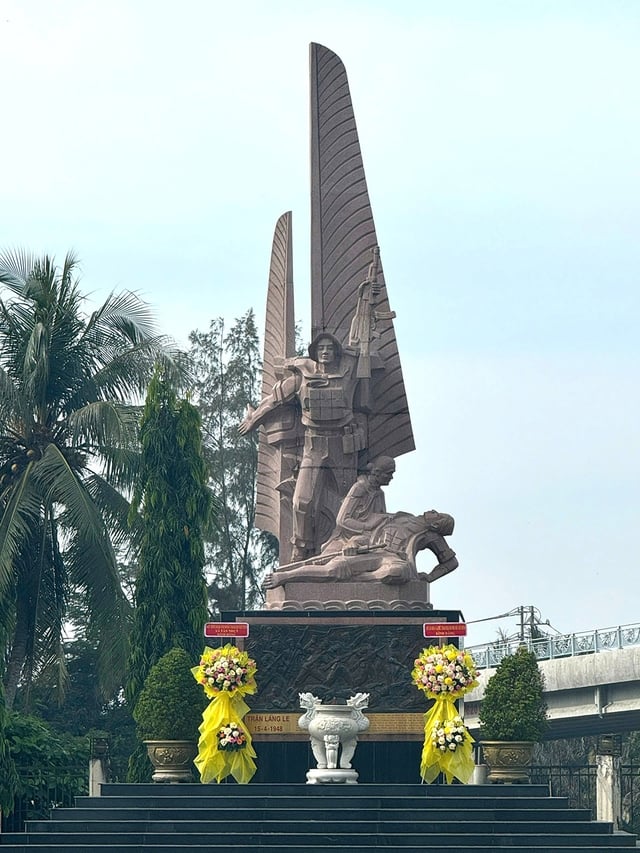
The Láng Le - Bàu Cò historical monument
Photo: Quynh Tran
Writer Tram Huong, Vice President of the Ho Chi Minh City Writers Association, shared: "Director Nguyen Hoang and I recently came here to find locations for a film about the poet Hoai Vu, but after searching all day, we couldn't find any mangrove forests to film in. Therefore, restoring the 'ancient ecosystems' - characteristic of the riverine wetlands - or recreating historical spaces at the historical site to educate about traditions is extremely urgent." "We must act quickly, because in just a few years, the elderly and frail witnesses will no longer have time to wait for us," the author of " In the Whirlwind " urgently stated.
Researcher Nguyen Do Gia Bao (Center for Conservation of Historical Relics, Department of Culture and Sports of Ho Chi Minh City) suggested the need to develop a tourist route " Following the Footsteps of the Southern Resistance ," connecting Lang Le - Bau Co with the Vuon Thom - Ba Vu Revolutionary Tradition Area, Cu Chi Tunnels, Ben Duoc… and other historical sites in the region. "In the digital age, it is necessary to proactively build the image of historical sites on the internet through websites and fan pages; produce short videos, podcasts, documentaries, and clips telling witness stories on digital platforms for young people to access; design virtual reality tours and interactive online maps to help tourists visit remotely," Mr. Bao emphasized.
Based on the scientific evidence of the Lang Le - Bau Co historical site and its invaluable historical value, Mr. Le Quang Thuan (from the Culture and Social Affairs Department of Tan Nhut commune) hopes that the specialized agency of the Ho Chi Minh City Department of Culture and Sports will conduct a survey, assessment, and soon submit a dossier proposing that Lang Le - Bau Co be recognized as a national historical site, as it is entirely deserving.
Through the workshop, scientists and delegates focused on clarifying the historical and cultural values, directions for protecting and promoting the value of the relics, and scientific basis, and unanimously agreed that the Lang Le - Bau Co relic site deserves to be recognized as a national historical relic. We will soon finalize the dossier to submit to the Ho Chi Minh City People's Committee and the Ministry of Culture, Sports and Tourism for consideration and decision.
Nguyen Minh Nhut, Deputy Director of the Department of Culture and Sports of Ho Chi Minh City
Source: https://thanhnien.vn/lang-le-bau-co-trang-su-vang-ky-uc-cua-nam-bo-185251024215929168.htm
![[Image] Pleasant weather helps students enter the 10th grade entrance exam with confidence.](https://vphoto.vietnam.vn/thumb/1200x675/vietnam/resource/IMAGE/2026/05/29/1780034401612_ngay-1-thi-lop-10-minh-duy-8-5009-jpg.webp)
![[Photo] Ba Lang An Lighthouse - the "eye of the sea" amidst the "rock museum" of Quang Ngai province.](https://vphoto.vietnam.vn/thumb/1200x675/vietnam/resource/IMAGE/2026/05/29/1780038698840_anh-man-hinh-2026-05-29-luc-14-10-42.png)













































































Comment (0)