

Perched on a mango branch, a pair of nightingales stood on tiptoe, their pink beaks vying with each other in a song, mimicking the melodious calls of the skylark and the fiery-throated warbler in a series of clear, resonant notes; suddenly dropping to a low, mournful melody; then soaring upwards with a burst of vibrant, flowing music. Phuong and I stood still, holding our breath, savoring this wondrous duet of nature, a melody of love rising at the moment when the new day was dawning with a rosy glow from the East.
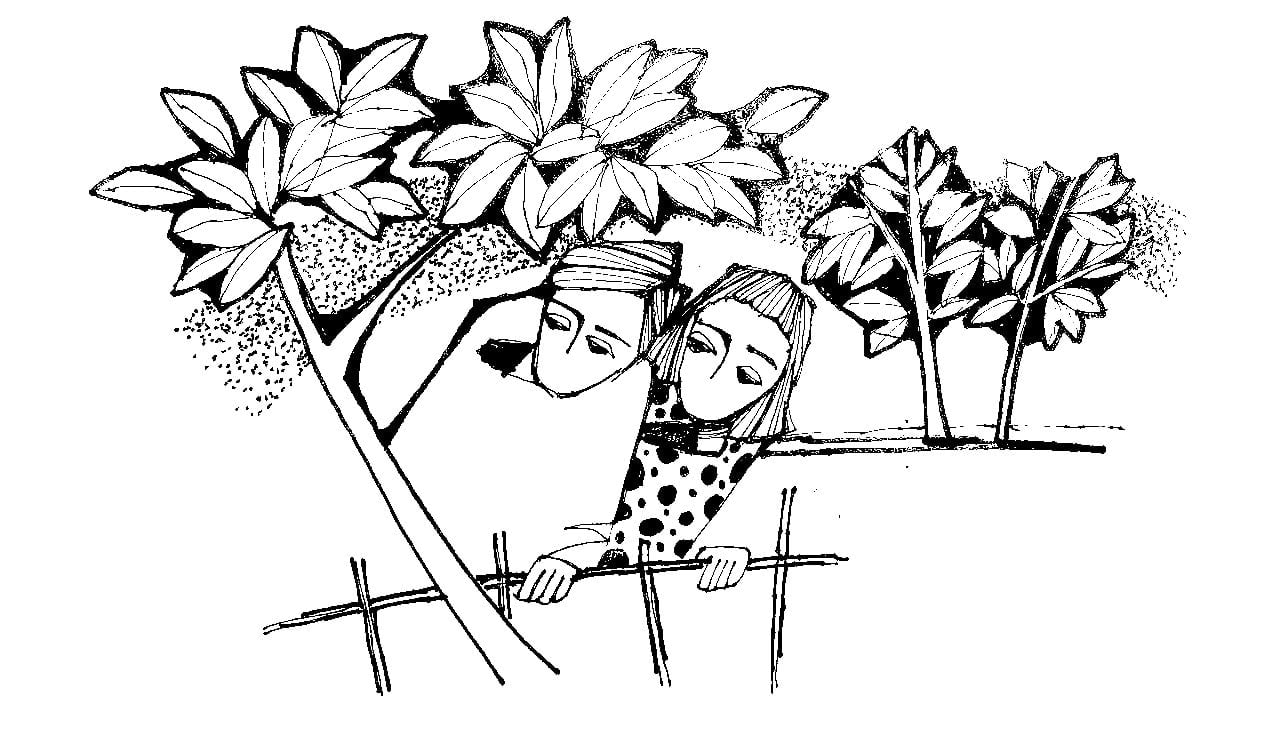
The nightingale's song is a melodic, rhythmic, and emotionally rich performance. The nightingale composes and plays its own words, notes, and rhythms, with each phrase unique and never repeating the previous one. This is the artistic talent of the "musician" of the mango orchard. The nightingale learns the songs of other birds, but not by imitation; instead, it transforms the sounds into new musical scales.
The two little friends stopped their morning exercise walk along the village road, observing and listening to nature's gentle murmur in the early morning. They stood still so as not to distract from the rhythmic courtship of the "musician" couple. Phuong eagerly followed the direction of my outstretched arm, counting: "1, 2, 3… Phuong! There are 7 bird nests on the mango tree!" "Yes, dear. Good land attracts birds!" "But I don't see any birds nesting on the jackfruit tree." "That's right, dear. Jackfruit leaves are small and sparse. Jackfruit has sticky sap, so birds don't perch there. A mature mango tree is a sturdy home for birds to live and breed. Mango trees shed their leaves slowly from autumn to early spring. Mango trees are never bare; new leaves always grow. Mango leaves are large, thick, and provide shelter from the sun and rain, so many birds like to come and build nests there. Especially the Hoa Loc sand mango variety, which has a captivating fragrance."
The two birds looked up at the mango tree canopy to pinpoint the source of the melodious chirping. Oh! There it is! A pair of birds hopped and flitted from branch to branch. The "actors," the nightingales, adorned their beautiful eyes with bright white eyeliner. The pair mated with graceful, vigorous, and bright body language; with a melodious, resonant musical language, a joyful, lively rhythm. Their songs soared high like the gentle breeze rustling through the hills; the wind swirling over the lush green grass; the wind sweeping through the valleys and streams, carrying the fragrant scent of the hills and gardens, as if returning to a pristine, untouched time.
The pair of nightingales performed with passionate enthusiasm, performing graceful glides like on an ice rink, then releasing each other, drawing closer, rubbing their pink beaks, resting their spread wings, cuddling, shaking their feathers, tapping their feet, and singing joyfully. Phượng and I took deep breaths, absorbing the energy of the new day. Our young chests swelled, filled with the fresh morning air. The air was crisp and light. A thousand pink rays of sunlight shone down. All the creatures in the mango orchard leaned in to enjoy nature's magnificent love song.
Tuan composed the song "The Nightingale's Song" based on my musical notation of the bird's song. He credited Thanh Tuan, Hoai Phuong, and Bich Phuong as co-authors, which made my sister and I feel both embarrassed and overjoyed. He performed on the violin like a skilled musician. His face was serene. His lips curved into a beautiful smile. His eyes shone brightly. His hands moved gracefully across the violin strings. My sister Phuong, the nightingale couple, and I silently enjoyed the cheerful, lively, gentle, and melodious music flowing through the hills and gardens.
Tố Tồ, whom I've been raising for over six months, is a mixed-breed German Shepherd, with a black and gray body and yellow stripes. Its keen eyes, perked ears, and raised snout alerted it to any strangers entering the garden. Phượng and I walked down to the Bình An stream and encountered a man carrying a cage of decoy birds. I immediately understood that the lives of the mango orchard's nightingales were threatened. Tố Tồ became angry, its eyes glaring, its four legs flailing. I restrained it and stroked its head.
I stared wide-eyed at the intruder: "Where did you come from? You're such a stranger!" My brother hesitated, slowing his pace: "Why do you ask, young man?" "You're not allowed to trap birds in my garden." "Birds in the sky. Fish in the water. What right do you have to forbid me from trapping birds?" I pointed to the mango tree: "The birds that nest in the mango tree are my birds." My brother burst out laughing: "Aha! You're so argumentative! I'm just trapping birds for fun, I'm not going to eat them." Phuong asked: "Do you have any close friends?" "Why do you ask, young lady?" "The nightingale is our close friend. If your friend were caught, would you tolerate it?" My brother hesitated, not saying anything. "I'm asking you, for example, if you were free to roam around, and suddenly someone caught you and locked you in a cage, would you tolerate it?" My brother chuckled: "Aha! Arguing again. Well, I'm leaving, standing here listening to you two argue is a waste of time!"
My older brother waded along the stream far into the distance. My father knew that the bird trappers were diligently trying to catch the nightingale couple. Every day, my father started his lawnmower, making a deafening noise. My brother packed up and left the mango orchard, but he hadn't given up his wicked plan to capture the nightingale couple alive. I cautiously led Phuong along, following the strange footprints along the stream bank to the main road in the distance. Uncle Tuan devised a plan to protect the birds. We patrolled the stream bank, erected thorny bamboo fences to block their path, and started the lawnmower daily. Phuong, Tuan, and I worked tirelessly, so worried that we lost sleep and appetite for many days. My brothers, disheartened and disappointed, stopped their game of disturbing the birds' lives.
I took Phuong to a bookstore in the city. We both happily admired the countless books displayed on the shelves. The magnificent, glorious world of books and stories, overflowing with color and fragrance, overwhelmed Phuong and me. We "camped" in the bookstore for a day, browsing and reading to our heart's content, choosing a few books that fit our budget.
At the bird market by the park, the two girls saw people selling various kinds of pet birds. A nightingale was caged. Its mournful cries expressed longing for its freedom. Phuong's eyes welled up with sadness. After thinking for a moment, she did something I didn't expect. "Uncle! How much are you selling this nightingale for?" The man with a dark, weathered, bearded face quoted a price: "One million dong!" Phuong asked, "If I buy it and release the nightingale into the free sky, will you lower the price?" The man remained silent, his eyes fixed on Phuong. "Do you see the nightingale crying, missing its parents and siblings? Why was it captured and imprisoned? People are so cruel! Please lower the price so I can buy and release the bird!" The man, moved by compassion, replied, "I will lower the price!"
Others paid attention to the negotiation. “How much are you reducing the price?” “Halfway. Five hundred thousand dong.” The group chimed in: “The girl is buying the bird to release, only two hundred thousand dong!… Just one hundred thousand!…” The bird seller made the final decision. He opened the cage, gently took the nightingale, and gave it to Phượng: “Here! I’m giving it to you, no money. Release it!” Phượng’s eyes widened with joy: “Thank you, sir!”
She cupped the nightingale in her arms, her lips kissing its delicate, white eyelashes. Phượng smiled, looked up, and extended her arm, sending the nightingale soaring into the sky. The green trees in the park would be its new home. At that moment, many camera lenses were focused on Phượng. She radiated beauty, freshness, and healthiness, more so than any movie star I'd seen in Korean dramas.
It was a damp, rainy Sunday. The nightingales were fast asleep in their nests. The cuckoo lay curled up by the roadside. The hills and gardens were silent. Only the geckos occasionally chirped in the oil palm trees by the Binh An stream. I, too, lazily snuggled under the blankets, my hands clutching a storybook. Tri thought that my daily memorization was something I was learning from Tuan. My heart remembered the footprints of me and Phuong on the small slope by the Binh An stream; the footprints of the two of us skipping to school. The footprints of the two of us longing to venture beyond the confines of the hills and gardens. When I climbed onto the fork of the mango tree to read, gazing into the distance, I saw the highway crossing the village, the cars speeding along on their powerful and courageous journey.
The mango trees that Phượng and I planted were for her birthday. I dug the holes and fertilized them. She carefully placed the saplings in the ground. I listened attentively to Tuấn's instructions on how to care for the mango trees. Two seasons passed, and the mango trees shed their old leaves, and we both went to 9th grade. The mango trees also competed with each other, stretching their branches and spreading their canopies to shoulder height. My parents said that mango trees like to be close to people. Mango leaves know how to filter the air. Their breath is fragrant, clean, and light. After school, Phượng and I would cuddle, chatting, laughing, and singing. The mango trees knew how to "listen," so they grew quickly.
I fertilized the mango tree's roots with organic nutrients that my father had gathered and composted from weeds in the garden. I watered the tree with a showerhead. The mango tree seemed to have "eyes" looking up at the sky. Its branches reached up and "saw" the corrugated iron roof blocking its view, so the tree bent its trunk to "dodge" to one side. Phuong asked me in surprise, "What's so funny, Phuong? Why are you laughing to yourself?" "I'm delighted to see the mango tree knowing how to handle the situation to survive and thrive." I whistled a cheerful tune, causing the nightingale on the mango branch to lift its head and look at me attentively.
Autumn strolls through the hills and gardens. Fluffy white clouds drift lazily by. The earth is cool and refreshed by the raindrops. The green grass bursts forth in a bright emerald hue. A carpet of mango leaves spreads across the garden, rustling with joyful footsteps. Autumn sunlight, like tiny spheres, falls on Phuong's hair. Warm golden sunlight fills the peaceful countryside. I secretly gaze at her cheeks, shining like little suns.
The nightingale couple flew over, looked around for a long time, then decided to build their nest in the mango tree near the porch. My sister Phuong and I followed their example: waking up early, flying around, exercising, singing and dancing, and greeting the sunrise. The couple worked together, carrying building materials like branches and straw, and stacking them on the forks of the mango tree. The nest was finished by morning. The female bird lay in the nest, turning and chirping happily. The male bird shook its feathers, leaned its head against the tree, and whispered. The music of their hearts was sweet and melodious. A gentle happiness crept into my heart.
Source: https://baobinhthuan.com.vn/nhac-si-hoa-mi-vuon-xoai-130056.html













![[Photo] Tran Cam Tu, Standing Member of the Secretariat of the Central Committee, presides over the first meeting of the Central Steering Committee on the Development of Vietnamese Culture.](https://vphoto.vietnam.vn/thumb/1200x675/vietnam/resource/IMAGE/2026/03/19/1773895004549_ndo-br-bnd-1195-2-jpg.webp)








































Comment (0)