


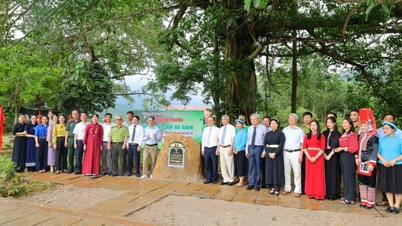
I visited Thien Co Mieu Temple in Huong Lan village, Trung Vuong commune, Viet Tri city on a scorching hot afternoon. Under the cool shade of a 2,300-year-old yellow-flowered Táu tree, Mr. Nguyen Ngoc Luan (the caretaker of Thien Co Mieu Temple) slowly recounted the story of the two "ancient Táu trees" associated with the sacred temple.

According to genealogical records, during the reign of the 18th Hung King, in the Hung Due Vuong era, the teacher couple Vu The Lang and Nguyen Thi Thuc opened a school in the capital of Van Lang. They were invited by King Hung to the palace to teach Princess Tien Dung and Princess Ngoc Hoa. The two princesses were taught literacy and moral values by Vu The Lang and his wife, becoming virtuous and talented. When the teachers unexpectedly passed away, the local people buried them and erected a temple in their honor in the village. Two white-flowered Táu trees (silver trees) and a yellow-flowered Táu tree (golden trees) were planted by the ancestors during that time and have survived to this day.

The respect and affection of the local people for the two ancient trees are clearly expressed in the stele erected in the temple: "For nearly 2,300 years, through the vicissitudes of war and conflict, the people of Huong Lan and Lau Thuong have forever cared for and, when necessary, are ready to sacrifice their lives to preserve intact the temple, shrine, tomb, and the two precious trees - valuable relics of the learning tradition of the Hung King era." On May 28, 2012, the Vietnam Association for the Protection of Nature and Environment recognized the two trees as Heritage Trees, and also as the oldest Heritage Trees in Vietnam.


Following Mr. Hap, I arrived at Thien Sinh Ba Nhan Pagoda – home to a row of ancient frangipani trees over 700 years old. Legend says these trees appeared in the early 14th century (during the Tran Dynasty). Originally, there were seven frangipani trees, but unfortunately, two died over time, leaving five that still stand tall and majestic. Each tree is up to 10 meters high, with a gnarled, bumpy trunk, but its branches and leaves are lush and green, and its abundant flowers spread a pure, fragrant scent that is rarely found elsewhere.


Strangely, the "ancient tree" bears two types of fruit on the same branch: round and flat. The round fruit contains seeds, while the flat fruit is seedless. Standing under the tree and looking southwest, at head height, one can see the image of a mother elephant and her baby embracing each other in a loving gesture, bowing respectfully towards the sacred North Temple. With its age and profound spiritual significance, the "ancient tree" was recognized as a Heritage Tree on May 10, 2012, much to the joy and honor of the villagers.


To date, Phu Tho province has 87 recognized Heritage Trees, many of which are ancient, beautifully shaped, and associated with old stories and legends imbued with mystical charm. Typical examples include the "Two Great Trees" over 500 years old, consisting of a banyan tree and a fig tree, located within the complex of the Mother Goddess Temple in Son Cuong village, Cam Khe town, Cam Khe district. These trees witnessed the historic August Revolution, sheltering the temple where the Son Cuong Party cell and the No Luc branch held meetings and made decisions to lead the people's resistance. Another example is the pair of thousand-year-old Dipterocarpus trees in Coi village, Xuan Son commune, Tan Son district, associated with the touching love story of an orphaned Dao boy and a girl who was the daughter of a Muong tribal chief.

In fact, besides their historical and cultural value, Heritage Trees are of particular importance in the conservation of genetic resources. Heritage Trees, some hundreds or thousands of years old, demonstrate excellent adaptability to regional climate conditions, ecosystems, climate change, and the negative impacts of human activities. They represent a very valuable genetic resource for scientific research. Currently, it is entirely possible to cultivate gene combinations to create organisms with superior pest and disease resistance, growth, development, and economic value.

Regardless of the time period, the cluster of Heritage Trees holds profound significance. Preserving this cluster is a practical way to safeguard a priceless "treasure" for future generations. However, the conservation and protection of Heritage Trees remains an unsolved problem, requiring the concerted efforts of the entire society to maintain this precious "green gold."

Thanh An
Source: https://baophutho.vn/cay-thieng-tren-dat-coi-nguon-ky-i-nhung-nhan-chung-cua-lich-su-219798.htm

























































Comment (0)