

"Wealth and poverty are determined by oneself."
One sunny, windless afternoon, we visited the home of Mr. Mai Phuoc Toan in So Tai hamlet, Thanh Phu commune. Mr. Luu Anh Phap, the agricultural extension officer of Thanh Phu commune, briefly introduced him: "In this hamlet, Mr. Toan is the best." Looking at the dark-skinned man, his clothes still damp with sweat, I immediately asked: "How much land do you own? What is your production model?" The homeowner smiled brightly, not in a hurry to answer, and offered us a plate of bright red watermelon, urging: "Here, try a piece of watermelon." We tried a piece, then began to eat enthusiastically; the watermelon was delicious.
Without waiting for further questions, Mr. Toan recounted: "I own five and a half acres of land. Like everyone else, I've worked various jobs and traveled far and wide, thinking that with that much land, no matter how capable I was, I wouldn't be able to make a living." But then, the hardship of earning a living through sweat and tears, and the feeling of being dependent on others, made Mr. Toan decide: "Well, it's my land, my house, and whether I'm rich or poor depends on me."
After much deliberation, realizing that with that plot of land, he couldn't rely on the "hit or miss" of shrimp farming, Toan began searching for a new direction. Suddenly remembering the old saying, "One hectare of upland rice paddies is worth seven hectares of paddy fields," Toan felt encouraged: "Surely one hectare of upland rice paddies is worth seven hectares of paddy fields, right?" But farming on saline paddy fields was incredibly difficult, almost seven times harder than farming in freshwater areas. Then, on the embankments of the paddy fields, he sowed hope with watermelon seeds that he had begged people to buy.
For over 20 years, with three watermelon crops a year, interspersed with other crops like rice and shrimp, plus shrimp and crab farming, Mr. Toan has not only had a stable income but also accumulated invaluable experience in agricultural production. As a watermelon grower, Mr. Toan constantly pondered how to grow delicious, clean, and nutritious watermelons for long-term sustainability. Hearing others suggest using fermented fish and shrimp fertilizer as a base dressing for better watermelon growth, he immediately started doing it. But after a few days, the fermented fish and shrimp mixture started to rot terribly, and the neighbors' dogs and cats came and vandalized the place, leaving Mr. Toan devastated.
Refusing to give up, Toan went to ask the agricultural extension officers in the commune, then searched online, and finally understood: "People have to mix in probiotics to compost fish and shrimp fertilizer, no wonder." Since then, Toan's watermelons and vegetables have never used chemical fertilizers or pesticides. Toan shared: "Growing watermelons three times a year is easy, but it's very difficult. You have to alternate watermelon crops with long beans or other crops; if you keep doing it continuously, you won't have any watermelons to eat, let alone sell."
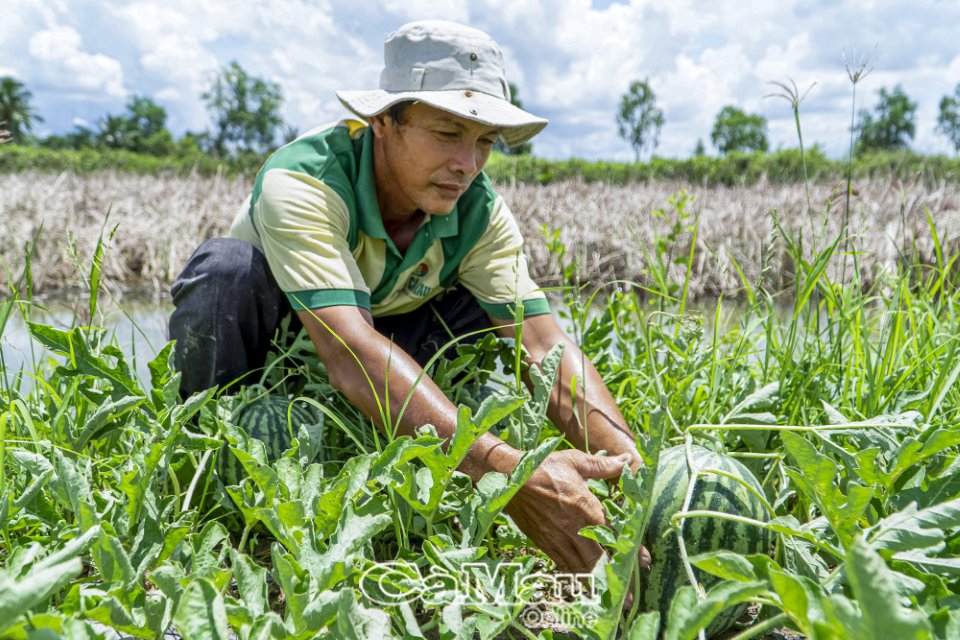
Mr. Mai Phuoc Toan stands beside his off-season watermelon crop, which is about to be harvested.
It was off-season, but visiting Mr. Toan's watermelon field felt like it was almost Tet (Vietnamese New Year). I asked, "Are you harvesting all at once or selling gradually?" He laughed, "Like during the main Tet season, the watermelons are beautiful and plentiful, but the prices are very low. I plan differently..." For Mr. Toan, selling watermelons year-round means he can sell them continuously without all at once. The good prices and steady income mean he never has to worry about daily expenses. He sells the ripest watermelons first. Even though they might look a bit less appealing out of season, the prices are always good.
Showing off the pile of rice behind his house, Toan said: "While others might abandon rice cultivation, I certainly won't. Every year, I harvest around a hundred sacks or more."
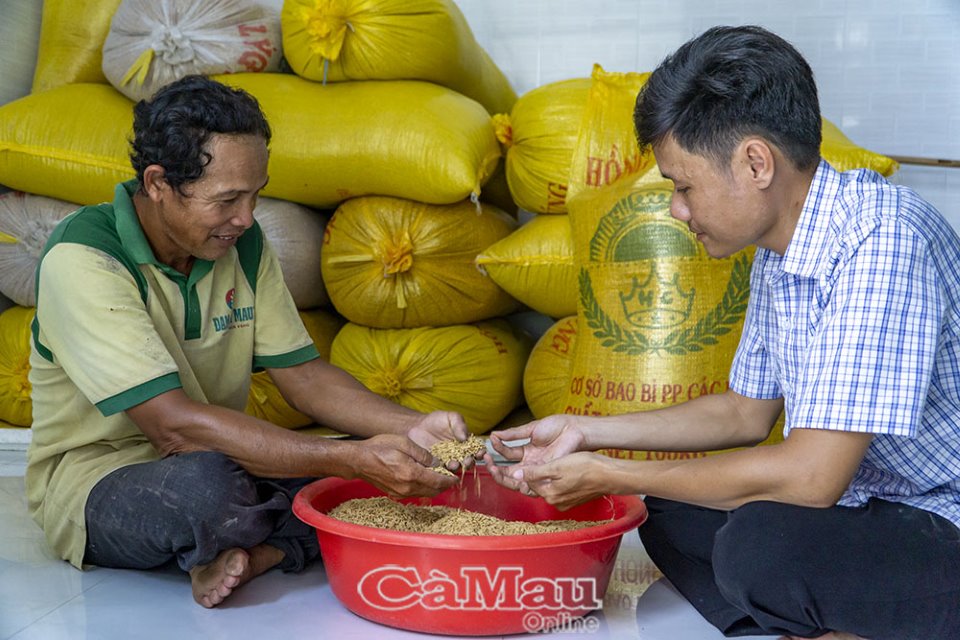
Toan also meticulously cares for the shrimp and crabs in his ponds. According to Toan: "In farming, if you don't plan, big land or small land are the same. Anyone can be hardworking, but without science , technology, knowledge, experience, and innovation, hard work is useless." Furthermore, as Toan says, farmers must consider the season, the harvest, and the price of whatever they produce. Only those who dare to think differently, accept a little risk, and have faith and a basis for believing in what they are doing might be able to prosper.
Think new, do things differently.
Meanwhile, farmer Le Van Thanh from Cai Ran A hamlet, Phu Hung commune, showed us firsthand what a successful crab harvest looks like. Mr. Thanh's crab farming method isn't new, but it's incredibly effective.
According to Mr. Thanh, he leveled over 4 hectares of land to create a flat surface for the pond. Below the pond, he prepared many mounds of brushwood for the crabs to take shelter in. Before each stocking season, he carefully prepared the ponds and selected high-quality crab larvae. While many farmers were worried about falling shrimp prices, Mr. Thanh's income from selling crabs remained substantial. Each year, his family harvested around 1 ton of crabs. And the way Mr. Thanh prepares for stocking and selling his crabs is what's truly interesting.
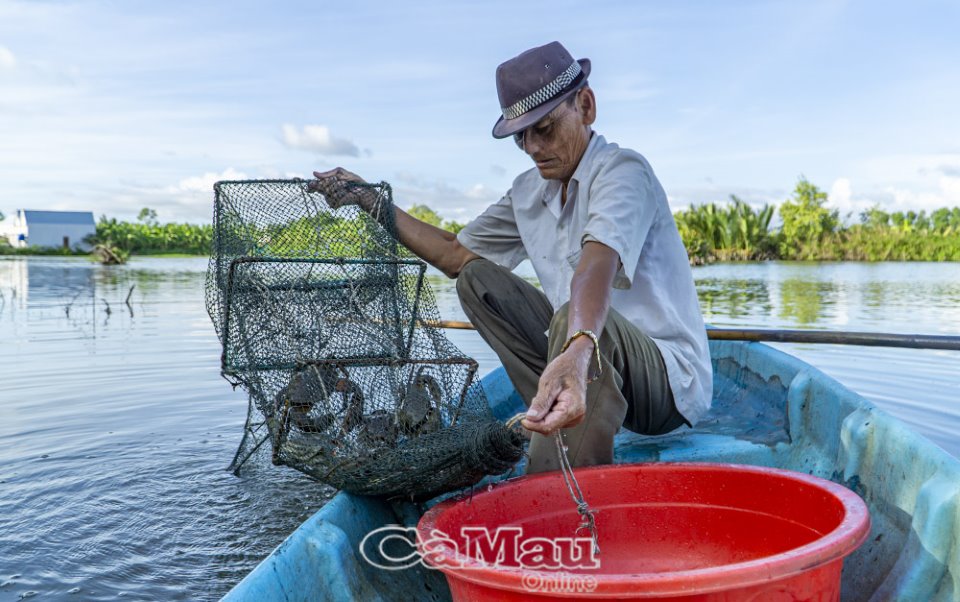
Elderly farmer Le Van Thanh struck it rich with his mid-year crab harvest, while many other farmers are still worried about the low price of shrimp.
The old farmer's experience shows that each year, sea crabs have peak prices, such as around Tet (Lunar New Year), Mid-Autumn Festival, April 30th, and National Day... Catching and selling crabs at those times brings farmers great satisfaction. Unfortunately, most farmers don't have crabs to sell when prices are high. But for Mr. Thanh, those are the times when he puts his best crabs on the line to make a fortune.
Sharing his thoughts, Mr. Thanh confided: "I also need to research more about how to feed the crabs, use probiotics to treat the water environment, and monitor their growth. In general, raising any kind of animal now requires knowledge; otherwise, relying on luck will lead to failure."
From Mr. Thanh, we also heard the heartfelt wish of farmers whose greatest asset in life is their square plot of land: "We don't need to think too much about complicated calculations yet. We just need to see the prices of crabs and shrimp stabilize; that would make us all very happy."
That's right! For most farmers in Ca Mau , crabs and shrimp bring joy, sorrow, and hope. Many leave their homeland because they disdain the idea that farming is a difficult and unprofitable occupation. But there are also those who choose to stay, who dare to think, dare to act, and think differently, like Mr. Toan and Mr. Thanh. This proves that farming can also achieve enviable success.
Hai Nguyen - Hoang Vu
Source link


![OCOP during Tet season: [Part 3] Ultra-thin rice paper takes off.](/_next/image?url=https%3A%2F%2Fvphoto.vietnam.vn%2Fthumb%2F402x226%2Fvietnam%2Fresource%2FIMAGE%2F2026%2F01%2F28%2F1769562783429_004-194121_651-081010.jpeg&w=3840&q=75)





Comment (0)