

Deeply concerned about heritage.
Ca trù has existed in Hiep Hoa since the 16th century, evidenced by the carving of a young woman playing the đàn đáy (a type of Vietnamese stringed instrument ) at Lo Hanh communal house, which is still preserved today. The carving not only showcases the skillful hands of ancient artisans but also serves as a testament to the once flourishing and integral part of the spiritual life of the local people.
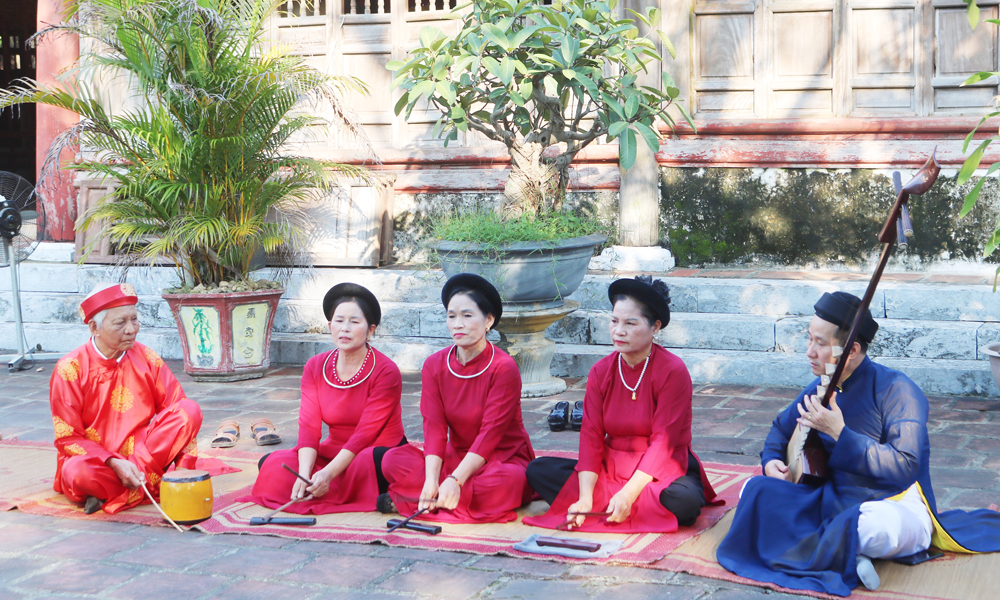 |
The Ca Tru Club of Hiep Hoa commune performs at the Lo Hanh communal house, a national historical site. |
On an autumn afternoon, amidst the tranquil atmosphere of the ancient Lo Hanh communal house, the resonant sound of the zither blends with the singing and the crisp rhythm of the clappers, leading listeners into a captivating and enchanting world of art. The slightly awkwardly made-up faces of the female singers, who have spent their lives working in the fields, still radiate pride and happiness as they sing, contributing to the preservation and spread of the beautiful culture of their homeland.
Rushing to her Ca Tru rehearsal after harvesting rice before the storm, singer Ngo Thi Thanh, while preparing her costume, explained: “We farmers are busy harvesting rice before Typhoon No. 10 hits. We have a lot of work to do, but my colleagues and I are trying our best to make time to promote the beauty of our homeland. After nearly 20 years of diligently practicing vocal techniques and rhythm, Ca Tru has become ingrained in our blood. Wherever we are, whatever we do, we are always deeply committed to the songs and rhythms. Preserving and promoting this traditional art form is the heartfelt wish not only of those who are passionate about it, but of most of the local people.”
Cherishing the precious heritage of her homeland, Mrs. Tran Thi Bon, 66 years old, from Khoat village, also studied Ca Tru (a traditional Vietnamese folk singing style) from the very beginning of the club's establishment. However, due to family circumstances, she couldn't maintain regular participation. In recent years, as her children and grandchildren have grown up, she has returned to actively participating, diligently practicing various singing styles such as spoken songs, letter-sending songs, and ceremonial songs. "Learning a Ca Tru melody is very difficult, but no matter how difficult it is, I am determined to practice. As long as I have my health, I will continue to learn Ca Tru," Mrs. Bon confided.
The enduring love of these simple, unassuming farmers has quietly continued the lifeblood of ca trù (traditional Vietnamese singing) in the low-lying areas of Hiep Hoa. During periods of agricultural leisure, especially on the 15th and 1st of each lunar month, the deep, resonant sound of the đàn đáy (a type of lute), the crisp sound of the phách (a type of percussion instrument), and the melodious voices of the female singers resonate throughout the ancient space of Lo Hanh communal house. Though originally farmers with "muddy hands and feet," when they step onto the stage, they transform into dignified female singers, graceful officials, and relaxed male musicians, immersing themselves in the ups and downs of ca trù art.
Singer Dang Thi Nam, Deputy Head of the Ca Tru Club of Dong Lo commune (formerly), shared: “Ca Tru is an academic and scholarly form of music, so it's selective in terms of both singers and listeners. Besides passion, learners must also have great determination because it's very difficult to learn; sometimes it takes a whole year to master a single melody. From 2010 to the present, we have participated in Ca Tru teaching classes every year, and we never feel like we've learned enough. Despite the hardships, we teach as much as we can; those who know more teach those who know less, and those with less knowledge guide those who don't. During the summer, we also teach students, some of whom have won third prize in the 'Youth Singing Contest'!" These voluntary teaching activities have contributed to nurturing the next generation, fostering love for and igniting new hope for this heritage.
The beauty of the traditional folk singing at Lo Hanh communal house will live on forever...
According to researchers, from the 17th and 18th centuries, Hiep Hoa was a "highlight" on the map of Northern Vietnamese Ca Tru (traditional singing), a gathering place for many singing troupes, female singers, and male instrumentalists. During the spring festivals, the sounds of singing at communal houses, singing competitions, and singing in worship echoed throughout the villages, creating an elegant and unique cultural atmosphere. Historical upheavals caused Ca Tru to decline and fall into oblivion for a period of time. But after Ca Tru was recognized as a UNESCO heritage, in 2010, the villages of Khoat, Chung, Hung Dao, and later Cham in Hiep Hoa commune established Ca Tru clubs, attracting nearly 40 members of various ages. Each person has a different background and circumstances, but they all share a common passion and a deep love for this precious art form.
After 15 years of dedicated efforts to revive and maintain the traditional Ca Tru singing tradition in Hiep Hoa, it has become a cultural highlight closely intertwined with the community. Key members actively participate in performances at local festivals and political and cultural events. Recognizing the dedication of the female singers and male instrumentalists, in 2019, the Dong Lo Commune Ca Tru Club was honored with a Certificate of Commendation from the Chairman of the Bac Giang Provincial People's Committee. In 2022, the four Ca Tru clubs from the four villages in the commune were reorganized and merged into the Dong Lo Commune Ca Tru Club, now part of Hiep Hoa Commune. The club established its own operating regulations and maintains regular practice sessions twice a month, creating an environment for regular exchange and learning for those who love this heritage. In 2024, the club won the A prize overall at the district-level Folk Song, Dance, and Music Festival, affirming the renewed vitality of the Ca Tru heritage.
According to Ms. Pham Thi Hai Yen, an official from the Culture and Social Affairs Department of Hiep Hoa commune: Although there are still many difficulties and challenges, with the practical support, both material and spiritual, from the local government, and the dedication of the community to preserving the heritage, Ca Tru singing in Hiep Hoa is gradually being revived and affirming its position in contemporary life, contributing to preserving the identity and enriching the spiritual life of the people. In the future, the specialized agency will continue to advise on opening training courses, restoring ancient melodies, documenting typical performances, and linking the preservation and promotion of Ca Tru with the development of community tourism.
Currently, the number of young people studying Ca Tru is modest, and the preservation of this heritage faces many challenges due to a small number of successors, with training being mostly spontaneous and lacking standardized curricula. Furthermore, limited operating funds and a small public interest in Ca Tru make expanding performance venues difficult. Nevertheless, witnessing the farmers of Hiep Hoa passionately practicing, with older generations teaching younger ones, meticulously refining each rhythm and musical note, strengthens the belief that the vitality of Ca Tru in this region will be continued and preserved for generations to come.
Source: https://baobacninhtv.vn/nhung-nong-dan-giu-nhip-phach-ca-tru-postid429352.bbg

























































































Comment (0)