

(NLĐO) - The "Red Princess" lived approximately 2,000 years ago and is unlike any other remains previously discovered in China.
At the Shengjindian cemetery site in Xinjiang, China, along the ancient Silk Road, archaeologists discovered the remains of an unnamed young woman. They nicknamed her "The Red Princess."

Portrait of the "Red Princess" resting beside the Silk Road - Graphic image from the research team.
According to Science Alert, this ancient cemetery includes 31 tombs containing many valuable burial goods such as silk, pottery, gold and bronze artifacts, glass beads, and agate.
The "Red Princess" was found in a tomb containing the remains of three other people, including a child.
She died approximately 2,050-2,200 years ago and was only 20-25 years old at the time.
However, what caught the archaeologists' attention was that the "Red Princess" was unlike the other remains in the tomb, nor like all other remains previously discovered in China.
Writing in the scientific journal Archaeological and Anthropological Sciences , a Chinese-American research team led by Jilin University (China) reported strange markings on the teeth of the "Red Princess".
They conducted tests and determined that the substance was cinnabar, intentionally applied to the teeth rather than accidentally contaminating the tomb's environment.
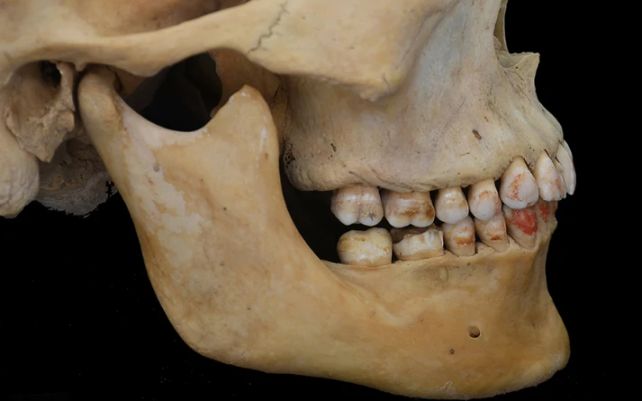
Traces of cinnabar are still clearly visible on the young woman's teeth after more than 2,000 years - Photo: Archaeological and Anthropological Sciences
According to researchers, cinnabar played a significant role in several ancient rituals as well as traditional medicine. Its psychoactive properties made it potentially useful as a hallucinogen.
Nevertheless, evidence suggests that it wasn't just a single ritual that caused the Red Princess's teeth to be stained cinnabar.
Analyses suggest she used it very frequently throughout her life. Since the custom of teeth dyeing also existed in some ancient Asian cultures, scientists speculate that the red color may have symbolized her status.
Furthermore, cinnabar is noteworthy because it is not a local commodity. The nearest cinnabar mines in China are located in provinces quite far from Xinjiang. There are also other mines located in the Near East and Europe.
At that time, usually only people of high social standing could afford to buy imported goods.
Although it cannot be confirmed whether she was actually a princess, considering the geographical distribution of cinnabar and other details within the tomb and the ancient cemetery, the authors suggest that the tomb's occupant was "extraordinary enough to have access to this valuable resource."
Source: https://nld.com.vn/phat-hien-mo-cong-chua-do-bi-an-ben-con-duong-to-lua-196250326114355713.htm


![[Photo] General Secretary and President To Lam meets with National Assembly delegates from ethnic minorities.](https://vphoto.vietnam.vn/thumb/1200x675/vietnam/resource/IMAGE/2026/04/20/1776696701056_a1-bnd-8331-3342-jpg.webp)

![[Image] National Assembly discusses the implementation of the socio-economic development plan.](https://vphoto.vietnam.vn/thumb/1200x675/vietnam/resource/IMAGE/2026/04/20/1776696707422_ndo_br_img-20260420-185419-jpg.webp)































































































Comment (0)