

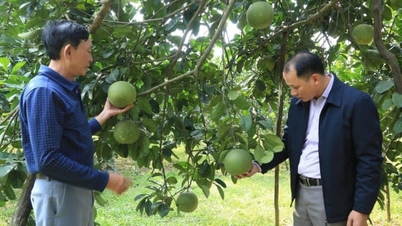
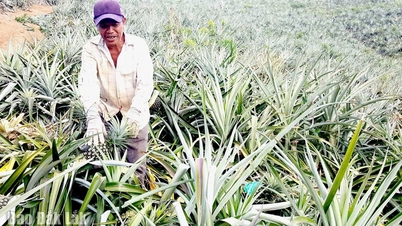
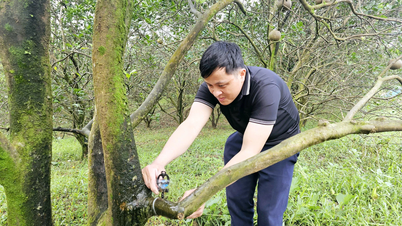
Ms. Truong Thi Nguyet (Dai Dong village, Tay Ho commune, Da Nang city) said that her family had 1,000 square meters of undeveloped garden land. In 2023, after being informed about Resolution No. 35 by the Farmers' Association and the People's Committee of Tam Loc commune (formerly), she and her husband renovated their overgrown garden and planted more than 70 green pomelo trees. At the same time, with government support of nearly 34 million VND, they built a well and installed an advanced drip irrigation system, and the pomelo garden has now yielded fruit.

“This model helped us earn a few million dong extra in the first harvest, so I believe it will improve our family's income in the future. At the same time, I combine it with free-range chicken farming, which is very effective because the grapefruit trees provide shade, helping the chickens grow well and minimizing losses,” Ms. Nguyet said.
Mr. Nguyen Thanh Long (Cam Lanh village, Son Cam Ha commune) invested in planting mangosteen trees for high economic returns. He said that he recognized that fruit trees would be the main crop in the locality, providing sustainable economic benefits and contributing to preventing soil erosion and degradation.
After harvesting the acacia wood for raw materials, he registered to receive support from Resolution No. 35 and, guided by commune officials, he proactively renovated his 2,000m² garden, which was producing poorly, and bought 100 mangosteen saplings to plant.
Mr. Long expressed that the main difficulty for farmers is the financial burden of changing their production model. For example, his family couldn't afford to replace their dug well with a drilled well powered by the electricity grid. "The support from Resolution No. 35 helped my family dig a new well, receive some assistance with seedlings, and switch to a production model that aligns with the local agricultural development orientation."
In 2021, the People's Council of the former Quang Nam province issued Resolution No. 35/2021/NQ-HĐND (dated September 29, 2021) on mechanisms to support the development of garden and farm economies. This serves as a leverage for farmers to escape poverty, contributing to the promotion of rural economies and the restructuring of the agricultural sector.
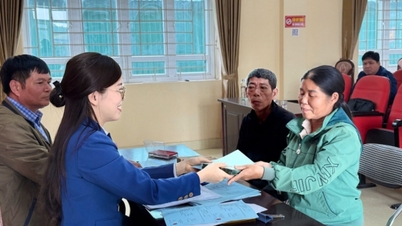
According to the leaders of Tay Ho commune, the locality has so far supported 108 households in developing garden-based economic activities with a total amount of over 3.8 billion VND. After receiving support, these gardens have proven effective thanks to the solution of irrigation water issues.
At the same time, advanced water-saving irrigation systems help reduce investment costs and increase income per unit area of cultivated land. Resolution No. 35/2021/NQ-HĐND (extended until the end of 2025) meets the urgent requirements in developing garden and farm economies and has been supported and embraced by the people of Quang Nam province (formerly).
According to Mr. Hoang Anh Tuan, Vice Chairman of the People's Committee of Son Cam Ha commune, in 2025, the locality will establish a council to appraise and approve the implementation of Resolution No. 35 in the commune, and simultaneously issue a plan to continue implementing the resolution during the year.
“Before implementation, we organized training and guided people according to regulations. It is expected that by the end of 2025, we will disburse over 1.5 billion VND in support to 20 orchard owners, covering a total area of 4 hectares for planting new durian, mangosteen, and green pomelo trees,” Mr. Tuan said.
Many farmers believe that Resolution No. 35 solves the problem of irrigation water for crops in semi-mountainous and mountainous areas; reduces the burden of investment costs for renovating and upgrading neglected orchards, and changing crop types to suit planning and soil conditions. This creates conditions for people to concentrate production, form agricultural raw material areas, and eliminate fragmented production.
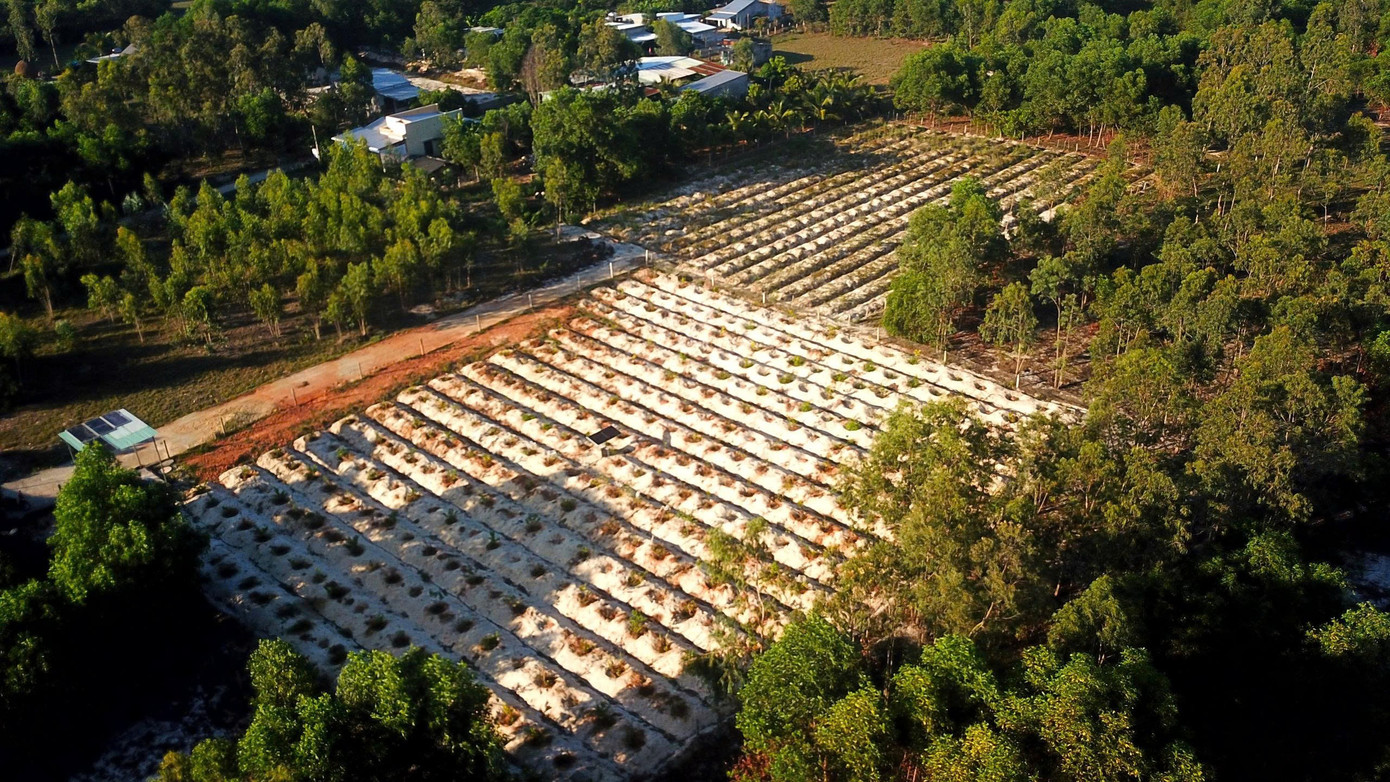

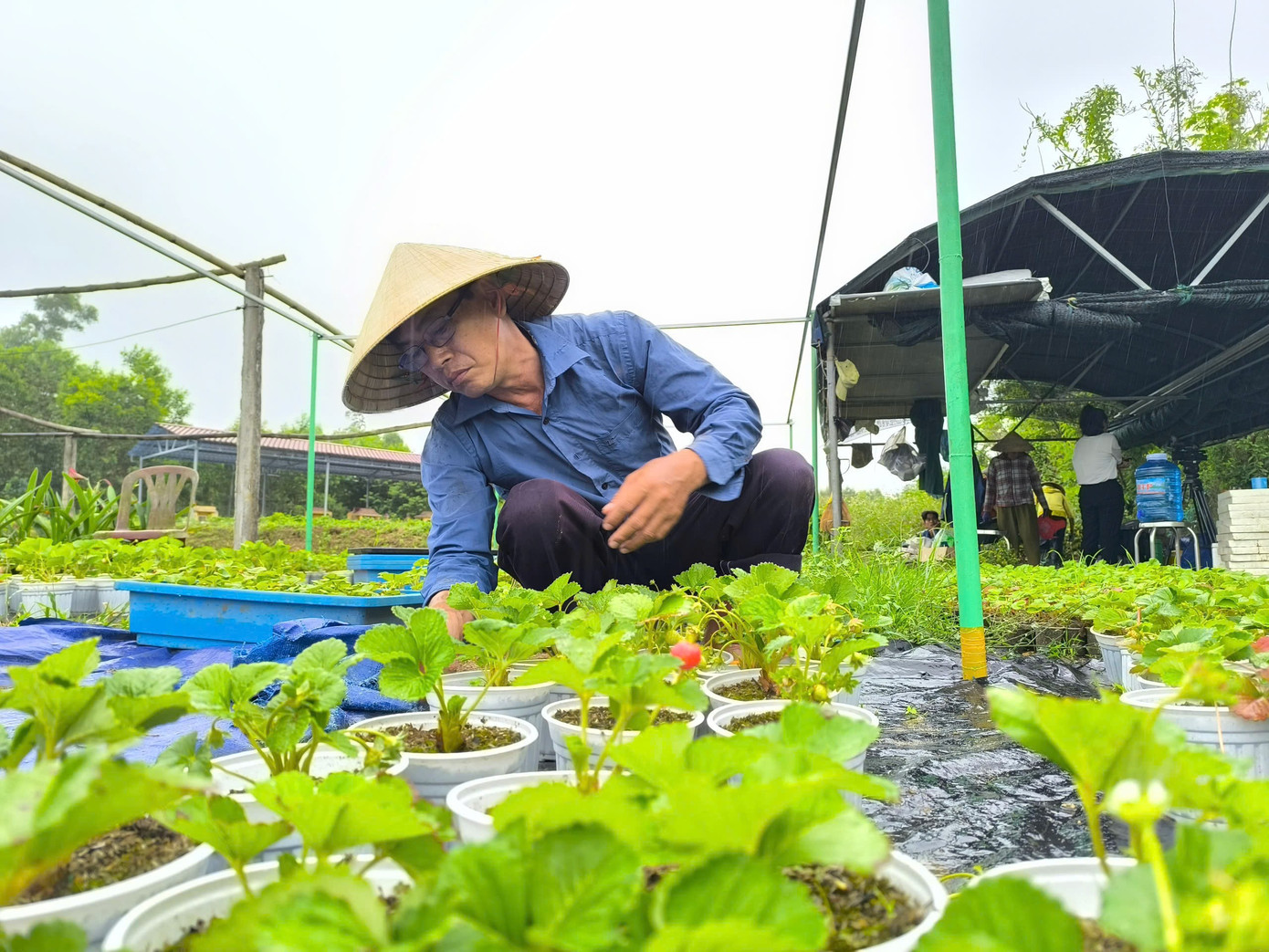

Recommendation to maintain the support policy.
According to the leaders of Son Cam Ha commune, agriculture is the "backbone" of the commune's economy. This includes developing agriculture in an organic, circular, ecological, multi-value, and sustainable manner, while adapting to climate change.
At the same time, production should be linked with the development of raw material areas, the establishment of planting area codes, and the linking of consumption of key agricultural products to form a supply chain and develop agricultural tourism.
In Tay Ho commune, in addition to the support policies of Resolution No. 35, the commune proactively integrates capital from sustainable poverty reduction programs, production linkages, and new rural development programs to invest in infrastructure and support people in developing production. As a result, this has contributed to increasing the average per capita income to nearly 54.9 million VND/year and reducing the poverty rate to 2.13%.
"However, the unstable output and prices of agricultural products still make people hesitant to build production development models. Therefore, we propose that the city soon develop mechanisms to encourage businesses and cooperatives to invest in agriculture and rural areas; including tax incentives and infrastructure support," suggested Huynh Ngoc Hai, Vice Chairman of the People's Committee of Tay Ho commune.
Source: https://tienphong.vn/thoat-ngheo-tu-nhung-khu-vuon-ngu-quen-post1804372.tpo
![[Photo] Prime Minister Pham Minh Chinh receives the Governor of Tochigi Province (Japan)](/_next/image?url=https%3A%2F%2Fvphoto.vietnam.vn%2Fthumb%2F1200x675%2Fvietnam%2Fresource%2FIMAGE%2F2025%2F12%2F16%2F1765892133176_dsc-8082-6425-jpg.webp&w=3840&q=75)


![[Photo] Prime Minister Pham Minh Chinh receives Lao Minister of Education and Sports Thongsalith Mangnormek](/_next/image?url=https%3A%2F%2Fvphoto.vietnam.vn%2Fthumb%2F1200x675%2Fvietnam%2Fresource%2FIMAGE%2F2025%2F12%2F16%2F1765876834721_dsc-7519-jpg.webp&w=3840&q=75)
![[Image] Leaked images ahead of the 2025 Community Action Awards gala.](/_next/image?url=https%3A%2F%2Fvphoto.vietnam.vn%2Fthumb%2F1200x675%2Fvietnam%2Fresource%2FIMAGE%2F2025%2F12%2F16%2F1765882828720_ndo_br_thiet-ke-chua-co-ten-45-png.webp&w=3840&q=75)
![[Live] 2025 Community Action Awards Gala](/_next/image?url=https%3A%2F%2Fvphoto.vietnam.vn%2Fthumb%2F1200x675%2Fvietnam%2Fresource%2FIMAGE%2F2025%2F12%2F16%2F1765899631650_ndo_tr_z7334013144784-9f9fe10a6d63584c85aff40f2957c250-jpg.webp&w=3840&q=75)
























































Comment (0)