

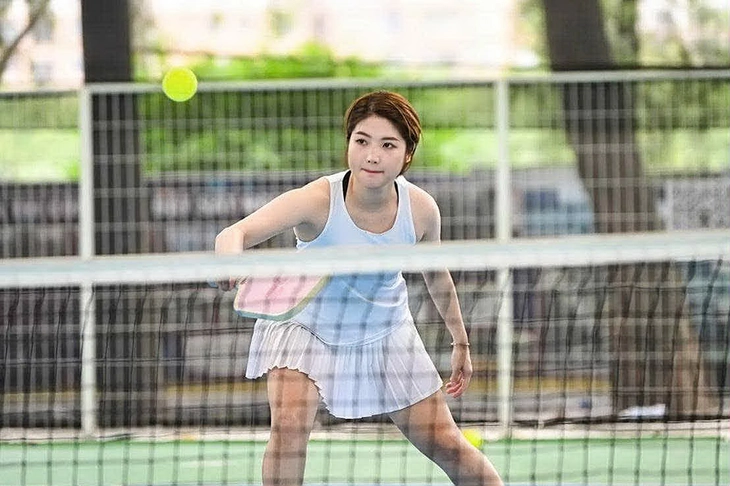
Pickleballs make noise even when you play in silence - Photo: QT
Why do pickleballs make noise?
There are many reasons why pickleball is disliked by those who don't play the sport , with noise being a leading factor. In many countries, lawsuits have arisen over this seemingly minor issue.
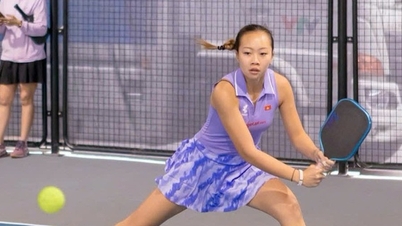
Pickleball uses a solid composite racket surface and a perforated plastic ball, creating a sharper, more resonant "clack-clack" sound than tennis.
According to a 2023 survey by the community advocacy organization Noise Free America, the average sound level measured at pickleball court fences ranges from 70 to 85 decibels, equivalent to the noise of a truck moving at close range.
The U.S. Environmental Protection Agency (EPA) recommends 55 decibels as the threshold at which people can regularly go about their daily activities without experiencing long-term health effects. This has caused many households living near playgrounds to feel annoyed, even worried.
The Los Angeles Times quoted clinical audiologist Jillian Coleman as saying that "the constant, rapid bouncing of a baseball can cause auditory strain and contribute to an increased risk of headaches, sleep disturbances, and irritability."
This expert confirmed that the sound of a pickleball is characterized by its high frequency, which can easily irritate the sensitive ears of the human body, especially in older adults.
A 2022 survey by the city of Newport Beach (California) found that over 60% of noise complaints in the park area were related to pickleball.
In many localities, residents have submitted petitions requesting the relocation of playgrounds. The city of Arlington, Virginia, once received dozens of complaint letters each week when it converted its tennis courts into pickleball courts.
Following independent measurements, authorities had to temporarily close some yards and install additional soundproof walls. This also led to prolonged litigation in New York and Arizona, forcing court intervention.
In a ruling in August 2024, the Scottsdale County court (Arizona) ordered limits on playing hours and suggested building golf courses away from residential areas to avoid legal repercussions.
The risk of being "wiped out" from the city.
Sports administrators are beginning to worry about the sustainability of the movement. The US Pickleball Federation acknowledges noise as a “growth problem” and warns that local authorities need to plan from the ground up.
A sound engineer named Robert Unrath told NPR that the hollow ball construction makes the sound emitted "sharp like metal striking," and when multiple people play simultaneously, the resonance can easily exceed acceptable limits.
He recommended using rubber barriers, sound-diffusing panels, or placing the yard at least 100 meters away from residential areas.
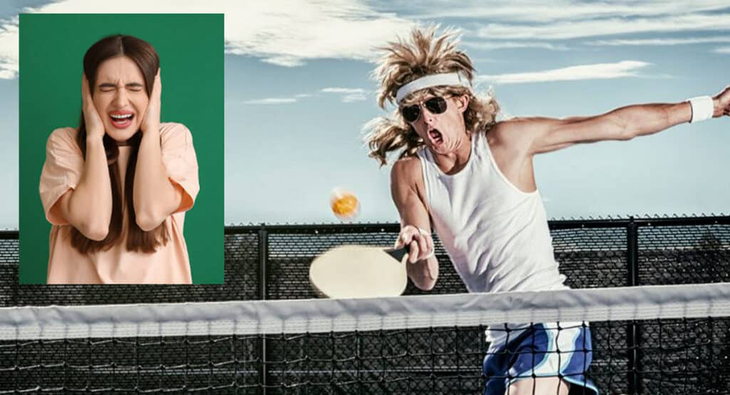
It's difficult to play pickleball in silence - Photo: PN
Conversely, the players' community argues that the complaints are exaggerated. Some clubs claim that playing times are mainly in the morning and late afternoon, with minimal impact on sleep.
However, pressure continues to mount, especially as the number of public pickleball courts in the U.S. has increased by more than 150% in three years, according to statistics from USA Pickleball.
Notably, manufacturers have released "shock-absorbing" rackets and "sound-reducing" balls. An independent 2023 test by the Acoustical Society of America found that these could reduce noise by an average of 5–10 decibels.
However, this number is still not enough to reassure noise-sensitive residents. Some cities are experimenting with "quiet golden hours," limiting games to after 8 p.m. and banning the use of loudspeakers near the stadium.
Many urban planners consider this a prime example of the conflict between public space and quality of life. As living standards rise, people demand quieter environments, while community sports movements also flourish.
The Washington Post quoted urban planning expert Mark Sasaki as saying that future cities should dedicate separate areas for active sports, rather than "cramming" them close to residential areas.
With pickleball continuing to grow, the controversy surrounding noise shows no sign of subsiding. Without proper planning, the sport risks creating a counterproductive effect.
Source: https://tuoitre.vn/tieng-on-khuyet-diem-cua-pickleball-2025102919563978.htm
![[Image] National Assembly discusses the implementation of the socio-economic development plan.](https://vphoto.vietnam.vn/thumb/1200x675/vietnam/resource/IMAGE/2026/04/20/1776696707422_ndo_br_img-20260420-185419-jpg.webp)


![[Photo] General Secretary and President To Lam meets with National Assembly delegates from ethnic minorities.](https://vphoto.vietnam.vn/thumb/1200x675/vietnam/resource/IMAGE/2026/04/20/1776696701056_a1-bnd-8331-3342-jpg.webp)

















































































Comment (0)