

Although it is a unique handicraft product, the issues of raw materials and market outlets for silk woven from lotus fibers in Phung Xa village remain a difficult problem to solve.
This information was presented at the seminar "Artisan Phan Thi Thuan - Lotus Silk - Current Situation and Solutions for Reaching the Global Market ," organized by the Phan Family Business Club of Northern Vietnam in collaboration with several other organizations on January 19th in Hanoi.
4,800 lotus stems are needed to make one piece of silk.
Phung Xa (My Duc district, Hanoi ) is considered the cradle of mulberry cultivation, silkworm rearing, and silk weaving. After many ups and downs, the mulberry cultivation, silkworm rearing, and silk weaving craft in Phung Xa gradually declined. Today, the Phung Xa craft village only has one very successful enterprise: My Duc Silk and Mulberry Company Limited, owned by Ms. Phan Thi Thuan.
According to artisan Phan Thi Thuan, Director of My Duc Silk and Mulberry Company Limited, following the special product of silk quilts woven by silkworms themselves, the next product is lotus silk – a unique product with high cultural and economic value. This not only affirms her talent and creativity but also opens up a new and promising direction for Vietnamese handcrafted weaving.
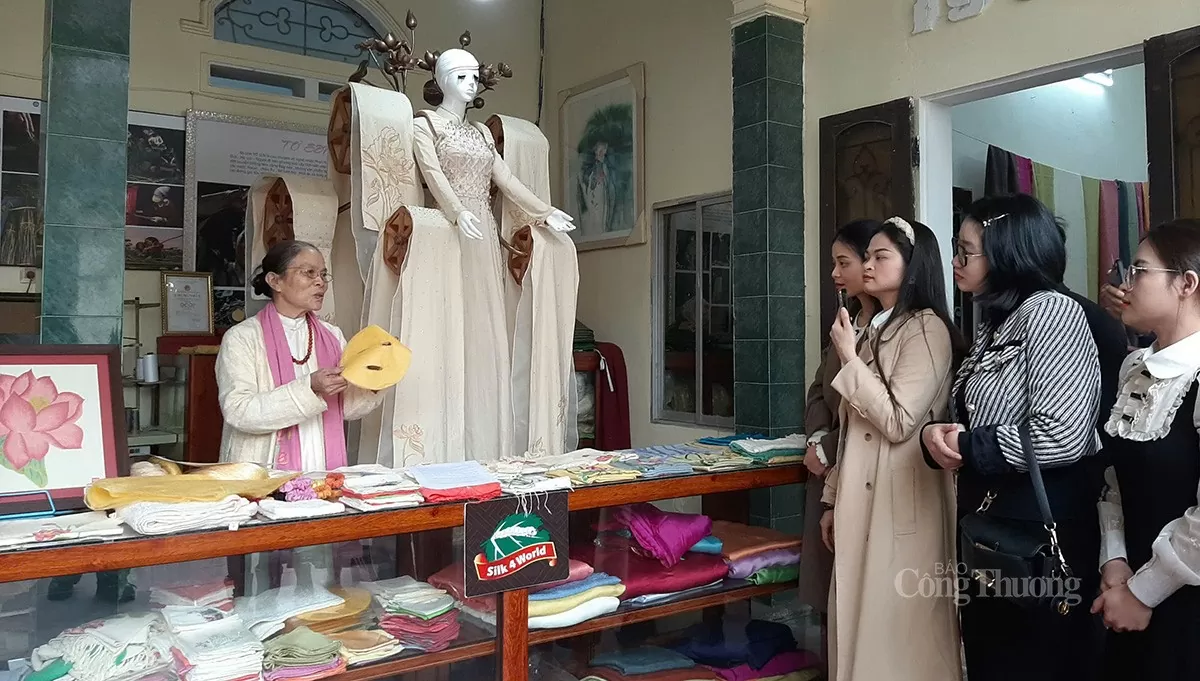 |
| Artisan Phan Thi Thuan introduces hand-woven silk and lotus silk products to visitors. Photo: Nguyen Hanh |
Creating lotus silk requires meticulous processes. Lotus stems are harvested, cut, and cleaned of thorns. After sorting, the artisans use knives to lightly score and cut the outer layer of the lotus stem. The extracted silk is then placed on tubes and spun to tighten the threads. The lotus silk threads that meet the standards are then woven into finished silk fabrics on looms.
A single piece of lotus silk requires approximately 4,800 lotus stems, but even the most skilled artisans only process about 200-250 stems a day. Lotus silk has a pleasant, herbal fragrance. Each lotus silk thread is like a "blood vessel" nourishing the lotus plant. Thanks to its uniqueness and cultural value, products woven from lotus silk attract many customers both domestically and internationally. The lotus silk industry has received investment from the government for development. In 2023, products such as lotus silk scarves and embroidered lotus silk paintings from the craft village were evaluated and classified by the city in the OCOP program.
"It takes us 1 month and 7 days to produce one hand-woven lotus silk scarf. Unembroidered scarves sell for around 10 million VND each, while hand-embroidered scarves sell for around 12 million VND each," said artisan Phan Thi Thuan.
Desire to connect and expand the market.
According to the Ministry of Agriculture and Rural Development, Vietnam currently ranks third in the world in silk production, after China and India. Silk exports in 2022 reached US$70 million. The majority of Vietnam's raw silk is exported to India, accounting for over 90%.
However, products made from lotus silk possess many factors that allow them to expand into major global markets. For example, lotus silk products have been recognized as 5-star OCOP (One Commune One Product). The lotus silk products of artisan Phan Thi Thuan also have fascinating and unique stories. Lotus silk products have been and are being loved and highly valued by the international market thanks to their uniqueness and positive humanistic and humanitarian values.
Willing to pass on her skills for free to anyone who wants to learn, Ms. Phan Thi Thuan hopes to be connected and supported to create broader outlets not only in the domestic market but also globally.
Speaking at the seminar, Dr. Dao Trong Chuong - former assistant to Deputy Prime Minister Truong Vinh Trong - commented that the lotus silk products of artisan Phan Thi Thuan have great potential to reach international levels. Currently, artisans, businesses, and craft villages have received support and favorable conditions from the local government and the State to expand their production, business, and markets abroad.
However, for handicraft products in general, and lotus silk and mulberry silk products in particular, to reach the international market, besides uniqueness, silk production needs to upgrade its technology to keep pace with the times. Furthermore, the raw material market needs to expand to meet demand. In addition, companies need to upgrade their infrastructure, apply technology and machinery to shorten production time and increase competitiveness. Finally, social security and welfare must be ensured for the artisans working with lotus silk and mulberry silk products so they can work with peace of mind.
| In 2024, designer Bui Cong Thien Bao used lotus silk to create the "Lotus Silk" design, which was worn by Miss Huynh Thanh Thuy at the Miss International 2024 competition in Japan. The highlight of the outfit was the replica of a hand-woven loom attached to the back. The garment received high praise from international experts. |
Source: https://congthuong.vn/lang-nghe-phung-xa-tim-huong-di-cho-lua-to-sen-370327.html

































































































Comment (0)