

On September 17, the Algerian presidential office announced that Prime Minister Nadir Larbaoui had submitted his government's resignation to President Abdelmadjid Tebboune.
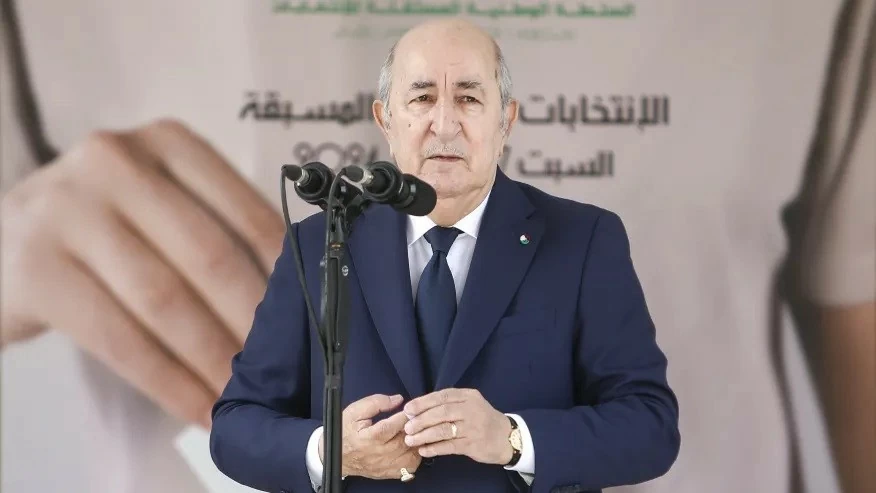 |
| Algerian President Abdelmadjid Tebboune. (Source: AP) |
According to Reuters , the Algerian president has asked the government to remain in office to ensure the continued resolution of pressing issues, including the preparation of the 2025 budget draft for submission to Parliament .
Earlier that same day, September 17th, Abdelmadjid Tebboune, who had just been re-elected president for a second five-year term in early September, was sworn into office in an official ceremony in the capital Algiers in the presence of state officials and the highest authorities.
The leader also said he would open a nationwide dialogue.
Mr. Tebboune won in the first round of the election with initial results showing he received nearly 95% of the vote.
His rivals – opposition leader Abdelaali Hassani Cherif of the Social Movement for Peace and candidate Youcef Aouchiche from the Social Forces Front – subsequently appealed the vote results to the Constitutional Court.
However, on September 14th, the Court announced the official results of the presidential election, confirming that President Abdelmadjid Tebboune was re-elected with 84.3% of the vote.
Tebboune's victory means Algeria can likely maintain its policies of boosting energy exports and implementing reforms that benefit businesses, while still sustaining large subsidies.
The impact of Tebboons' public spending policies is evident everywhere in the capital, Algiers. New apartment buildings and social housing are springing up, creating new neighborhoods decorated with election posters in recent weeks.
Algeria's unemployment rate has fallen from over 14% during the Covid-19 pandemic in 2020 to 12.25% in 2023. President Tebboune also promised to increase subsidies and create around 500,000 new jobs for the people.
Last March, the International Monetary Fund (IMF) praised Algeria's efforts to reform its economy to diversify and reduce its dependence on oil and gas as a means of stimulating private sector growth and boosting employment.
However, the IMF also warned that large budget deficits resulting from high spending risk making public finances vulnerable to economic shocks.
Source: https://baoquocte.vn/algeria-tong-thong-tebboune-tuyen-the-nham-chuc-nhiem-ky-2-chinh-phu-tu-nhiem-286720.html

![[Photo] Two flights successfully landed and took off at Long Thanh Airport.](/_next/image?url=https%3A%2F%2Fvphoto.vietnam.vn%2Fthumb%2F1200x675%2Fvietnam%2Fresource%2FIMAGE%2F2025%2F12%2F15%2F1765808718882_ndo_br_img-8897-resize-5807-jpg.webp&w=3840&q=75)





























































Comment (0)