

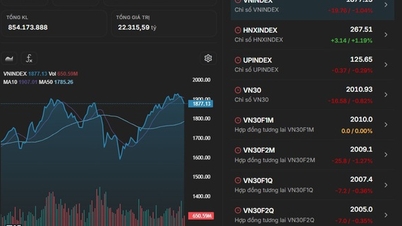
On November 3rd, the market continued its downward trend. With 240 declining stocks and only 88 rising stocks on the HoSE, the VN-Index lost 22.65 points, equivalent to a 1.38% decrease.
This marks the second consecutive session in which the index has fallen by more than 20 points. The previous trading session, at the end of October, saw the VN-Index drop 29.92 points. Prior to that, on November 30th, the index also lost 16.26 points, equivalent to -0.96%.
Thus, in the last three trading sessions, the VN-Index has fallen by more than 71 points. This indicates that selling pressure remains strong.
However, while many large-cap stocks continued to fall and investors remained in a selling position, the proprietary trading desks of securities companies took advantage of the situation to accumulate shares.
According to data from the Ho Chi Minh City Stock Exchange (HoSE), on November 3rd, proprietary trading desks made net purchases in both order matching and negotiated transactions. Specifically, proprietary trading desks made net purchases of over 739 billion VND through order matching and over 146 billion VND through order matching, bringing the total net purchase value of proprietary trading desks to 885 billion VND.
In this session, in line with foreign investors, domestic institutional investors accumulated a net 284 billion VND worthof FPT shares. Additionally, MWG was also bought net 226 billion VND.
Notably, the trading session on November 3rd saw a sharp decline in the prices of numerous bank stocks. TCB fell 4.27%, MBB fell 2.12%, STB fell 5.77%, and CTG also dropped more than 1%… Contrary to the market trend, proprietary trading desks took advantage of the opportunity to buy into this group of stocks.
Earlier, on October 31st, when the market fell nearly 30 points, proprietary trading desks bought even more aggressively, with net purchases exceeding 1,103 billion VND.
While selling only 496 billion VND worth of shares, proprietary trading desks bought over 1,600 billion VND worth of shares. Of that, FRT was the largest net buyer with over 543 billion VND.
Thus, along with the modest net buying of 82 billion VND on October 30th, proprietary trading desks have now had three consecutive net buying sessions with a total value of over 2,000 billion VND amidst the decline of the VN-Index and the drop in prices of a series of large-cap stocks.
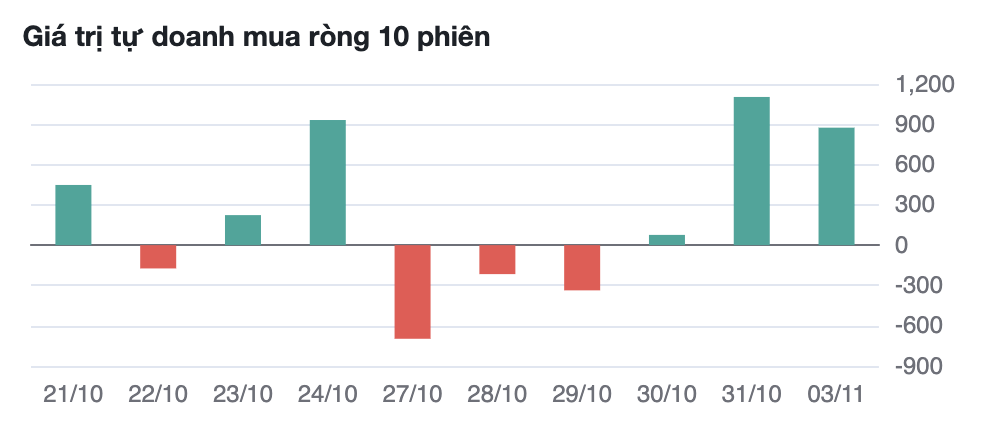 |
| Proprietary trading firms increased net buying on the HoSE over the past 3 sessions. |
Meanwhile, foreign investors also narrowed their net selling. The net selling value of this group on November 3rd was only 136 billion VND, marking the third consecutive session of reduced net selling since October 29th, with selling concentrated in certain areas. VIX (284 billion VND), MBB (123 billion VND), STB (87 billion VND) were among the stocks with net foreign investment. Conversely, FPT (250 billion VND),ACB (118 billion VND), and VJC (87 billion VND) were the stocks with net foreign investment.
Foreign investors' buying volume exceeded their selling volume. On November 3rd, the value of purchases reached VND 3,641 billion, a 21% increase compared to the previous session, while the value of sales amounted to VND 3,778 billion, only a 10% increase.
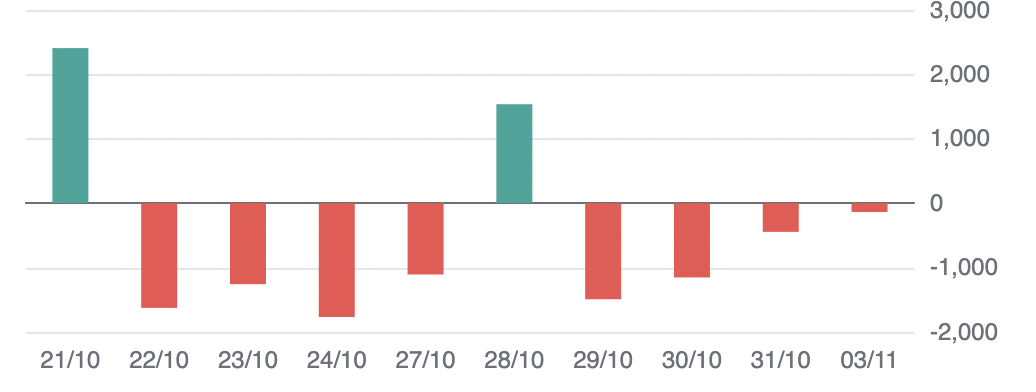 |
| Foreign investors have also reduced their net selling for three consecutive sessions. |
Nevertheless, the fact that the market has experienced three consecutive days of decline will continue to test investor sentiment. SSI Securities Company forecasts that the index is retreating to the important support zone of 1,600 - 1,610. Reactions around this area will provide direction for the next trend. In a balanced scenario, the index will need time to accumulate to rebuild a new price base, and conversely, the risk of an extended correction may increase, with room to retreat to the 1,550 - 1,560 zone.
VCBS recommends that investors closely monitor market movements to restructure their portfolios promptly when stop-loss levels are reached. Instead of rushing to buy at the bottom, investors should use this time to "filter" and identify stocks that have held firm at important technical support levels such as the MA20 or the nearest accumulation base despite the selling pressure from the overall market. This will allow them to seek opportunities to invest when the VN-Index stops falling and begins to show signs of stabilizing. Stocks with strong resilience during a VN-Index downtrend are often the ones that recover fastest and most strongly during the market's recovery phase.
Source: https://baodautu.vn/tu-doanh-da-tung-ra-2000-ty-gom-rong-co-phieu-d427998.html
![[Image] Close-up view of the interchange connecting the two expressways and Long Thanh Airport.](https://vphoto.vietnam.vn/thumb/1200x675/vietnam/resource/IMAGE/2026/05/25/1779703378210_ndo_br_z7863716673926-224453a31600126cce10622af6290afd-4549-jpg.webp)




![[Image] Hanoi's urban life under the challenge of a "scorching hot" environment](https://vphoto.vietnam.vn/thumb/1200x675/vietnam/resource/IMAGE/2026/05/25/1779706979265_nang-nong-t5-2026-minh-duy-7-4636-jpg.webp)































































































Comment (0)