

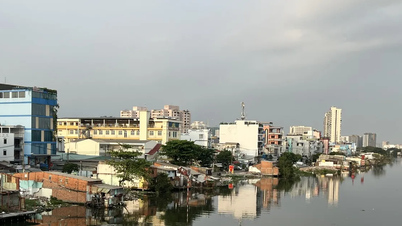
The Sa Lung River is the largest tributary of the Ben Hai River. As it flows through Vinh Long commune, the Sa Lung River has witnessed the ups and downs and events of a small village called Sa Long. On this land lies the sacred historical and cultural relic of the Le Dynasty Queen Mother's Temple, revered and worshipped by the local people to this day.

Mr. Le Phuoc Bai lights incense at the altar of Queen Le - Photo: TRAN TUYEN
From the Sa Lung River...
The Sa Lung River originates at the foot of the Truong Son mountain range, flows through the Bai Ha area (Vinh Ha commune), and then flows to the plains of the communes of Vinh Long, Vinh Thuy, Vinh Lam, Vinh Son... Originally, the river's birth name was Sa Long, associated with the legend of the "falling dragon" in prehistoric times.
Long ago, no one remembers the exact time, on a beautiful sunny day, dark clouds suddenly gathered, obscuring the sky, accompanied by fierce thunder and lightning, and torrential rain and wind. A dragon appeared, riding on the dark clouds, flying from the sea inland with the raging storm.
After passing through Ho Xa area, the dragon, exhausted, swooped down. After a while, it struggled to fly again, heading towards the Truong Son mountain range. Just as the dragon touched the foot of the Truong Son mountains, the rain suddenly stopped, the wind subsided, the sky turned clear and blue, and the sun shone brightly.
The dragon descended here to prepare for childbirth. While writhing in agony, its two front paws clawed at the ground, creating two large pools from which water surged from the earth. After giving birth, the dragon was exhausted and died, leaving its form etched into the rock and earth.
From where the dragon's head plunges down, water flows along its body, creating a river that flows into the Minh Luong River (the Ben Hai River today) at its lower reaches. The name Sa Long River (meaning "dragon falling") originates from this.
At the two lakes formed when the mother dragon struggled and clawed during childbirth, humans later inherited the underground water source to build two large irrigation projects of great significance to the plains of Vinh Linh district.
Those are La Nga Lake and Bao Dai Lake. There is another lake in Vinh Chap commune, which the locals call Sao Sa Bay. That bay is said to be the tail of a dragon thrashing about at birth.

Sa Nam village (formerly part of Sa Long village) is located on the right bank of the Sa Lung river - Photo: TRAN TUYEN
For generations, the Sa Long River has provided water and alluvial soil to a vast, fertile plain in Vinh Linh district. It is for this reason that groups of migrants from the North settled here, creating peaceful villages, including Sa Long village.
Arriving at Sa Long village
To find out the origin of the place name Sa Long village, I went to Sa Nam village, Vinh Long commune to meet Mr. Le Phuoc Bai (71 years old). Mr. Bai previously worked in the army and retired in 2013 with the rank of lieutenant colonel.
After retiring, he returned to his hometown and served as the Party Secretary of Sa Nam village for 10 consecutive years. Currently, he is the Chairman of the Le Family Council of Vinh Linh district, the deputy head of the Le Phuoc clan in Sa Nam village, and the Head of the Management Board of the Le Family's Queen Mother Temple. Mr. Bai is a 16th-generation descendant of the Le Phuoc clan in Sa Long village.
According to the Lê family genealogy (a lineage considered to be the pioneers of Sa Long village), written from the reign of Cảnh Trị (1663) to the reign of Thiệu Trị, the 12th-generation descendant, Doctor Lê Đức (who passed the doctoral examination in 1841, and was later appointed as a Compiler in the Hanlin Academy, Director of the National Academy, and Governor-General of Vĩnh Long province), researched and revised the genealogy after returning to his ancestral home, Sa Long village (Sa Long commune, Nam Trực district, Nam Định province), to verify the origins of the Lê family. He found that the founding ancestor of the Lê family was named Lê Viết Thức (from Nam Trực district, Nam Định province), who was instrumental in establishing Sa Long village (Minh Linh district). He had three children, "sons who brought honor and daughters who directly pioneered the settlement, attracting people to establish villages, leaving behind immense contributions that will remain unchanged for generations to come."
Sa Long village has five clans considered to be pioneers and co-cultivators: Le Da, Le Van, Le Phuoc, Vo, and Ho. Among them, the progenitor of the Le Da clan is Mr. Le Dai Lang (also known as Le Quang Phu), whose tomb is located in the area of the Le Queen Mother's Temple (in Loi Xo Ro), and who is revered by the villagers as the first to reclaim the land. Mr. Le Quang Phu was the maternal uncle and the one who directly raised the three siblings of Mrs. Le Quy Phi after their parents passed away prematurely.
Mr. Le Viet Dao was the founder of the Le Van clan, and Mr. Le (anonymous) was the founder of the Le Phuoc clan. Both were revered by the villagers as the pioneers of the land. After settling in their new homeland, they returned to their ancestral village to move the remains of Mr. Le Viet Thuc and his wife to be buried together in Loi Tai Mang.
According to the book "Ô Châu Cận Lục" by Dương Văn An, written in 1555, during the Later Lê Dynasty, King Lê Thánh Tông had a policy of expanding the territory and bringing people to Châu Ô to settle. Empress Lê Quý Phi led a retinue along with her brother Lê Viết Đáo and Lê (name unknown), who were granted titles by the king, to the South to cultivate the land.
Upon reaching Truong Nha Ho (bordering Ho Xa), Empress Le Quy Phi and her entourage turned into an area with dense vegetation. Further on, they encountered the Sa Long River. Sensing the auspicious energy of the place, the Empress and her entourage decided to settle there, gathering people from various places (primarily from the North) to establish a village.
A vast area stretching from Co Kieng (Vinh Khe commune), Sen Thuy (Quang Binh province) to the entire plain of Vinh Linh district was cultivated for rice and other crops, and livestock and poultry farming, leading to a prosperous life for the people. The Empress and officials taught the people how to build houses, how to unite, love and support each other to protect against wild animals, thieves, and invaders.
Thus, Sa Long village was established at the end of the 15th century, and the name Sa Long is taken from its original name in the North, Sa Long village, Sa Long commune, Nam Truc district, Nam Dinh province. The person credited with pioneering the village was Mr. Le Quang Phu. His wife, the Le family's princess, along with her brother, Mr. Le Viet Dao, and her younger brother, Mr. Le (anonymous), made significant contributions to expanding the territory southward.
The names Sa Long River and Sa Long Village have existed for a long time in history. During the reign of King Gia Long, all place names, villages, and even personal names were prohibited from being named Long. If they were accidentally named, they had to be changed to avoid violating the taboo. Therefore, Sa Long River had to be changed to Sa Lung, and Sa Long Village was renamed Sa Trung. "Over time, the population of Sa Trung Village grew, so later, Sa Trung Village was divided into four smaller villages: Sa Nam, Sa Bac, Hoa Nam, and Trung Lap," Mr. Bai said.
And the Temple of Queen Le
Regarding the identity of Lady Le, the book "O Chau Can Luc" by Duong Van An mentions the following: "Lady Le: She was originally from Sa Lung commune, Minh Linh district, and was a daughter who served in the palace. When Man Le Vuong (i.e., King Le Uy Muc) was still in the royal residence (the residence of princes before ascending the throne) and studying with the royal tutor, she also came to study there. The King was pleased with her, and the two became fond of each other."
One day, Wang playfully kicked her foot. When she returned home, she told her teacher about it, and the teacher said, "Wang was testing you. If you ever see Wang do that again, cover his foot with both hands to show your affection."
The next day, she followed her teacher's plan exactly, much to the King's delight, and from then on, he no longer intentionally teased her. She, too, kept their beautiful love affair a secret, never revealing it. When the King ascended the throne, she was selected to join the imperial harem. Being intelligent, she was favored above all others, and thus she was promoted to the rank of concubine.
Princess Le was brought into the royal harem by King Le Uy Muc and made his consort. After King Le Tuong Duc dethroned Le Uy Muc and demoted him to the rank of Man Le Prince, later historical records often referred to Princess Le as Man Le Phi.
Sa Long village is where Lady Le resided during the period of land reclamation and village establishment. To commemorate her great contributions, the people of Sa Long village erected a shrine immediately after her death. Throughout the reigns of Minh Mang, Thieu Tri, and Tu Duc, royal decrees and gifts were bestowed upon Lady Le at the shrine (currently, these decrees and gifts no longer exist due to war damage and some loss). The shrine of Lady Le has been recognized as a historical and cultural relic by the Provincial People's Committee. Every year, on the 27th day of the 3rd lunar month, the people of Sa Long village hold a ceremony to worship Lady Le according to the rituals of the ancient court.
Tran Tuyen
Source

![[Photo] General Secretary and President To Lam presides over a working session with the Central Policy and Strategy Committee on the development of the materials industry.](https://vphoto.vietnam.vn/thumb/1200x675/vietnam/resource/IMAGE/2026/05/21/1779359935432_a3-bnd-3129-1412-jpg.webp)





























































Comment (0)