

In recent days, as part of the "We Love Vietnam" program of Nhan Dan Newspaper, Bac Kan province has coordinated with relevant units to install three NFC chip-equipped billboards at the special national historical site of Cho Don Safe Zone; the special national historical site of Ba Be Lake; and the Song Cau pedestrian street.
These are locations carefully selected by Bac Kan province to be featured in the Nhan Dan Newspaper, for the purpose of installing NFC signage. These locations can be considered Bac Kan's "tourism identity cards," representing its potential for historical tourism, experiential tourism, and the development of its night-time economy .
Beneath the tranquil canopy of ancient palm trees, amidst vast bamboo forests, and occasionally glimpses of golden camellia blossoms in the communes of Binh Trung, Luong Bang, Nghia Ta… in Cho Don district (Bac Kan province), lie a dense concentration of revolutionary historical relics associated with the resistance war against the French.
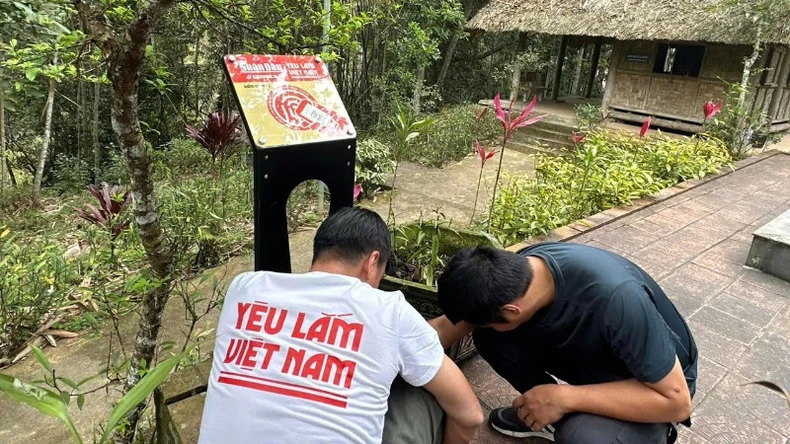 |
Installing NFC chip boards at the Na Pau historical site, Luong Bang commune, Cho Don district. (Photo: HA TUYET) |
To reach the Cho Don Safe Zone, a special national historical site, tourists can take the Hanoi-Thai Nguyen expressway from Hanoi , which takes about an hour. From Thai Nguyen, tourists can follow the old National Highway 3, passing through Dinh Hoa district (Thai Nguyen province) to reach the destination.
Tourists can take the second route via the Thai Nguyen-Cho Moi road, going to Bac Kan city and then continuing on to Cho Don district.
Both routes, from Hanoi to the Cho Don safe zone, take only about 4 hours.
It is no coincidence that the communes of Bình Trung, Lương Bằng, and Nghĩa Tá were chosen by President Ho Chi Minh and the Central Party Committee as safe zones within the Việt Bắc war zone.
With its ancient forests "sheltering soldiers and encircling the enemy," its strategic location allowing for both offensive and defensive maneuvers, and the support and protection of the local ethnic communities and Bac Kan in general, the Cho Don Safe Zone held a crucial position in the revolutionary history during the resistance against the French.
The Cho Don Safe Zone National Special Monument Complex comprises 25 historical sites, of which 6 are classified at the national level, and more than 40 other sites are currently being surveyed and documented for classification.
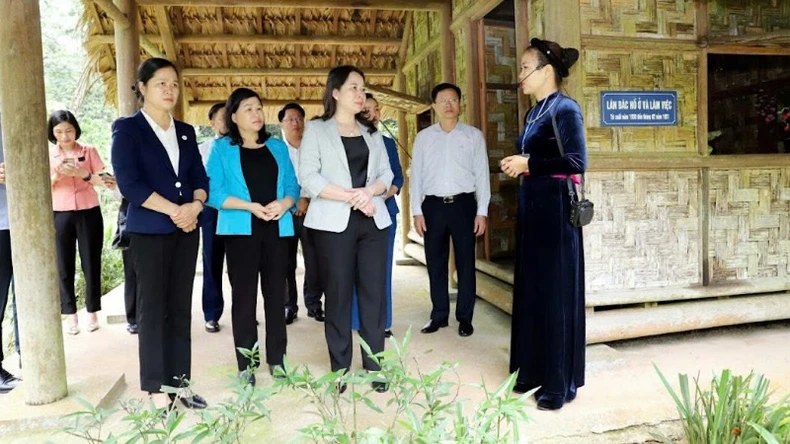 |
The Cho Don safe zone welcomed many Party and State leaders for visits. (In the photo: Vice President Vo Thi Anh Xuan visits the Cho Don safe zone). (Photo: Tuan Son) |
The main historical sites are distributed along National Highway 3C, from the communes of Bang Lang and Luong Bang to Nghia Ta, Binh Trung, and Ban Thi. Each site has its own historical value, creating a special complex of historical relics, a precious "red address" in the former war zone. One such site is Pu Co Hill in Ban Bang village, Nghia Ta commune, which marks the meeting of the southern and northern advance troops in October 1943.
The Bản Ca historical site in Bình Trung commune is where President Ho Chi Minh stayed and worked in late 1947. The Nà Pậu historical site in Lương Bằng commune is where President Ho Chi Minh stayed and worked in late 1950 and early 1951. The Nà Tẳng hamlet in Lương Bằng commune was the residence and workplace of Prime Minister Phạm Văn Đồng from 1950 to 1951.
The Khuoi Linh historical site in Na Deng village, Nghia Ta commune, was the residence and workplace of Comrade Truong Chinh, former General Secretary of the Central Committee of the Communist Party of Vietnam, and also served as the headquarters of the Central Party Office in late 1950 and early 1951. The Na Quan historical site in Binh Trung commune was where the Central Party Committee established its meeting hall during the resistance war against the French from 1948 to 1952.
The Cho Don safe zone is still densely populated with relics associated with President Ho Chi Minh's journey from Pac Bo (Cao Bang) to Tan Trao (Tuyen Quang); the relics of the Cuu Quoc Newspaper and the Su That Newspaper, where the logistics agency (Ministry of National Defense) was located; the Na Kien relic where the closing ceremony of the 2nd and 3rd courses of the Tran Quoc Tuan Military Academy was held; the Phja Tac relic in Ban Thi commune, where the Ministry of Finance's money printing factory was located from 1947 to 1951…
In the Cho Don safe zone, the Central Committee of the Party, the Government, and President Ho Chi Minh formulated the resistance strategy and directed many major campaigns, such as: the Viet Bac Autumn-Winter Campaign of 1947; the Border Campaign of 1950; and prepared the conditions for the Second National Congress of the Party held in Chiem Hoa (Tuyen Quang) in February 1951...
Given its exceptional and immense historical value, on December 22, 2016, the Prime Minister signed Decision No. 2499/QD-TTg classifying the Cho Don Safe Zone historical site as a special national historical site.
From Bac Kan city, along the newly opened tourist road nearly 40km long, winding through natural forests, visitors will reach the scenic Ba Be Lake.
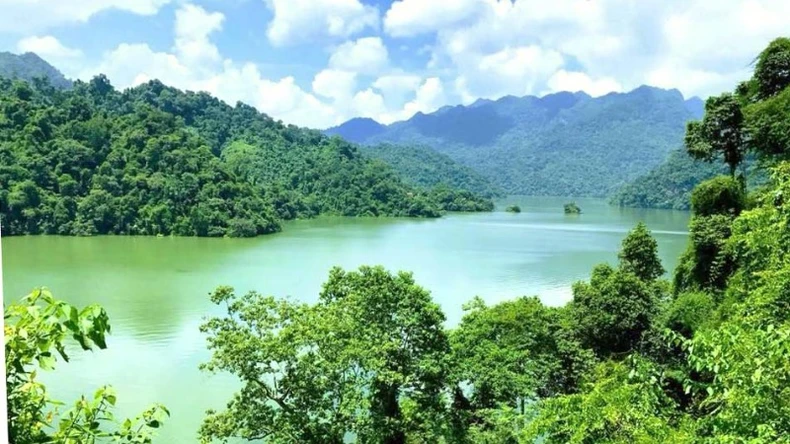 |
A scenic view of Ba Be Lake. (Photo: THU CUC) |
This is one of the largest natural freshwater lakes in Vietnam; it is recognized as one of the 20 most important freshwater lakes in the world that need protection. The lake was formed approximately 200 million years ago due to major geological upheavals that caused the subsidence of limestone mountain ranges.
Ba Be Lake is named after the fact that it is formed by merging three lakes: Pe Leng, Pe Lu, and Pe Lam. The lake is over 8km long, 2km wide at its widest point, with a surface area of approximately 500 hectares and an average depth of 20m, reaching up to 35m in some places. The lake's water is always a deep blue, reflecting the clouds and sky. On the lake's surface are islands such as Ba Goa Island and An Ma Island… Along the lake's edge are Hua Ma Cave and Don Den Peak… Along the lake's shores are villages of the Tay ethnic group, most of which have now been converted into homestays to accommodate tourists.
Visitors can experience the scenic beauty of Ba Be Lake and the unique culture and cuisine of the highlands. They will have the opportunity to immerse themselves in the cultural atmosphere of playing the zither, singing Then songs, and performing traditional dances.
After a good night's sleep at lakeside homestays, visitors can stroll along the lakeside paths, watch the sunrise, and breathe in the fresh air. Further afield, visitors can climb to the top of Don Den peak to chase the clouds, cycle to visit Hua Ma cave, or hop on a boat to glide across the deep blue lake…
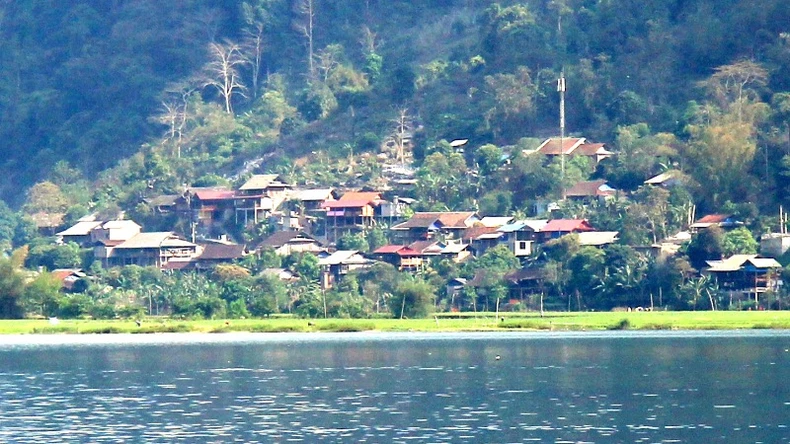 |
A view of Pac Ngoi village on the shores of Ba Be Lake. (Photo: THU CUC) |
Before visiting the Cho Don Safe Zone and the scenic Ba Be Lake, tourists can stop and experience the Song Cau pedestrian street in Bac Kan city.
This is a new tourist attraction inaugurated by Bac Kan city in August 2024. The street is 1km long, extending from Doi Ky Bridge to the intersection with Thanh Nien Street.
The pedestrian street has four main areas, including: an area for organizing art performances; a space for displaying paintings and photographs; an area for experiencing and participating in folk games; and a space for trade promotion. Since its opening, every week, from Friday evening to Saturday, the Song Cau pedestrian street has attracted many tourists from within and outside the province.
With NFC tags now installed at these three tourist destinations, visitors will have the opportunity to use their phones to verify their check-in, save personal photos, and receive useful information. This will help spread awareness of the area's image and potential, contributing to tourism development.
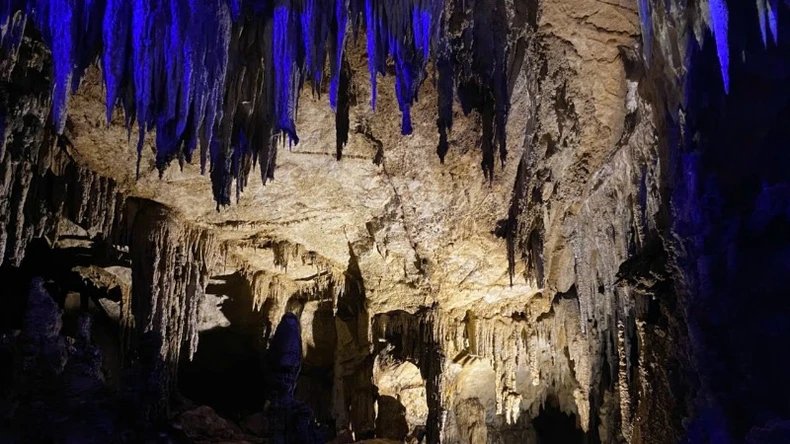 |
The unique scenery inside Hua Ma Cave, located on the edge of Ba Be Lake. (Photo: Tuan Son) |
![[Photo] Prime Minister Pham Minh Chinh attends the Conference on the Implementation of Tasks for 2026 of the Industry and Trade Sector](/_next/image?url=https%3A%2F%2Fvphoto.vietnam.vn%2Fthumb%2F1200x675%2Fvietnam%2Fresource%2FIMAGE%2F2025%2F12%2F19%2F1766159500458_ndo_br_shared31-jpg.webp&w=3840&q=75)






![[Photo] Prime Minister Pham Minh Chinh attends the Conference on the Implementation of Tasks for 2026 of the Industry and Trade Sector](https://vphoto.vietnam.vn/thumb/402x226/vietnam/resource/IMAGE/2025/12/19/1766159500458_ndo_br_shared31-jpg.webp)





















































Comment (0)