

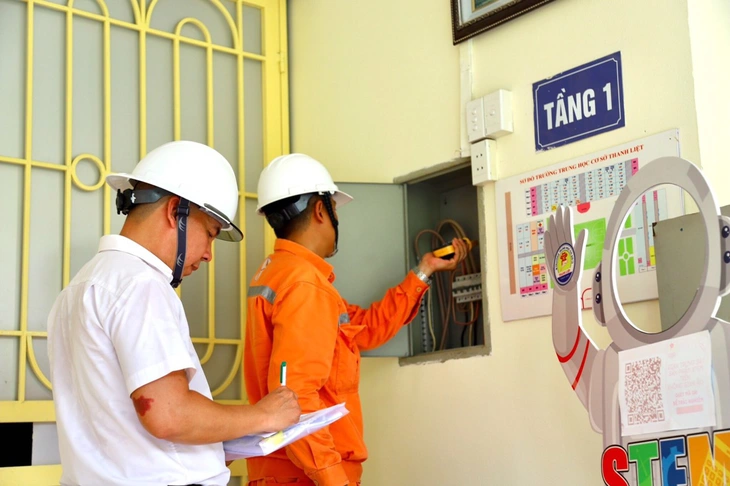
Electricity company employees measure electricity meters - ensuring the infrastructure is a requirement for implementing the two-component pricing system - Photo: C. DUNG
Minister of Industry and Trade Nguyen Hong Dien has requested that all necessary conditions be fully prepared so that from January 1, 2026, the two-component electricity pricing mechanism (price based on capacity and energy) will be implemented, initially applying to large electricity consumers without exception.
Why can't the two-tiered electricity pricing system be implemented yet?
To implement the project, Mr. Dien requested that relevant functional units finalize the project proposal for submission to competent authorities, assess the impact report, and provide complete information for reporting to the Government .
Additionally, from now until December 31st, two invoices will be issued simultaneously: one using the current system for actual payment, and another using a two-part system for customers to review and adjust as needed.
Practical experience shows that the two-component electricity pricing system has been applied in many countries around the world , but in Vietnam, its implementation is only just beginning.
The reason is that our power infrastructure is not yet complete enough to implement this because it requires two-component meters. Furthermore, there have been no specific studies proposing or conducting pilot tests for this pricing system because the calculations would be complex, requiring a complete and consistent data system.
According to sources from Tuoi Tre Online , the Vietnam Electricity Group (EVN) has basically completed the plan to develop a roadmap for applying a two-component electricity pricing system for different customer groups, and is expected to submit it to the relevant authorities by September 15th.
EVN proposes a two-component electricity pricing system that will initially be applied to non-residential customers with high electricity consumption.
In fact, the selection of large electricity consumers as the target group for the pilot program of two-component electricity pricing has been included in the development plan since 2024.
These are customers covered under Decree 80 who operate under a direct power purchase agreement (DPPA) between renewable energy power generation units and large electricity consumers, with an average monthly electricity consumption of 200,000 kWh or more, and connected to a voltage level of 22kV or higher.
According to the proposal, applying a two-component electricity pricing system, consisting of a capacity price and an energy price, benefits both customers and ensures the recovery of investment costs for the electricity sector.
Therefore, the two-component electricity pricing mechanism is seen as a measure to manage natural load demand, continuously improving the utilization of fixed assets to reduce production costs and enhance overall social efficiency.
The metering and data transmission system needs to be ready.
The two-component electricity pricing system aims to accurately reflect the full cost that electricity consumers incur for the system. However, implementing this pricing mechanism requires a system capable of measuring both electricity (kWh) and power (P max / I max ).
Therefore, the application and implementation of a pricing system requires ensuring the readiness of the electricity infrastructure, such as meters and data transmission systems.
Therefore, data from the 2024 project indicates that the total number of normal production households according to Decree 80, meeting the calculation criteria, is approximately 6,000 households, most of which are at the medium and high voltage levels, accounting for up to 70% of direct retail sales.
This choice of target group is considered appropriate for marginal cost calculations, as the seller, EVN, will charge the full cost, and the buyer is the end consumer without any intermediaries.
Furthermore, the customer group selected under Government Decree 80 is deemed appropriate and necessary now that the DPPA mechanism has come into effect. This group of customers purchases electricity directly from renewable energy plants, while the remaining electricity output will have to be purchased from EVN.
This will create significant supply costs for EVN, impacting the group's revenue, as it must ensure electricity supply while simultaneously reducing the amount of electricity sold to customers.
In addition, electricity corporations have now implemented the use of electronic meters capable of measuring power and energy consumption for most customers using electricity for production and business purposes (customers subject to time-of-day electricity pricing - TOU).
As of 2019, more than 523,000 TOU meters had been installed nationwide for all eligible customers implementing the new tariff.
Meanwhile, for households, international experience shows that the tiered electricity pricing system, with prices increasing progressively based on consumption levels, remains very common.
This is also because residential households are characterized by a very large number of households but small electricity production. Therefore, implementing a two-component electricity pricing system with power and energy meters would be quite costly and would not be feasible immediately; a suitable roadmap is needed.
Source: https://tuoitre.vn/vi-sao-ap-gia-dien-hai-thanh-phan-neu-dung-tu-200-000-kwh-thang-20250910104355668.htm


![[Photo] Prime Minister Pham Minh Chinh attends the Conference summarizing and implementing tasks of the judicial sector.](/_next/image?url=https%3A%2F%2Fvphoto.vietnam.vn%2Fthumb%2F1200x675%2Fvietnam%2Fresource%2FIMAGE%2F2025%2F12%2F13%2F1765616082148_dsc-5565-jpg.webp&w=3840&q=75)
























































































Comment (0)