

When the embodiment of Xam singing art – Ms. Ha Thi Cau – passed away, many worried that Xam singing would gradually fade away in the very place considered the cradle of this art form. But no, those who deeply cherish Xam singing still have every right to be full of hope for a bright future for this art form in their homeland, witnessing the passion of today's young generation.
At the end of the year, the weather is pleasantly cool. Distinguished artist Kim Ngan, head of the Kim Ngan Xam Club in Yen Nhan commune (Yen Mo district), is relaxing after a busy day of cleaning and decorating her house to welcome Tet (Lunar New Year).
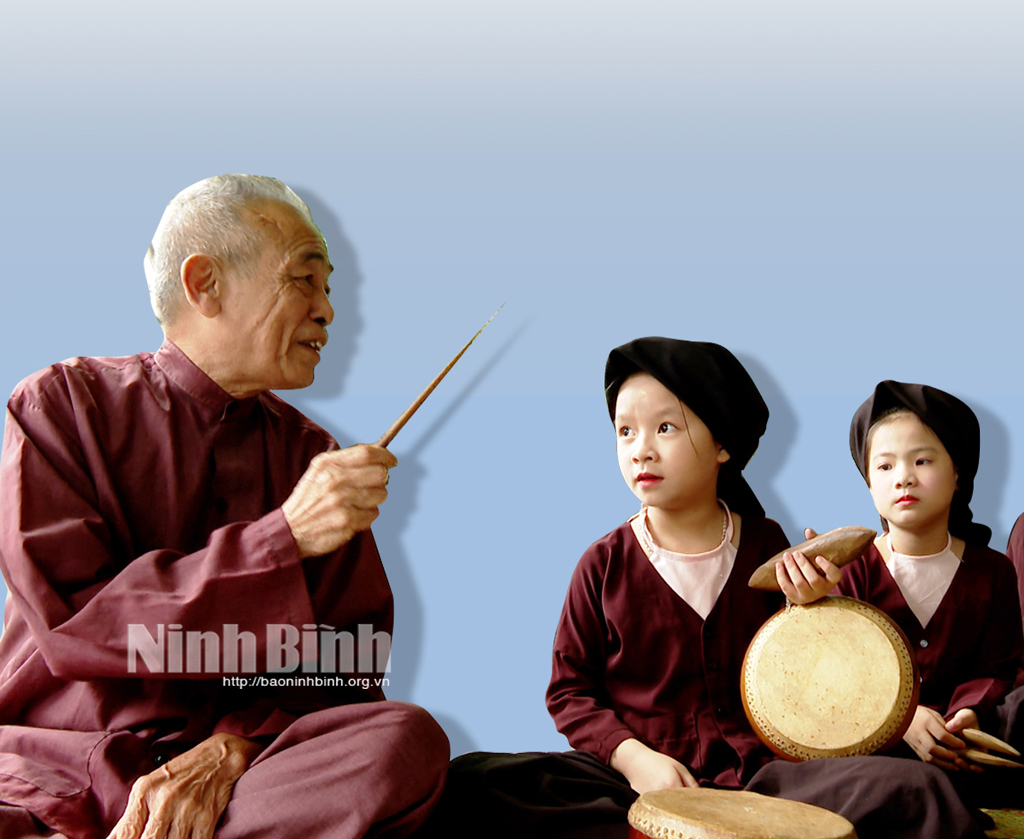
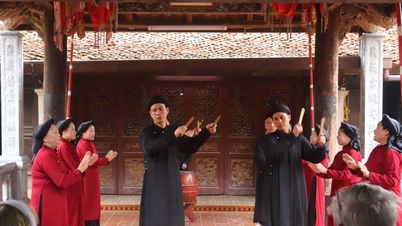
Beside a pot of simmering, fragrant sticky rice cakes, with a floral mat spread out in the courtyard, the esteemed artist Kim Ngan enthusiastically instructs her grandchildren on how to use intonation and pronunciation to sing a complete traditional Xam song. Her youngest granddaughter, Pham Quynh Anh, is only in third grade this year, but has been learning Xam singing from her grandmother for over two years.
Ms. Ngan is proud that most of her grandchildren have been learning Xam singing since they were very young. Not only does she teach Xam singing to her children and grandchildren, but as the head of the Yen Nhan Xam Singing Club – one of the most famous Xam clubs in Yen Mo district to date – Meritorious Artist Kim Ngan has diligently taught Xam singing to many young people both within and outside the local area.
According to Ms. Ngan, the club members range in age from 6 to 20 years old. Initially, members received theoretical instruction from artisans, practicing pronunciation, intonation, and articulation. Later, they learned to distinguish between different genres of Xam singing. To date, most of the children can play musical instruments, sing Xam Thap An, Tau Dien, Xam Cho, and more. Above all, they have ignited a passion for Xam singing in many people.
From these classes, many young people have participated in performances at local folk art festivals and won high awards. Most recently, three members of the club, Vuong Mai Thuy Trang, Pham Nhu Quynh, and Mai Ngoc Oanh, brought Xam (a traditional Vietnamese folk singing style) to the folk song competition of the three regions, held in Nghe An province, and excellently won first prize. Each performance is an opportunity to bring Xam closer to the general public, of all ages, helping listeners gradually become familiar with and develop a love for the simple sounds and melodies of the genre.
Meritorious Artist Kim Ngan said that generations of Xam singers like her will no longer worry about Xam singing fading away or being lost. She has taught hundreds of students. No one chooses to learn Xam singing as a profession to make a living in the future; rather, the students learn it simply to fulfill their passion and sense of responsibility as young people towards this traditional art form.
Xẩm, like many other forms of folk art, will not be forgotten but will continue to be passed down and developed strongly over time, thanks to the passion and responsibility of the younger generation. That is also the motivation and belief that has driven her to pursue the work of transmitting the art of xẩm singing for many years.
Young artist Bui Cong Son is also deeply devoted to Xam (a traditional Vietnamese folk singing style). Cong Son is only 23 years old this year, originally from Thai Binh province – the birthplace of Cheo (traditional Vietnamese opera) – but because of his love for Xam, he returned to Yen Mo, the land of Xam.
Son recounted that he had studied with many artisans, including the famous Xam singer Dao Bach Linh in Hai Phong city. He learned many good things, but still lacked something unique to Xam, like the singing style of Mrs. Ha Thi Cau. To learn from her, the only way was to go to her hometown. In 2016, Cong Son packed his bags and went to Yen Mo to learn Xam singing. He spent a lot of time researching materials, studying and carefully learning Mrs. Cau's singing style to emulate her.
"What's special about Mr. Cau is that it's evident in both his playing and singing. His xẩm singing is clear and resonant. His way of delivering lines, enunciating words, and keeping time is very expressive. While adhering to the general principles of singing, each time he sings, you see something new and different. His pauses and breaks are also free and varied. Especially when he plays the instrument, the sound of the instrument mimics the lyrics. Whatever the lyrics are, the music is imitated exactly..." - Mr. Son enthusiastically spoke about the singing style of the last xẩm singer of the 20th century.
Artist Bui Cong Son shared that he was fortunate to have a voice similar to that of Mr. Cau, so when he performs, many Xam enthusiasts recognize that his singing style is quite similar to Mr. Cau's. Many people believe that Xam singing is difficult to make a living from, especially in contemporary life, but Son proudly says that he can make a living from it.
From 2019 to the present, Mr. Son has participated in and won dozens of first prizes in competitions and festivals of Xam singing clubs. Recently, at the Xam singing club festival organized by Ninh Binh province, Mr. Son excellently won the first prize. Mr. Son was also one of three artisans invited to participate in the Northern and Central Vietnam Cultural Heritage performance night in the series of activities at the 2nd Ninh Binh-Trang An Festival in 2023.
Despite being a unique traditional art form, it must be acknowledged that Xam singing is being overshadowed in modern life and by the current tastes of young people. This is what Mr. Son is concerned about, and therefore, for many years, he has been involved in teaching Xam singing to children in Yen Phong commune at the Xam market.
Mr. Son also diligently collects documents and ancient musical instruments so that more people can access and spread the love of Xam singing to the public. "Currently, there are more Xam listeners than before. Audiences are increasingly seeking out Xam competitions and performances, including young audiences. Actually, some listen because they understand and love Xam, while many others listen simply because it's trendy. Teaching Xam is also like that; many young people learn out of passion, while others sing just to follow the trend… But even so, this is a very positive sign for the future of Xam. A new spring is coming. Personally, I hope that this year and many years to come, I can spread the love of Xam singing to many people, especially young people..." - shared artisan Bui Cong Son.
Dao Hang
Source


![[Photo] General Secretary and President To Lam presides over a working session with the Central Policy and Strategy Committee on the development of the materials industry.](https://vphoto.vietnam.vn/thumb/1200x675/vietnam/resource/IMAGE/2026/05/21/1779359935432_a3-bnd-3129-1412-jpg.webp)























































































Comment (0)