

 - With the motto "Putting patient satisfaction at the center of service," the health sector has implemented many solutions, continuously modernizing processes and keeping pace with "Industry 4.0." This has contributed to administrative reform and improved patient satisfaction at healthcare facilities throughout the province.

Digital transformation in healthcare is the process of applying information technology to healthcare activities in a comprehensive and holistic manner. The application of digital transformation in the healthcare sector will help optimize information management and storage, while simultaneously improving and enhancing service quality, and increasing the efficiency of healthcare management and care for the population.
From traditional healthcare to digital healthcare
In recent times, the health sector has prioritized the application of information technology in many areas, from resolving administrative procedures to managing medical examinations, treatment, and health insurance claims; building an integrated electronic health record platform on the national identification system (VNeID); implementing electronic medical record management, etc.
Mr. Ly Kim Soi, Deputy Director of the Department of Health, said: The national digital transformation program has identified healthcare as one of the eight top priority areas. In Lang Son , the Department of Health has issued a plan and directives from the provincial to the commune level, requiring all affiliated units to clearly understand the role of information technology in medical examination and treatment.
With the motto of prioritizing patient satisfaction, the Department of Health annually develops and issues comprehensive documents outlining the tasks of applying information technology and digital transformation within the sector. Simultaneously, it requires 100% of medical facilities, specialized departments, and affiliated units to fully understand the content, role, and significance of applying information technology and digital transformation in medical examination and treatment, ensuring that all officials, civil servants, employees, doctors, and medical staff are fully informed to create consensus in understanding and implementation.
Accordingly, in recent years, the province has focused on and promoted digital transformation in the healthcare sector, identifying digital transformation in medical examination and treatment as one of the key and continuous tasks of the health sector. To date, 100% of public medical facilities in the province use hospital information management software to manage patient information from admission to discharge; 95% of the province's population has electronic health records. The province has implemented the "Telemedicine" project for the period 2021-2025; 100% of medical facilities conduct medical examinations and treatments using chip-embedded citizen identification cards (CCCD) and the VNeID application.
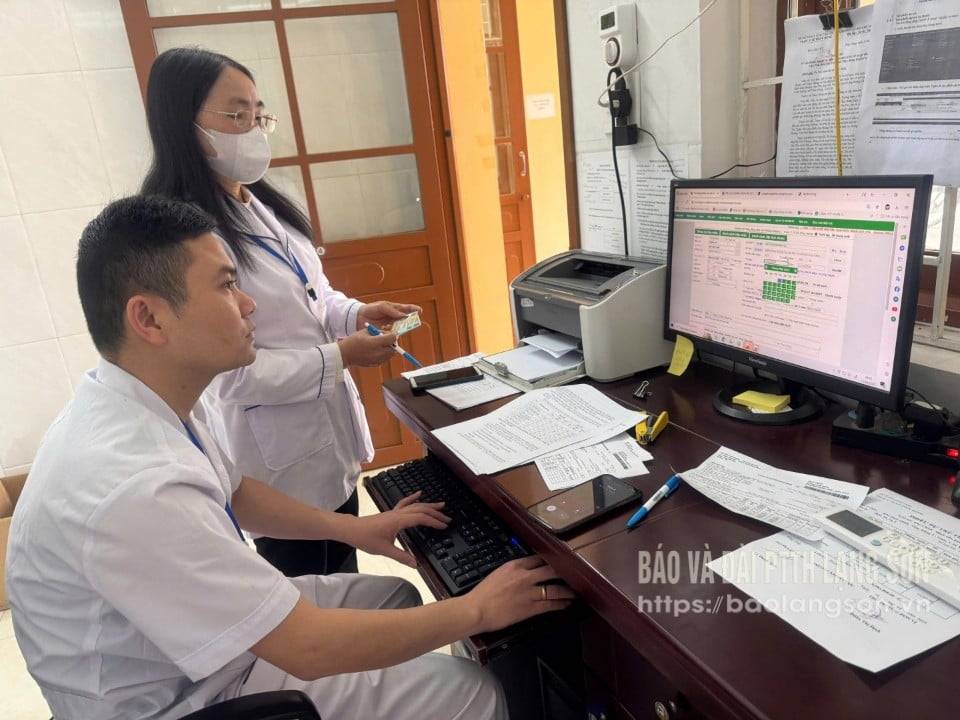
Furthermore, in implementing the "Project for the Development of Data Applications on Population, Electronic Identification and Authentication, Serving National Digital Transformation in the period 2022-2025, with a vision to 2030," the province has developed a phased and annual implementation plan with four groups of indicators, with particular attention paid to digital transformation in medical examination, treatment, and healthcare for the people, encompassing nine specific indicators. The Department of Health has directed healthcare facilities to enhance the processing of health insurance medical examination and treatment procedures using chip-embedded citizen identification cards or through the VneID application; 100% of provincial and district-level hospitals have online video conferencing and connect via digital platforms to serve medical examinations and treatments. The Department of Health has received and processed administrative procedures through the Public Service Portal and the Electronic One-Stop Information System. Provincial hospitals and district/city health centers have implemented cashless fee collection and strengthened the management of electronic medical records…
Implementing digital transformation in the healthcare industry contributes to improving the patient's healthcare experience, reducing costs and waiting times. Furthermore, thanks to digital transformation in healthcare, doctors can diagnose and provide treatment solutions more quickly and accurately. In particular, the application of digital technology in managing and operating medical equipment systems optimizes administrative work for hospitals and healthcare facilities.
A win-win situation
The implementation of information technology and digital transformation in medical examination and treatment within the healthcare sector has contributed to creating convenience for both the public and the medical staff.
At the Van An Commune Health Station, a remote commune in Chi Lang District, the "digitalization" process has truly taken place. The station currently has 3 computers, VNPT-HIS software, and a stable internal network. On average, the station receives more than 10 patients per day and serves over 50 people with chronic diseases each month. Mr. Lang Van Tich, Head of the Van An Commune Health Station, shared: "The current medical examination and treatment process is mostly done on computers and through specialized software. When people come for examination at the commune health station, they only need to bring their health insurance card or citizen identification card. The medical staff will then input the patient's personal data into the software's reception section. After the examination, the medical staff will print the prescription and dispense the medicine immediately. With the support of the software, medical staff no longer need to manually write out the examination and treatment information, and the examination time is significantly shortened. People do not have to wait long when coming for medical examination and treatment at the commune health station." Before we had the software, we had to write everything by hand, which made mistakes unavoidable. That's no longer the case. On the other hand, with the software, monthly reporting is much easier; we just need to extract the report from the system. In this Industry 4.0 era, we're used to using software; without technology, things would be much more difficult.
Similar to commune-level health stations, provincial and district-level hospitals are also receiving investment in implementing digital transformation in medical examination and treatment. In particular, within the framework of the Telemedicine Project for the period 2021–2025, the province has invested in online video conferencing infrastructure for 100% of provincial and district-level hospitals. Hospitals such as the Provincial General Hospital, the Traditional Medicine Hospital, and the Bac Son Medical Center have regularly connected and held consultations with central-level hospitals.
In addition, the Department of Health has implemented the acceptance of 100% of administrative procedures through the Public Service Portal and the province's administrative procedure resolution system, especially in the field of health insurance. Simultaneously, cashless fee collection has become a criterion for evaluating hospital quality at provincial-level hospitals and district health centers.
The use of technology has helped shorten waiting times for examinations, reduce errors in prescriptions, and improve the efficiency of healthcare cost management. People no longer have to wait or travel multiple times as before. As a result, the level of public satisfaction with healthcare services at public healthcare facilities has increased over the years. Specifically, the satisfaction rate of inpatients in 2024 reached 94%, an increase of 1.1% compared to 2023.
Ms. Doan Thi Thu, from Thanh Loa commune, Cao Loc district, shared: "I've had arthritis for a long time and have had to go to the hospital many times. Before, I had to carry a whole stack of medical records and wait a long time to complete the procedures. Now, at the hospital, I just need to show my patient number, and the doctor can look up all my information, treatment history, and medications. Everything is quick and saves time. I also pay hospital fees using my bank account, so I don't have to carry cash or worry about keeping track of money like before. I think digital transformation has made going to the hospital much more convenient and less troublesome for us people."
Digital transformation in the healthcare sector has proven to be highly effective. With a proactive spirit, flexible adaptation, and a determination to improve service quality, the healthcare sector has identified digital transformation as a key priority in the coming period. The entire sector will focus on implementing a comprehensive set of solutions: perfecting people's health data; expanding the connection of medical examination and treatment software from the commune to the provincial level; strengthening training for medical staff on new technologies; and promoting the integration of digital platforms into management and operations. These efforts not only help people access healthcare services conveniently and transparently but also serve as a foundation for building a smart healthcare system, aiming for effective and sustainable universal healthcare.
Source: https://baolangson.vn/y-te-bat-nhip-4-0-trong-kham-chua-benh-5049223.html





Comment (0)