

(NLĐO) - The tomb of Tutankhamun, the legendary pharaoh of ancient Egypt, continues to reveal new mysteries about the "Awakening Ceremony of Osiris".
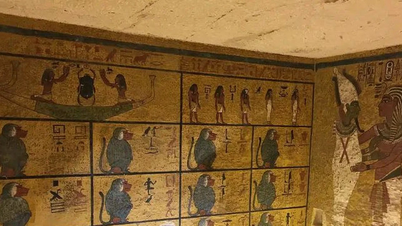
Inside the opulent tomb of Pharaoh Tutankhamun, also known as "King Tut," scientists have discovered eight unusual objects, including four trays and four staffs, located within the burial chamber.
According to a research team led by Egyptologist Nicholas Brown from Yale University (USA), the aforementioned artifacts are the oldest evidence of the "Awakening Ceremony of Osiris" performed on a pharaoh.
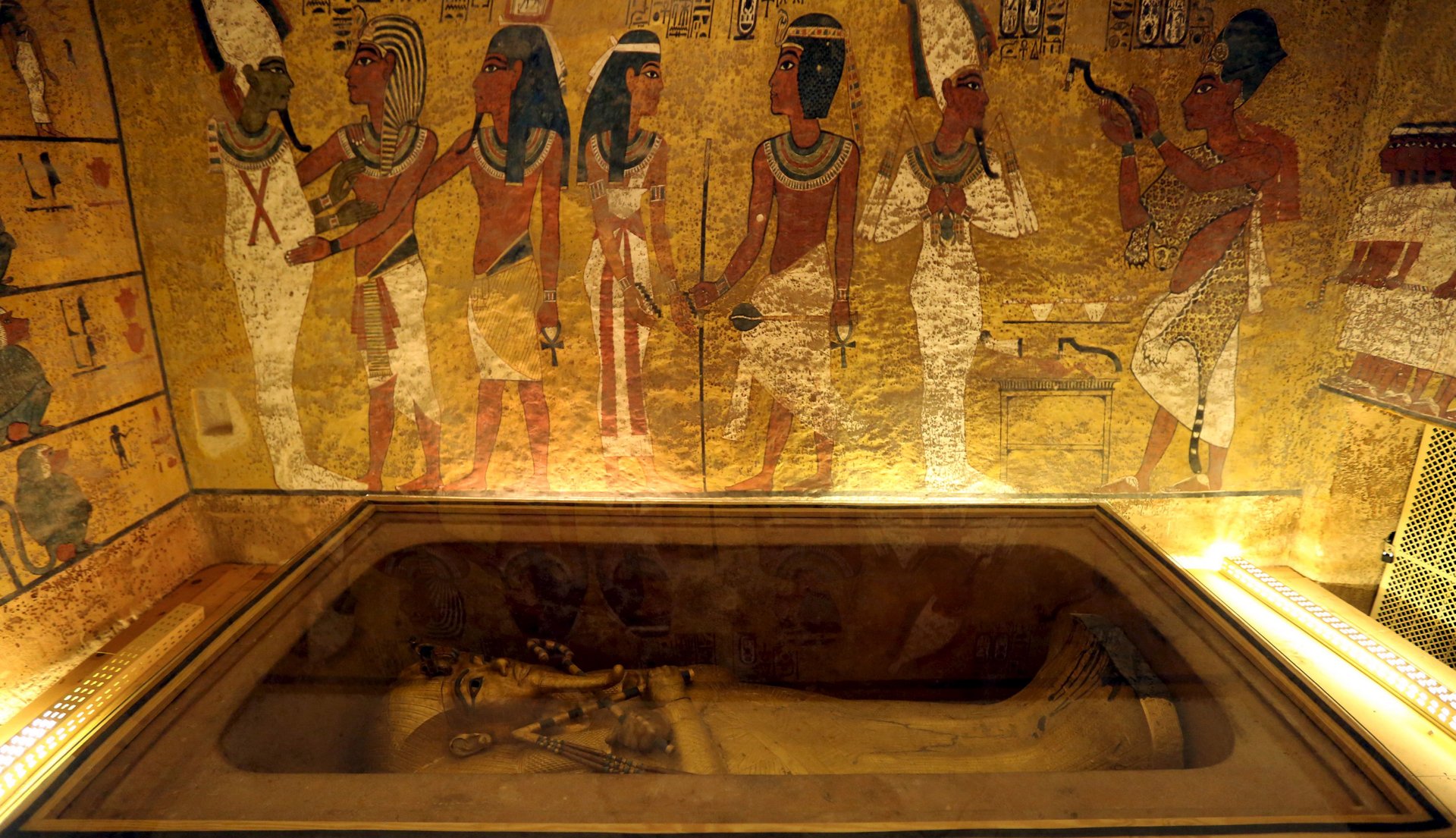
The burial chamber of Pharaoh Tutankhamun inside his tomb near Luxos, Egypt - Photo: Egyptian Ministry of Tourism and Antiquities
Osiris was the god of the underworld in ancient Egyptian mythology, symbolizing both death and rebirth.
According to mythology, Osiris was resurrected after being murdered by his brother Seth. At that moment, his son Horus waved a staff toward Osiris and called him to awaken.
Therefore, the "Awakening of Osiris" seems to reenact this story, using four trays of liquid—possibly Nile water or wine—to pour over the pharaoh's mummy or beside it.
Meanwhile, the four staffs could symbolize the staff that Horus used.
Offerings containing liquids held great symbolic value for the Egyptians, who believed they could reverse the condition of the corpse and bring it back to life.
Furthermore, water taken from the Nile River is known as the "Eye of Horus," a symbol of rebirth and victory over evil, including death.
The artifacts mentioned above are just a part of the enormous funerary treasure in King Tut's tomb, ranging from gold and precious stones to jewelry made from rare meteorite materials.
Pharaoh Tutankhamun ruled from 1332-1323 BC, belonging to the 18th Dynasty of the New Kingdom of ancient Egypt.
Ascending to the throne at the young age of 9, this pharaoh proved his exceptional ability by leading Egypt out of his father's unstable rule and into prosperity within just 10 years of his reign.
He implemented a series of changes including moving the capital back to the old capital of Thebes, restoring traditional religious practices, reviving the economy and improving diplomatic relations, and constructing many magnificent buildings...
Sadly, the talented King Tut died – possibly from malaria – at the young age of 19. He was deified by the Egyptians, who praised him for his talent as well as his physical beauty.
The mummy shows Tutankhamun to have a tall stature; while a 2023 study aimed at reconstructing his portrait revealed the pharaoh to possess a sharp, intelligent face and, notably, a brain volume significantly larger than that of an average person.
Source: https://nld.com.vn/8-vat-la-danh-thuc-diem-vuong-trong-lang-mo-vua-tut-196250330084532916.htm
![[Photo] Prime Minister Pham Minh Chinh receives the Governor of Tochigi Province (Japan)](/_next/image?url=https%3A%2F%2Fvphoto.vietnam.vn%2Fthumb%2F1200x675%2Fvietnam%2Fresource%2FIMAGE%2F2025%2F12%2F16%2F1765892133176_dsc-8082-6425-jpg.webp&w=3840&q=75)


![[Photo] Prime Minister Pham Minh Chinh receives Lao Minister of Education and Sports Thongsalith Mangnormek](/_next/image?url=https%3A%2F%2Fvphoto.vietnam.vn%2Fthumb%2F1200x675%2Fvietnam%2Fresource%2FIMAGE%2F2025%2F12%2F16%2F1765876834721_dsc-7519-jpg.webp&w=3840&q=75)
![[Image] Leaked images ahead of the 2025 Community Action Awards gala.](/_next/image?url=https%3A%2F%2Fvphoto.vietnam.vn%2Fthumb%2F1200x675%2Fvietnam%2Fresource%2FIMAGE%2F2025%2F12%2F16%2F1765882828720_ndo_br_thiet-ke-chua-co-ten-45-png.webp&w=3840&q=75)
![[Live] 2025 Community Action Awards Gala](/_next/image?url=https%3A%2F%2Fvphoto.vietnam.vn%2Fthumb%2F1200x675%2Fvietnam%2Fresource%2FIMAGE%2F2025%2F12%2F16%2F1765899631650_ndo_tr_z7334013144784-9f9fe10a6d63584c85aff40f2957c250-jpg.webp&w=3840&q=75)







































































Comment (0)