

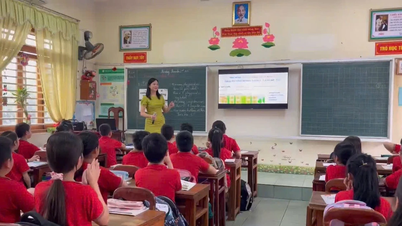
Kaizen is a philosophy that has been applied for many years, bringing outstanding results to the majority of students who have been and are currently studying English.
 |
| Kaizen is a philosophy that has been applied for many years, bringing outstanding results to the majority of students who have studied or are currently studying English. (Source: Communist Party of Vietnam Online Newspaper) |
This philosophy, originating from Japan, has been adopted by many businesses since the 1950s. In a short time, Kaizen attracted the attention of quality management instructors and businesses in the United States, and was widely implemented in various research and production processes.
Since then, this method has gradually become popular worldwide and has contributed greatly to the creation of mega-enterprises, most notably the renowned car manufacturer - Toyota.
The word "kaizen" In Japanese, the original meaning is "change for the better," but in Japanese dictionaries and in everyday usage, the term also encompasses the meanings of "continuity" and "philosophy."
However, after the term "kaizen" became widely used in business and industrial improvement methods, it gradually came to mean "continuous improvement." Kaizen should be understood as a philosophy or mindset rather than a specific method. Over time, Kaizen has become more flexible and widely applied to daily life and business operations.
The Kaizen method, applied at SunUni Academy, is characterized by: information synthesis and analysis, always seeking better solutions, time efficiency, the importance of consistency, identifying gaps, and avoiding blame. This training method is being applied consistently in all classes at SunUni Academy, and as a result, thousands of students have successfully achieved their English language goals.
Kaizen is a powerful philosophy that helps learners improve efficiency and quality not only in their studies but also in their lives and work through continuous small improvements.
Accordingly, the training program is well-structured, systematic, and flexible, serving a wide range of learners, from high school students to working professionals; at the same time, it applies advanced online learning platforms from technology partners, in line with current digital transformation trends, to provide the best learning experience for learners.
ELSA's integration of AI technology into its training program has supported students in practicing speaking and pronunciation after class, providing instant feedback and significantly improving learning effectiveness.
According to a report by the international education organization EF Education First, for many years, Vietnam has remained among the countries with low English proficiency levels. In 2023 alone, Vietnam's English proficiency score was only 505 out of 800 points, ranking 58th out of 113 countries and territories, placing it in the middle proficiency group. Despite improvements, this ranking shows that Vietnam still lags significantly behind other countries in terms of English proficiency.
Notably, one of the main causes of this situation, as pointed out by many studies, stems from traditional teaching methods that heavily emphasize grammar and rote learning, lacking practical application and real-world interaction. This leads to students finding it difficult to use English confidently even in simple everyday communication situations.
The need to improve English proficiency among young Vietnamese people has always existed, but the increasingly hectic pace of life makes it difficult to schedule time for in-person classes. After the limitations imposed by the pandemic, online learning became a temporary solution. This format quickly gained popularity due to its time and cost efficiency, as well as its convenience for students. This is also the training format that SunUni Academy has been implementing for nearly five years.
Source



























![[Photo] Reception to welcome General Secretary and President To Lam and his wife on their State visit to the Philippines](https://vphoto.vietnam.vn/thumb/1200x675/vietnam/resource/IMAGE/2026/06/01/1780295488620_vna-potal-chieu-dai-chao-mung-tong-bi-thu-chu-tich-nuoc-to-lam-va-phu-nhan-tham-cap-nha-nuoc-toi-philippines-8798060-7855-jpg.webp)


































































Comment (0)