

Speaking of Vietnamese women is speaking of courage, selflessness, sacrifice, diligence, patience, dedication, loyalty, and creative talent. "Heroic, indomitable, loyal, and capable" – these are the eight golden words that President Ho Chi Minh bestowed upon Vietnamese women during the resistance war, a truly honorable, well-deserved, and proud achievement.
Throughout the history of Vietnam's struggle for national liberation and defense, countless patriotic women have been immortalized in history books. From the time of the Trung Sisters to the era of Ho Chi Minh, millions of courageous women have sacrificed themselves for the independence of their country. This fervent patriotic tradition is brilliantly embodied in the image of Nguyen Thi Thap – an indomitable and steadfast daughter of the Tien River.
Ms. Nguyen Thi Thap (real name Nguyen Thi Ngoc Tot), born in 1908 into a poor peasant family in Long Hung commune, Chau Thanh district, Tien Giang province. From the age of 20, she embraced revolutionary ideals and participated in the Farmers' Association in Long Hung, engaging in many activities that garnered widespread support from poor farmers. In 1931, she had the honor of joining the Communist Party of Vietnam. Later, she adopted the pseudonym Muoi Thap and left her home to continue revolutionary activities, establishing bases in My Tho, Tan An, Ben Tre, Saigon, and other locations. In April 1935, she was elected to the Southern Regional Committee. That May, she was arrested and sentenced to prison. Immediately after serving her sentence, she secretly returned to her hometown and continued her revolutionary activities. In December 1938, after leading a peasant protest against taxes in Long Hung commune, Comrade Nguyen Thi Thap was arrested again, but this time thousands of people from Long Hung and Long Dinh communes came to her rescue.
In 1940, Mrs. Mười Thập joined the leadership of the Southern Uprising in Mỹ Tho province. Despite being close to her due date, she still wore a sash around her waist and commanded the militia and people to raise flags and banners as they stormed and seized the Tam Hiệp outpost. Her husband, a communist fighter who had been captured and imprisoned on Côn Đảo Island by the French colonialists since 1930, joined the uprising as soon as he returned to the mainland. After the Southern Uprising, her husband was captured in January 1941 and executed by the French.
In 1945, Mrs. Mười Thập participated in leading the people to seize power in Mỹ Tho province (now Tiền Giang province), and in 1946, she was elected as a representative to the first National Assembly of the Democratic Republic of Vietnam.
In November 1946, the French colonialists returned to Vietnam, and the entire nation began resistance. The Central Committee moved to the Viet Bac resistance zone. At this time, as a member of the Central Committee of the Party, she was assigned to return to the South with the special task of building and strengthening the Southern Party organization. In 1947, she was appointed Head of the Southern Women's National Salvation Group, and then President of the Southern Women's Union. In 1953, the Central Committee transferred her to work in the Viet Bac resistance zone. After the Geneva Accords were signed, she was sent to the South to disseminate information on the implementation of the ceasefire agreement. Ms. Nguyen Thi Thap relocated to the North in 1954, and from 1956 to 1974, she served as President of the Vietnam Women's Union. In 1955, she was elected to the Central Executive Committee of the Vietnam Workers' Party until her retirement (in 1980).
Ms. Nguyen Thi Thap was also entrusted with many important positions by the Party and the State, such as: Secretary of the Party Committee for Women and Head of the Central Committee for Women's Affairs; Member of the Central Executive Committee of the Party from the 2nd to the 4th term; elected to the National Assembly from the 1st to the 6th term; and served as Vice Chairperson of the National Assembly from the 2nd to the 6th term. In 1985, she was awarded the Gold Star Medal – the highest honor of the Vietnamese State – and was bestowed the honorary title of Heroic Vietnamese Mother.
In 1954, after many years of separation, the mother and her children were finally reunited. However, tragedy struck again. In May 1954, the eldest son – a village militia leader in the Long Hung-Long Hoa communes – bravely sacrificed his life in an enemy raid. The second son was selected to study filmmaking in the German Democratic Republic. Shortly after graduating and returning home, he asked his mother for permission to fight in the Southeast battlefield and bravely fell in his homeland, rich in revolutionary traditions, just like his father and older brother.
After the great victory of Spring 1975, she resumed her work summarizing the history of the Vietnamese women's movement before returning to the South to retire. In 1982, Ms. Nguyen Thi Thap, along with 12 veteran female revolutionary cadres, established the Southern Women's History Group with the task of summarizing the revolutionary struggle of women in Southern Vietnam during the two wars of resistance against French colonialism and American imperialism, collecting and preserving artifacts to introduce to future generations the role and contributions of women in these two wars. Driven by responsibility and love for future generations of women, the Southern Women's History Group published the book "History of Southern Vietnam Women as an Impregnable Fortress" and inaugurated the Southern Women's Tradition House in 1985, the predecessor of the Southern Women's Museum today.
Having dedicated nearly 60 years to revolutionary activities and been entrusted with many important responsibilities by the Party and the State, Ms. Nguyen Thi Thap always overcame all difficulties and dangers, fearlessly sacrificing herself to excellently fulfill all tasks assigned by the Party and the people.
Mrs. Nguyen Thi Thap – a resilient woman from the impregnable land of Southern Vietnam – after dedicating her entire life to the Fatherland, passed away on March 19, 1996, in Ho Chi Minh City at the age of 88 due to old age and infirmity. According to her wishes, her family buried her at the Tien Giang Provincial Martyrs' Cemetery, next to her husband's grave.
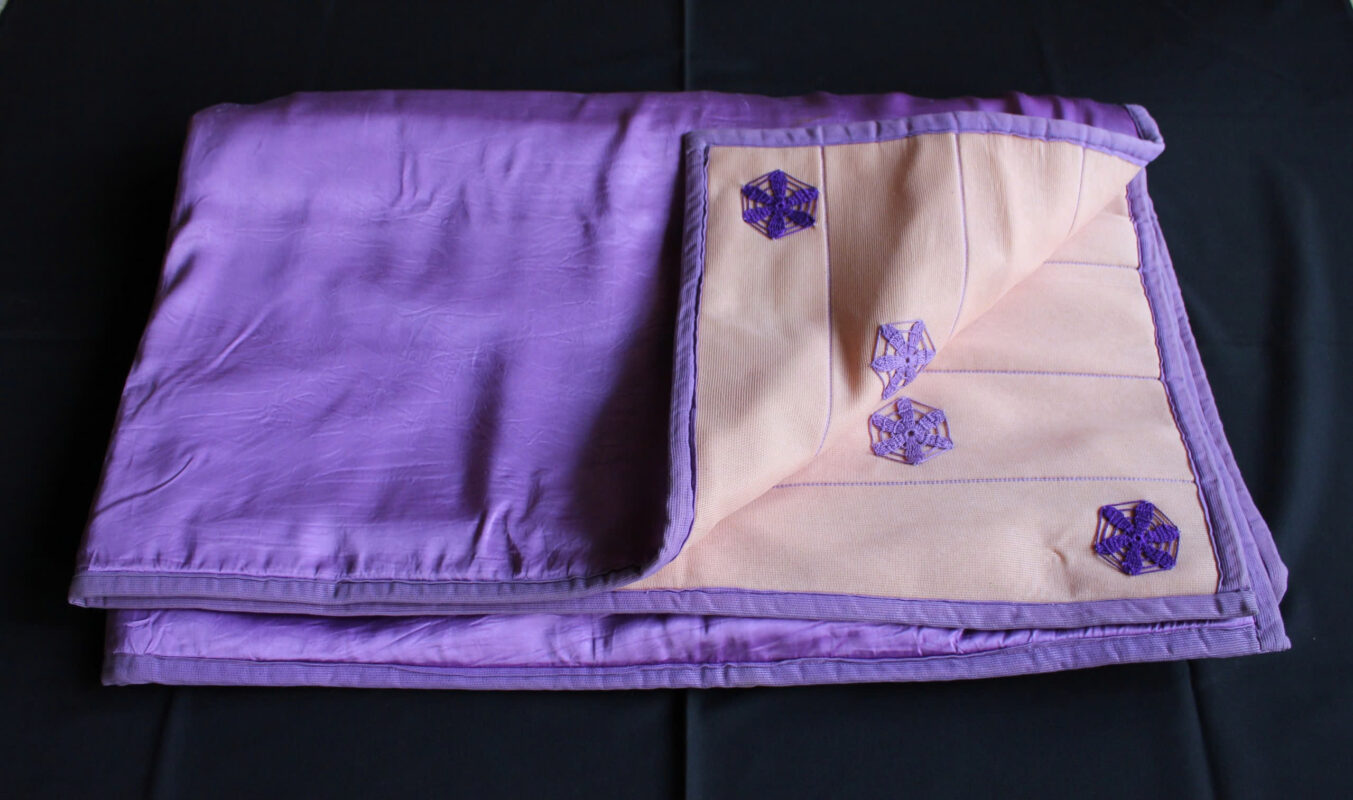
During her revolutionary activities, in 1965, Ms. Nguyen Thi Thap attended the Third Chinese Women's Congress in Beijing. Before leaving, she visited President Ho Chi Minh and President Ton Duc Thang. She noticed that President Ho Chi Minh's blanket was very old and worn in places, so she intended to buy a new one for him. However, fearing President Ho Chi Minh would find out, she asked Comrade Vu Ky (then President Ho Chi Minh's secretary) to measure the size of his blanket so she could buy the correct size.
During her time attending the Chinese Women's Congress, Ms. Nguyen Thi Thap bought this blanket and brought it as a gift to President Ho Chi Minh upon her return to Vietnam. Later, President Ho Chi Minh gave it back to Ms. Nguyen Thi Thap for her use, and she kept the blanket as a memento at home.
This "blanket" is made of satin fabric, cotton thread, and foam (the satin fabric has some frayed areas of about 1cm), measuring 177cm x 115cm. The blanket has two layers, with foam padding in between, and a layer of orange cotton thread on top with a purple floral pattern. It was hand-sewn using a sewing machine. This was a gift from Mrs. Nguyen Thi Thap to President Ho Chi Minh, and he later gave it to her for his own use.
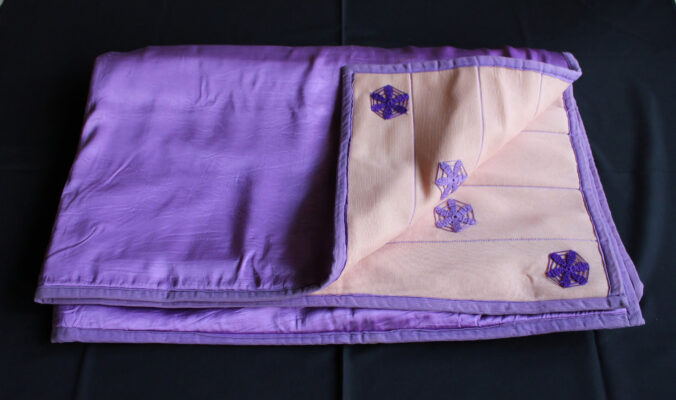
THE "BLANKET" THAT MRS. NGUYEN THI THAP GAVE TO PRESIDENT HO CHI MINH
In March 1997, Ms. Le Ngoc Thu – daughter of Comrade Nguyen Thi Thap – donated this artifact to the Ton Duc Thang Museum for safekeeping and preservation. With the aim of preserving and promoting the value of cultural heritage related to the great President Ho Chi Minh, the Ton Duc Thang Museum transferred the artifact to the Southern Women's Museum on February 28, 2005 (under the direction of the Board of Directors of the Ho Chi Minh City Department of Culture and Information). Attached is the artifact's file, bearing inventory number 149.
Ho Chi Minh City, March 3, 2025
Pham Tuan Truong
Department of Communications, Education and International Relations
Source: https://baotangphunu.com/ba-nguyen-thi-thap-and-the-bedding-blanket-for-chairman-ho-chi-minh/

![[Live] 2025 Community Action Awards Gala](/_next/image?url=https%3A%2F%2Fvphoto.vietnam.vn%2Fthumb%2F1200x675%2Fvietnam%2Fresource%2FIMAGE%2F2025%2F12%2F16%2F1765899631650_ndo_tr_z7334013144784-9f9fe10a6d63584c85aff40f2957c250-jpg.webp&w=3840&q=75)
![[Photo] Prime Minister Pham Minh Chinh receives the Governor of Tochigi Province (Japan)](/_next/image?url=https%3A%2F%2Fvphoto.vietnam.vn%2Fthumb%2F1200x675%2Fvietnam%2Fresource%2FIMAGE%2F2025%2F12%2F16%2F1765892133176_dsc-8082-6425-jpg.webp&w=3840&q=75)
![[Image] The tenacious fighting spirit of Vietnamese women's football](/_next/image?url=https%3A%2F%2Fvphoto.vietnam.vn%2Fthumb%2F1200x675%2Fvietnam%2Fresource%2FIMAGE%2F2025%2F12%2F17%2F1765990260956_ndo_br_4224760955870434771-copy-jpg.webp&w=3840&q=75)


























































Comment (0)