

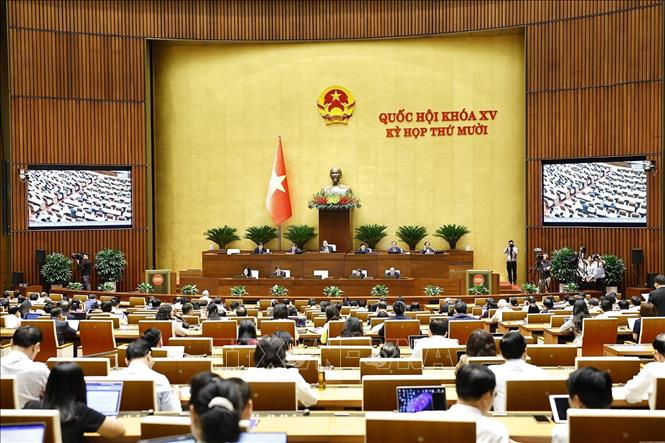
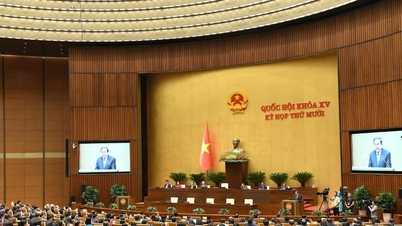
In his report explaining, addressing, and clarifying issues of concern to National Assembly deputies, Minister of Agriculture and Environment Tran Duc Thang stated that the deputies' opinions clearly demonstrated the responsibility, vision, and support of the National Assembly, serving as an important source of encouragement and motivation for the Government, the Ministry of Agriculture and Environment, and other ministries, sectors, and localities to continue innovating and improving the effectiveness of law enforcement.
Minister Tran Duc Thang stated that the 2020 Environmental Protection Law marks a significant step forward in Vietnam's sustainable development thinking and approach, affirming the spirit of innovation and action for a green future. The law has designed many groundbreaking policies, clearly shifting from a passive approach of dealing with consequences to a proactive approach of preventing and controlling risks and promoting market-based economic tools.
After nearly four years of implementation, significant progress has been made in environmental protection. Many new mechanisms and policies have begun to show effectiveness, such as changes in management methods, expanding the responsibility of manufacturers in recycling and waste treatment, and promoting community participation in monitoring. In practice, many green development models, eco-cities, and circular industrial zones have been established; the application of digital technology and automated monitoring has expanded; environmental quality in many areas has improved; and awareness throughout society has significantly shifted.
Regarding air pollution, the Ministry of Agriculture and Environment has submitted to the Prime Minister the National Action Plan for the period 2026-2030, proposing comprehensive solutions ranging from improving institutions to controlling emission sources and transitioning to green transportation.
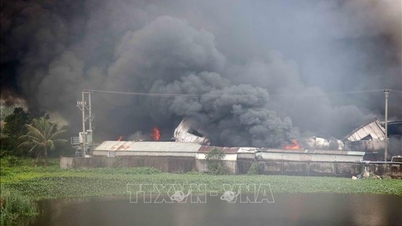
Regarding the development of the carbon market, the legal framework has been largely established, and it is expected that in 2025, the Government will issue three related decrees to create a basis for businesses to implement the plan. The Minister also frankly acknowledged the shortcomings and limitations pointed out by the Supervisory Delegation and the delegates, such as the continued complexity of environmental degradation, the unresolved issues of air pollution and pollution in some river basins, and the limited waste treatment infrastructure. The subjective causes identified are mainly due to the lack of specific policies, insufficient capacity of officials, and low investment resources.
To overcome these limitations, in the coming period, the Ministry of Agriculture and Environment has identified key areas for breakthroughs in institutions, policies, and laws, focusing on the economic aspects of the environment; breakthroughs in waste management, addressing bottlenecks and promoting the circular economy; breakthroughs in science and technology and digital transformation, modernizing the monitoring system and building a carbon trading platform; and strengthening communication efforts, raising awareness, and building a team of highly skilled environmental management officials.
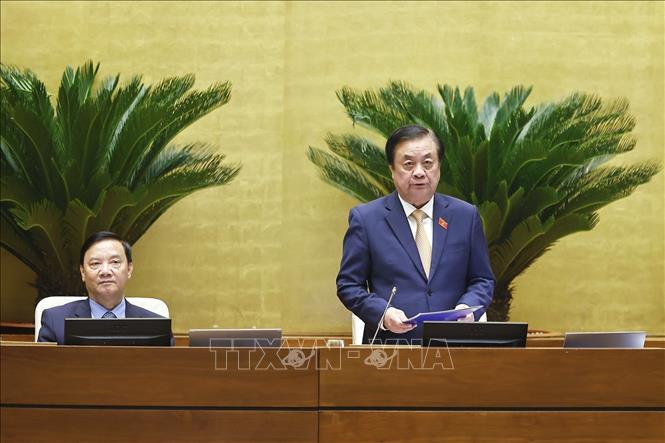
Concluding the discussion session, Vice Chairman of the National Assembly Le Minh Hoan emphasized that the Party and State of Vietnam have always advocated environmental protection as a crucial pillar of sustainable development, and have issued numerous resolutions and directives to strengthen environmental protection efforts. The State's system of policies and laws on environmental protection is consistent, comprehensive, and regularly reviewed, supplemented, and perfected to suit the country's realities and the development trends of the times.
Deputy Speaker of the National Assembly Le Minh Hoan stated that while environmental protection previously focused primarily on preventing and treating pollution, the current requirement is to create new development values based on harmony between humans and nature. Environmental protection does not equate to the cost of growth. Environmental protection is a responsibility and duty to preserve and promote natural resources, closely integrated within the new development space. Controlling emissions, treating waste, recycling, and reusing must become links in a circular economy ecosystem. The world is entering a phase where the green economy is no longer just a concept but is gradually becoming a national competitive advantage. Each locality should be considered a green incubator, a testing ground for and a place to disseminate models of circular economy, ecological tourism, community tourism, and low-emission agriculture.
While acknowledging the commendable figures on waste treatment, recycling rates, and the development of eco-industrial parks, Deputy Speaker of the National Assembly Le Minh Hoan emphasized that it is more important to transform these results into social awareness and a new driving force for development. Environmental protection will be difficult to succeed if it relies solely on laws, measures, and sanctions.
Environmental protection requires systemic thinking and systemic action. Environmental protection is not just the responsibility of the State, but of every citizen; it needs to be rooted in the awareness and daily behavior of each individual. Each of us is not only complying with environmental protection laws but is also protecting ourselves, preserving and creating a living environment for our families, loved ones, communities, and above all, the future of generations to come.
The opinions focused on analyzing the achievements, shortcomings, and limitations; at the same time, they contributed many solutions to improve policies and laws, overcome bottlenecks in implementation, with the motto of prioritizing the protection of the living environment and people's health, resolutely eliminating projects that cause environmental pollution, and working together for sustainable development.
Deputy Speaker of the National Assembly Le Minh Hoan stated that the opinions of the National Assembly deputies have been fully compiled. The Standing Committee of the National Assembly will direct the Supervisory Delegation and relevant agencies to study and incorporate these opinions to finalize the draft Supervisory Resolution for submission to the National Assembly for consideration and approval…
Source: https://baotintuc.vn/thoi-su/bao-ve-moi-truong-can-ben-re-trong-nhan-thuc-cua-moi-cong-dan-20251028183205080.htm




































































Comment (0)