Chau Thuan Bien village, Binh Chau commune, Binh Son district, Quang Ngai province has long been known as the "ancient artifact fishing village," because the fishermen here possess many valuable artifacts salvaged from ancient shipwrecks far out at sea.
There are artifacts over 600 years old.
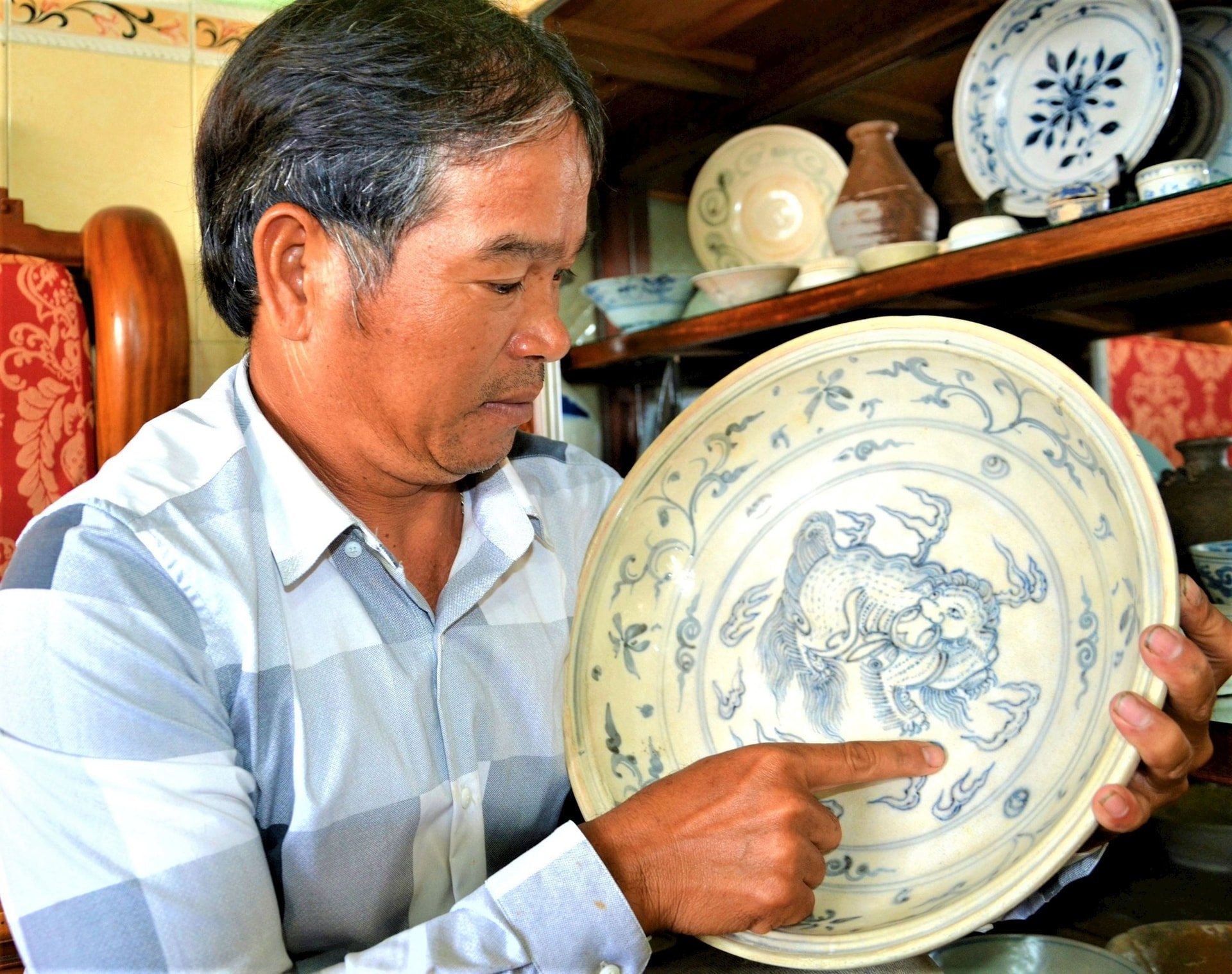
We visited the family of Mr. Truong Trang in Chau Thuan Bien village, a renowned figure in the fishing village for his collection of approximately 300 ceramic items of various kinds, produced from the 15th to 17th centuries. Among them are many valuable antiques that have been authenticated, such as Chu Dau ceramic cups and plates dating back over 500 years, or jars, vases, and powder containers dating back 300 to 500 years.
According to Mr. Trang, the sea area of Chau Thuan Bien village is also known as Vung Tau . In the past, many ships traded goods through this area. Natural disasters, fires, and storms at sea have caused many ships to sink, burying hundreds or thousands of artifacts at the bottom of the sea.
In 2012, fishermen in the village discovered an ancient shipwreck with a large amount of pottery and porcelain. Excavations revealed that the ship had caught fire before sinking, and inside were coins dating from 1264-1295.
In 2014, another ancient shipwreck was discovered with numerous artifacts, including bowls, plates, and dishes dating back to the early 17th century…
Holding a 17th-century blue and white porcelain bowl with a carp-transforming-into-dragon motif, Mr. Trang explained that he exchanged four cans of engine oil, worth 4 million dong. "I built this collection from that careful saving. Every beautiful antique I wanted to buy or exchange for, because they contained the values of time and history – incredibly precious cultural heritage," Mr. Trang shared.



Nguyen Van Vuong, also from Chau Thuan Bien village, said that this place is famous as a "village of antiques" because every house has ceramic vases, jars, cups, and bowls of various ages. Hundreds of households collect antiques. What is unique and valuable is that people mainly bring them home to display rather than sell.
Holding a ceramic bowl in his hand, Mr. Vuong recounted: “I found this while diving for seafood; the original patterns and designs are still intact. Many people, while diving or casting nets, often retrieve fragments of ceramics, earthenware jars, and charred wooden planks from ships. Some also find artifacts washed ashore after each storm season. Of course, people discover and collect them by chance, but when a shipwreck is identified as containing ancient artifacts, the authorities will organize protection and plan for salvage and preservation.”
"Not only do I enjoy collecting intact ceramic pieces, but I also love bringing home broken pieces to decorate my house. Each piece has its own unique pattern and design. Gradually, I learned more about the meaning of the patterns, the age of the ceramics, and I appreciate what I have even more," Mr. Vuong confided.
The villagers do not buy or sell antiques.
Not only Mr. Trang and Mr. Vuong, but many other villagers in Chau Thuan Bien hamlet said that people in the village do not buy or sell antiques, but only exchange them with each other according to their interests. Or they exchange antiques for fishing gear, engine oil, etc.
According to Mr. Phung Ba Vuong, Chairman of the People's Committee of Binh Chau commune, in Ganh Ca hamlet, Chau Thuan Bien village, out of nearly 300 households, more than 150 are involved in collecting and displaying antiques. Since 1999, thousands of artifacts discovered from shipwrecks in the Binh Chau sea area have been collected and displayed by local residents.
"Most of the antiques collected by local fishermen were acquired while they were diving in the waters of Vietnam's Hoang Sa and Truong Sa islands, or in the waters around Cu Lao Cham and Hoi An city, Quang Nam province," Mr. Vuong said.
Mr. Vo Hoai Nam, Chairman of the Quang Ngai Provincial Cultural Heritage Association, said: "In Ganh Ca hamlet, there are up to 30 people participating in the Provincial Cultural Heritage Association. Most of them are very knowledgeable about antiques, especially ceramics."
According to Mr. Nam, determining the age of an antique object relies on details of its patterns. For example, the cracked glaze, the date, symbols, motifs, etc. Then, based on that and the knowledge gained from reading, one can determine which era it belongs to, and which king ruled it.



According to Dr. Doan Ngoc Khoi, Deputy Director of the Quang Ngai Provincial Museum, experts have discovered many ancient shipwrecks in the Binh Chau sea area, but only two have been excavated so far. These shipwrecks are located about 200 meters from the shore, at a depth of about 5 meters. Archaeologists recovered many artifacts from the shipwreck excavated in 2013, dating back to the 14th century. The artifacts from the shipwreck excavated in 1999 mainly date from the 17th century. The excavation of these artifacts is valuable material for Vietnam's underwater archaeology.
Dr. Khoi added that archaeological experts believe the Binh Chau sea area once had a bustling trading port. Ships entering Binh Chau to exchange goods were either caught fire or sunk by storms. Therefore, this area has many ancient shipwrecks. Today, the people of Binh Chau, while working at sea, collect ancient artifacts and bring them home to display for tourists visiting the area.
As we left Gành Cả hamlet, Châu Thuận Biển village, we were deeply impressed by this land, by the fishermen who tirelessly work at sea day and night, preserving ancient artifacts. They have transformed Gành Cả hamlet, Châu Thuận Biển, into a highly valuable "ancient artifact fishing village," a destination for tourists wishing to visit and learn about precious artifacts.
Mr. Nguyen Tien Dung, Director of the Department of Culture, Sports and Tourism of Quang Ngai province, said that households in Ganh Ca hamlet currently preserve and safeguard many valuable ancient artifacts. Recently, the department has collaborated with the Binh Son Heritage Association to develop a community-based tourism destination – an ancient artifact village – in Binh Chau. We have chosen this as a destination for tourists to visit and study ancient artifacts. It's a very special place that not every location possesses.
Source: https://daidoanket.vn/bi-an-co-vat-o-mot-lang-chai-10301707.html


![[Image] Overview of the construction site for the underground station of metro line 5 at the Hanoi Ring Road 1 intersection.](https://vphoto.vietnam.vn/thumb/1200x675/vietnam/resource/IMAGE/2026/07/03/1783065595682_ndo_br_z7974930852369-100ca093c306e72675f1d3700966a86b-jpg.webp)