

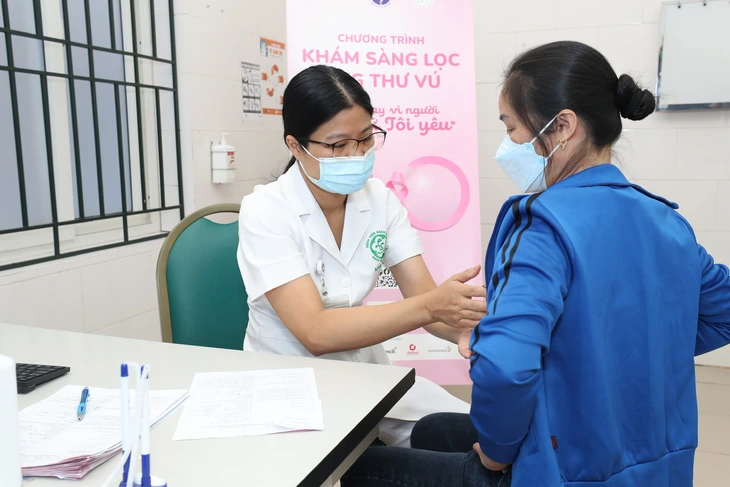
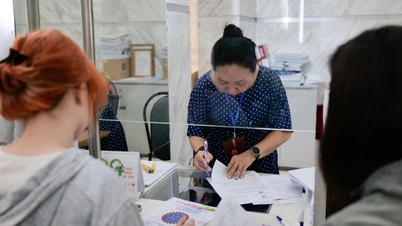
Doctors conduct breast cancer screenings as part of the "Joining Hands for the Woman I Love" program. Currently, HER2-positive breast cancer treatment drugs are included in this partially subsidized medication program - Photo: Provided by the hospital.
The program has been running for many years, with a large number of participants. The drugs included are all new and expensive (for treating cancer, rare diseases, etc.), costing billions of VND per year per patient. Without support, very few patients would be able to access them.
One side argues it's due to the law, the other asserts it's due to the way it's implemented.
According to some stakeholders, the reason the program is at risk of being stopped is due to regulations in Article 42 of the current Pharmaceutical Law. The current regulations only allow full drug support programs, not partial support, while 19 out of 20 drug support programs to date have only provided partial support.
However, relevant agencies within the Ministry of Health still have differing opinions on how to resolve this issue. Specifically, the Health Insurance Department has proposed amending Article 42 of the Pharmaceutical Law to allow for the continuation of partial drug support programs (since July 1, 2025, three drug support programs have had their new approvals suspended).
Meanwhile, some argue that not only the current Pharmaceutical Law, but also Clause 1, Article 88 of the Commercial Law stipulates that promotional activities "are activities to promote the buying and selling of goods and services by offering customers certain benefits." The regulations in this law and Article 5 of Decree 81/2018 do not permit the promotion of medicinal drugs.
Therefore, even if Article 42 of the Pharmaceutical Law is amended, the Commercial Law will still not allow the promotion of pharmaceuticals.
This expert stated that they have been monitoring the implementation of drug support programs over the past period and have observed that the Law on Pharmaceuticals stipulates that drug support programs fall under the authority of the Minister of Health. The main difficulties and obstacles stem from the implementation process of the regulations in Circular No. 31/2018 and practical implementation, ensuring both the humanitarian purpose of drug support and compliance with the Commercial Law, without violating regulations prohibiting the promotion of medicinal drugs.
Experts believe that an impact assessment of partial drug support programs is needed. For the 20 programs already implemented, in addition to the reported funding, it is necessary to clarify how many patients participated and the program's effectiveness.
"The essence of the medication support program is partly financial support to reduce the amount of money patients have to pay. Therefore, in addition to supporting medication, the financial support solution also needs to consider supporting other costs such as diagnostic imaging, laboratory tests, and chemotherapy..." - the expert said.
How can medication support be provided so that patients can continue to receive their prescribed medication?
Speaking to Tuoi Tre Online , an expert from the Ministry of Health suggested that the fundamental solution to continue maintaining the drug support program is for pharmaceutical companies to provide support packages to medical facilities based on the total annual projected quantity (according to the results of the bidding process, or the quantity used in the previous year).
"Depending on each company's support policy, hospitals may purchase 10 units but only have to pay 5 or 7 of the cost of the medicine on the invoice, while the selling price remains unchanged compared to other countries," this expert shared.
Upon investigation, it was found that all the drugs in the program are licensed for circulation. Therefore, this expert believes that the Ministry of Health does not need to approve each program individually, but only needs to establish a legal framework for pharmaceutical companies to coordinate with healthcare facilities and proactively implement each program according to its scale.
The hospital proactively organizes and implements a medication support program for patients, establishing regulations and coordinating with the company to create criteria for patient selection. The percentage of medication support received is calculated based on the total amount of medication the patient has used, ensuring the same rate for all patients.
The hospital calculates the cost of the medication based on the purchase price of the drugs and the company's subsidy. This reduces the actual cost patients pay when they receive support. Humanitarian support can also be provided through funds such as the Cancer Patient Support Fund - A Brighter Tomorrow...
"The programs have been very effective for patients, but the next phase requires a new approach that is more in line with current regulations," shared an expert from the Ministry of Health. However, the Ministry of Health also suggested that the regulations currently hindering drug support need to be amended.
Given the risk that over 10,650 patients may have their medication interrupted, relevant agencies need to reach a consensus soon to avoid affecting patients' treatment.
Source: https://tuoitre.vn/cach-nao-de-nguoi-benh-hiem-ngheo-dang-dung-thuoc-dat-tien-tiep-tuc-nhan-ho-tro-20251025134318025.htm

![[Photo] Prime Minister Pham Minh Chinh receives the Governor of Tochigi Province (Japan)](/_next/image?url=https%3A%2F%2Fvphoto.vietnam.vn%2Fthumb%2F1200x675%2Fvietnam%2Fresource%2FIMAGE%2F2025%2F12%2F16%2F1765892133176_dsc-8082-6425-jpg.webp&w=3840&q=75)
![[Live] 2025 Community Action Awards Gala](/_next/image?url=https%3A%2F%2Fvphoto.vietnam.vn%2Fthumb%2F1200x675%2Fvietnam%2Fresource%2FIMAGE%2F2025%2F12%2F16%2F1765899631650_ndo_tr_z7334013144784-9f9fe10a6d63584c85aff40f2957c250-jpg.webp&w=3840&q=75)

![[Image] Leaked images ahead of the 2025 Community Action Awards gala.](/_next/image?url=https%3A%2F%2Fvphoto.vietnam.vn%2Fthumb%2F1200x675%2Fvietnam%2Fresource%2FIMAGE%2F2025%2F12%2F16%2F1765882828720_ndo_br_thiet-ke-chua-co-ten-45-png.webp&w=3840&q=75)
![[Photo] Prime Minister Pham Minh Chinh receives Lao Minister of Education and Sports Thongsalith Mangnormek](/_next/image?url=https%3A%2F%2Fvphoto.vietnam.vn%2Fthumb%2F1200x675%2Fvietnam%2Fresource%2FIMAGE%2F2025%2F12%2F16%2F1765876834721_dsc-7519-jpg.webp&w=3840&q=75)































































Comment (0)