

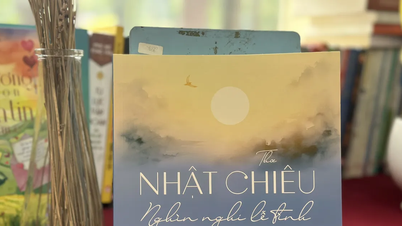
"Tuyệt Duyên" (Fatal Love) is a collection of 9 contemporary short stories by 9 prominent young authors in Asia, selected and published in both Japanese and Korean by Shogakukan (Japan) and Munhak Dongne (Korea). The Vietnamese translation of "Tuyệt Duyên," by Tama Duy Ngọc and published by NXB Trẻ (Youth Publishing House), has just been released to the public.
The nine authors featured in *Tuyệt Duyên* are all prominent contemporary young writers who have achieved considerable commercial success and received high praise from critics, including: Sayaka Murata (Japan); Alfian Sa'at (Singapore); Hac Canh Phuong (China); Wiwat Lertwiwatwongsa (Thailand); Han Le Chau (Hong Kong-China); Lhacham Gyal (Tibet-China); Nguyen Ngoc Tu (Vietnam); Lien Minh Ve (Taiwan-China); Chung Serang (Korea).


According to translator Tama Duy Ngoc, "Severing Connections" means cutting off, severing a karmic connection or relationship with a person, many people, a place, or even the whole world. In this anthology, "Severing Connections" is both the title and the key word that carries the main theme throughout the work. In today's era, connection and separation have become commonplace between people. We connect hastily and part just as quickly. The very concept of homeland has become blurred as modern people constantly move along with migration flows. There are times when a severed connection is decisive and leaves no trace of attachment, but there are also many times when it brings immense suffering, leaving a bitter taste that is hard to forget for a lifetime. Set in diverse contexts—sunny lands, rainy lands, dreamlands, real lands, peaceful lands, chaotic lands—each story is a painting, some fierce, some gentle, frankly revealing all the pain, conflict, and resentment deep within the soul. Everything is so intertwined and complex, and the human psyche has never been so brutally exposed.
The writers selected for this anthology, though young, possess a wealth of potential from across Asia, and they have raised a unified voice about how people confront the past, present, and future, and the turning points of their lives.
The writers selected for this anthology, though young, possess immense potential and have raised a unified voice on how people confront the past, present, and future, and the turning points of their lives. Evil must be exposed to its fullest extent, but the inherent goodness within ourselves will forever be celebrated. Where there is separation, there is connection. Where there is despair, there is hope.
Nine stories offer nine cultural perspectives from different regions across Asia, each with its own interpretation of the phrase "a tragic fate." From innocent children hesitantly entering adolescence, to frustrated young people, to mothers and wives burdened with deep-seated sorrows... to the scars on the mind, generational conflicts, social injustice, racial prejudice, and the turmoil of war, etc.
Writer Nguyen Ngoc Tu represents Vietnam in this anthology with her short story "Escape." It's a story of a mother's soul, on the verge of leaving her physical body, reflecting on her lifelong sacrifices for her children. In her final moments, the mother realizes, "When you give birth to your first child, you realize that a mother can hardly escape from her child, even if the child actively abandons her. Even if the mother heartlessly abandons her child on the roadside, the child will still follow her to the end. As long as she has her memory, she will never forget the tiny creature she warmed in thick blankets, the one whose first encounter left both her and the child scarred," Nguyen Ngoc Tu writes.
Nguyen Ngoc Tu is one of the leading young writers of contemporary Vietnamese literature, with a series of short stories, novellas, and essays highly praised by literary critics. She has won numerous literary awards both domestically and internationally, and many of her works have been adapted into plays and films.
Most recently, Nguyen Ngoc Tu was awarded the "20th Outstanding Southeast Asian Literature Award 2024" selected by the Dianchi Literature magazine (China).
Source

![[Photo] The courage of new recruits of Brigade 144 on the training ground.](https://vphoto.vietnam.vn/thumb/1200x675/vietnam/resource/IMAGE/2026/05/27/1779881651341_anh-man-hinh-2026-05-27-luc-18-32-52.png)
![[Photo] The heat at the fireworks display site on the opening night of the Da Nang International Fireworks Festival 2026](https://vphoto.vietnam.vn/thumb/1200x675/vietnam/resource/IMAGE/2026/05/27/1779889741485_ndo_br_z7872039145157-fecaba5112f39e8352544099d7ef4738-5140-jpg.webp)





































![[Photo] The courage of new recruits of Brigade 144 on the training ground.](https://vphoto.vietnam.vn/thumb/402x226/vietnam/resource/IMAGE/2026/05/27/1779881651341_anh-man-hinh-2026-05-27-luc-18-32-52.png)






















Comment (0)