

Russia turned the fields in front of its front lines into the world's largest minefield, making it extremely difficult for Ukrainian soldiers to counterattack.
One day in early June, a convoy of Bradley armored vehicles rumbled across the fields, heading towards a village in Zaporizhzhia province where Russian forces were entrenched in their defensive positions. Riding these modern American armored vehicles were soldiers from the elite 47th Brigade, trained in the West and serving in Ukraine's counteroffensive.
But unexpectedly, one of the armored vehicles in the convoy struck a mine and its tracks snapped, leaving it immobile in the field. Realizing they had entered a "killing field," where Russian forces had laid countless mines, the entire Ukrainian convoy quickly changed course and retreated.
Three weeks after launching its highly anticipated counteroffensive aimed at pushing Russian forces out of Ukrainian territory, the Ukrainian army is facing a series of challenges that are significantly hindering its plans, the most troublesome of which are the minefields laid by the enemy.
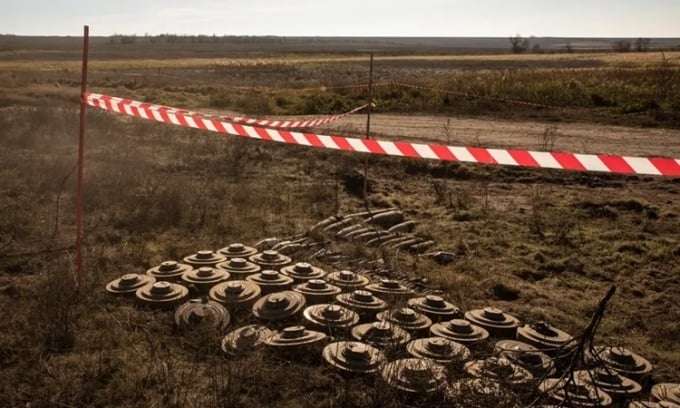
Dozens of landmines were recovered at a stockpile in Kherson, southern Ukraine, last November. Photo: Guardian
"Everywhere is mined," said Lieutenant Ashot Arutiunian, commander of a Ukrainian unmanned aerial vehicle (UAV) unit. From the camera on his UAV, Lieutenant Arutiunian witnessed modern Western armored vehicles being destroyed by anti-tank mines, while many of his comrades were instantly wounded by stepping on anti-personnel mines.
Russia recently released a UAV video showing a Ukrainian assault unit being almost completely neutralized by minefields as they disembarked from armored vehicles onto a field in front of Russian lines. Butterfly mines and anti-personnel mines exploded in quick succession, incapacitating the Ukrainian soldiers before they could fire a single shot.
With its massive stockpile of mines, Russia has turned the fields in front of a 1,000-kilometer-long front line in southern and eastern Ukraine into a giant minefield. Ukrainian Prime Minister Denys Shmyhal said earlier this year that Russia had created "the world's largest minefield" in the country.
Experts estimate that approximately 170,000 square kilometers of Ukrainian territory are currently mined with anti-tank or anti-personnel mines, nearly six times the area of Belgium.
"We are seeing Russia laying mines on an industrial scale," said Michael Newton, head of the mine clearance organization under Ukraine's HALO Trust program.
According to a report from the Royal United Services Institute of the UK, Russian forces are using a combination of anti-tank and anti-personnel mines in these "fields of death." These mines vary widely, from TM-62 mines that only detonate when tanks or armored vehicles pass over them, to the advanced PTKM-1R mines capable of penetrating the tops of military vehicles.
These minefields are a nightmare for Ukrainian tank crews. Several videos posted on Russian social media show Leopard 2 and Bradley tanks lying motionless in the middle of a field, tracks scattered around, indicating they had run over mines during the Ukrainian counterattack.
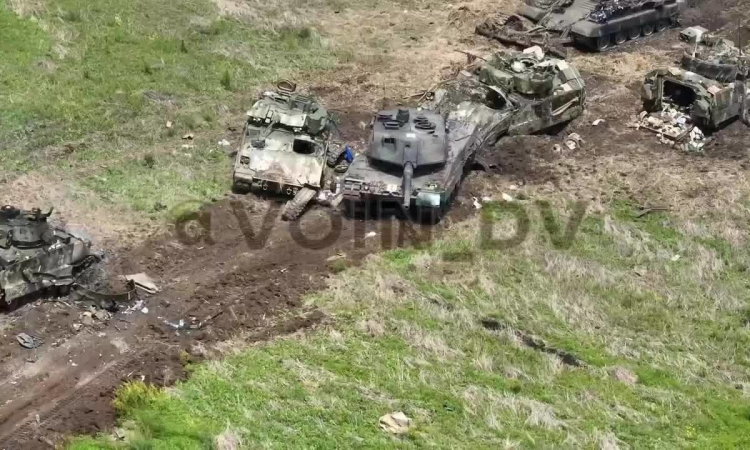
Ukrainian tanks and armored vehicles hit mines during a counterattack on the Orekhov front in Zaporizhzhia province. Video: Telegram/Voin_Dv
According to the Oryx website, which compiles losses for both Russia and Ukraine in the war, Ukraine has lost at least 16 Bradley armored vehicles, 4 Leopard 2 tanks, and two AMX-10 RC light tanks out of 109 vehicles delivered by the West.
Western military officials are interested not only in the scale of Russia's minefields but also in the tactics used to deploy them. Contrary to long-held beliefs, the minefields are not designed to prevent people and vehicles from passing through, but rather to direct enemy formations to a predetermined area where Russian artillery is ready to unleash its firepower.
"We laid mines in certain areas to shield our flanks and prevent the enemy from breaking through," a Russian soldier said in a video posted by the Russian Ministry of Defense on Telegram last month.
This tactic appears to have been very effective for the Russian military.
"In some cases, Ukrainian forces managed to cross unminefields, closing in on the Russian lines. At that point, Russian soldiers proactively withdrew from their defensive positions. As soon as the Ukrainian soldiers took control of the positions, Russian artillery and missiles rained down on those very spots," explained Stephane Audrand, a French military consultant.
A Ukrainian military official said that in many places along the front line, their forces are having to halt their advances to reassess which tactics are most effective.
"They dug trenches, planted mines, and prepared everything very thoroughly," said Yevhen, a private in a Ukrainian paramilitary police unit. "It was difficult, but there was no other choice."
Ukrainian Defense Minister Oleksii Reznikov declared on June 25 that the counteroffensive over the past three weeks "constitutes some preparatory activities," not the main offensive. However, he also acknowledged that Russian forces "have established very strong defensive lines" and that the counteroffensive is being "overly anticipated."
Minefields are often difficult to detect, even by soldiers on the ground or through satellite imagery analysis. However, experts believe Russia has almost certainly laid mines along its defensive fortifications.
"The usefulness of these fortifications would be significantly reduced if they were not combined with minefields," said Pasi Paroinen, an analyst at Black Bird Group, Finland.
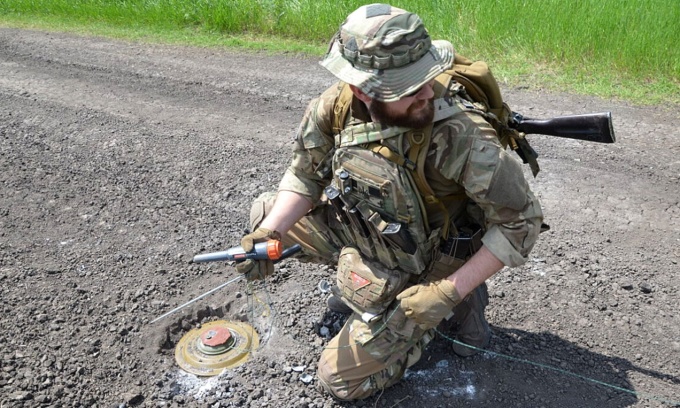
A Ukrainian soldier is defusing a landmine planted on the road. Photo: Ukrainian Ministry of Defense.
According to Matthew VanDyke, founder of Sons of Liberty International, a Washington-based organization that has sent American veterans to train Ukrainians in mine removal, there are few ways to deal with landmines while hostilities are ongoing.
"Soldiers don't have enough time to detect and neutralize mines if they're constantly being fired upon by the enemy," he said. "So the general rule is to stay as far away from them as possible."
Vu Hoang (Based on Moscow Times, Washington Post, Le Monde )
Source link
![[Photo] Two flights successfully landed and took off at Long Thanh Airport.](/_next/image?url=https%3A%2F%2Fvphoto.vietnam.vn%2Fthumb%2F1200x675%2Fvietnam%2Fresource%2FIMAGE%2F2025%2F12%2F15%2F1765808718882_ndo_br_img-8897-resize-5807-jpg.webp&w=3840&q=75)




























































































Comment (0)