

The newly discovered site has clusters of hydrothermal vents 10-15 m high and is home to many animal species.
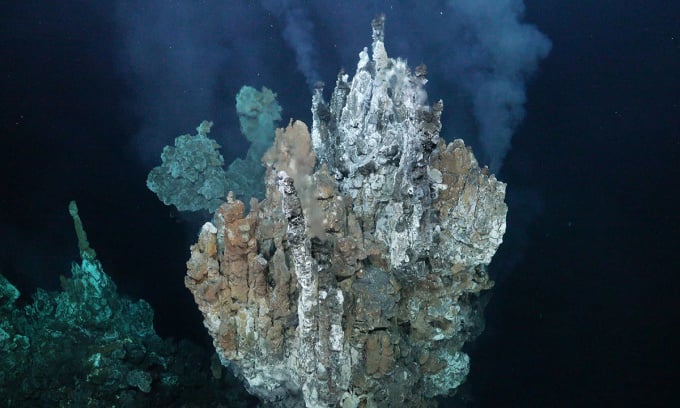
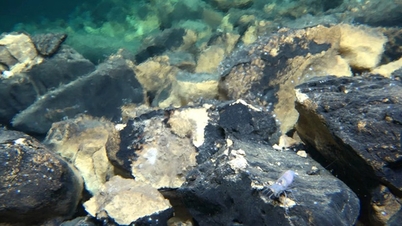
Scientists have discovered clusters of hydrothermal vents as tall as a four-story building on the seabed. Photo: ROV SuBastian/Schmidt Ocean Institute
During a 30-day sea expedition, a team of scientists aboard the research vessel Falkor (too) discovered a 600-meter-long area of hydrothermal vents, each as tall as a four-story building, near the Galápagos Islands, Ecuador, Live Science reported on December 1st. This hydrothermal vent field is located on the western edge of the underwater volcano Los Huellos East, according to the Schmidt Ocean Institute.
Using two high-resolution tools, the research team mapped the newly discovered field with astonishing detail. The area features numerous clusters of hydrothermal vents rising 10-15 meters above the seabed and spewing hot liquid. The surrounding seabed is teeming with animals, including 15 species never before seen in such an area. Among these is Monoplacophoran – a small, starfish-like mollusk that has remained virtually unchanged throughout its evolution.
"These incredibly detailed maps were created using the most advanced technology. The area they depict and the complexity of the seabed they reveal are truly extraordinary," said Jyotika Virmani, executive director of the Schmidt Ocean Institute.
During the expedition, the Falkor (too) also returned to a "nursery" for Pacific white stingrays ( Bathyraja spinosissima ) in a hydrothermal vent field discovered near the Galápagos in 2018. This is one of only two confirmed incubation sites for this species on Earth. The other site, discovered in July 2023 off the coast of Canada, is estimated to contain up to one million stingray eggs.
Additionally, the research team revisited the first hydrothermal vent field discovered on Earth and mapped in 1977. This field, known as Rose Garden, is located along the Galápagos Fault. The research team aboard the Falkor (too) spacecraft mapped Rose Garden with a resolution of 3 cm. They also created sonar images (a technology that converts sound into visual images), helping them understand how hydrothermal activity changes over time.
Thu Thao (According to Live Science )
Source link






















![[Video] The craft of making Dong Ho folk paintings has been inscribed by UNESCO on the List of Crafts in Need of Urgent Safeguarding.](https://vphoto.vietnam.vn/thumb/402x226/vietnam/resource/IMAGE/2025/12/10/1765350246533_tranh-dong-ho-734-jpg.webp)
















































Comment (0)