

It is said that no success in any career can compensate for failure in raising children, so in reality, for parents, raising children is a top priority. As parents, we should ask ourselves how well we have achieved in the process of raising our children? If raising children were a homework assignment, what would your score be?
During the process of raising your children, have you noticed any of the following signs? If so, it proves that your parenting is very successful and your child has already won from the start!
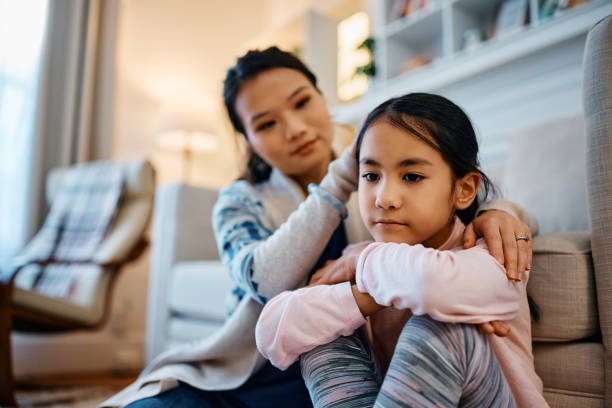
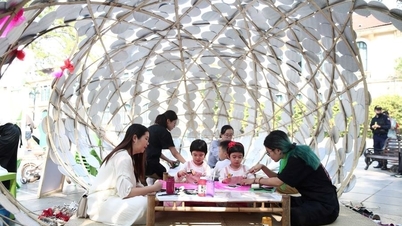
Illustration photo
1. Children can be held responsible.
One person recounted: "My daughter was playing with the neighbor's boy, playfully teasing him and getting chased. My daughter ran as fast as she could and hid safely at home, but the boy was caught and scolded. When I heard about it, I told my daughter: 'Now, if you take your younger sibling out to play and they get into trouble, and you run away, leaving them alone, that's irresponsible behavior.' My daughter cried, hesitated for a long time, and finally ran out to apologize to the boy and bring her sibling home."
The father's timely guidance helped his children learn responsibility. This is a character trait not innate but formed through upbringing. To nurture this quality in children, parents must first be firm in not spoiling them, but instead teach them to take care of themselves and be responsible for their own affairs. For example, let children clean their own rooms, wash their own dirty socks, and complete their schoolwork independently. If children do these things regularly and become accustomed to them, they will no longer feel dependent, and a sense of responsibility will develop naturally.
2. Children follow the rules.
A very "cunning" mother, in situations requiring queuing, would often encourage her son to cut in line to avoid long waits. However, after the child started kindergarten, the teacher required all the children to line up to get supplies. The child, clearly not the first to arrive, wanted to be at the front, which was naturally not allowed, so he started crying. When playing with toys, this child would also snatch toys from other children, and if he didn't get them, he would resort to hitting them. As time went on, the child became "isolated" by his peers, and everyone wanted to avoid him.
There's a saying: Those who disregard the rules will eventually suffer the consequences. Some children always treat rules as if they don't matter, littering, damaging public property, even making noise in crowded places, etc. Although these are children's behaviors, they directly demonstrate a failure in parental upbringing.
Every parent will encounter various challenges during their child's development. Establishing some rules from a young age can make parenting somewhat easier.
3. Children may express a wide range of emotions in front of you.
Generally, the closer you feel to someone, the easier it is to express your emotions in front of them. Similarly, if children feel familiar and safe with their parents psychologically, they will dare to express a wider range of emotions, especially negative emotions like anger and sadness.
If a child shows little emotion in front of their parents, or only displays a certain type of emotion, it indicates something is wrong in the parent-child relationship. Therefore, mothers shouldn't blame their children for losing their temper, nor should they assume that children who like to whine are spoiled. Instead, you need to teach your child how to control their emotions so they can develop the best communication skills.
4. Turn to a friend when you're facing a difficult problem.
In psychology, there exists a type of "secure attachment relationship," where people have an object of faith and attachment, believing that person will support them in any circumstances. Clearly, in the early stages of a child's life, parents are such an ideal object.
Many parents believe that when children encounter any problem and can solve it on their own, it fosters independence. This is true, but not always necessarily so. In fact, many problems children face during their growth are beyond their understanding and ability to solve.
If a child's first reaction is not to seek help from their parents when problems arise, or to try to solve them on their own, it's sometimes not an improvement in their independence, but rather a sign that you, as parents, haven't been successful enough in communicating with them. When your child asks for help, don't get angry or scold them; instead, do your best to help them resolve their issues.
5. Children are not "labeled".
For example, if a child is late today: "Why are you so lazy? You're so sluggish, you won't accomplish anything." Another example: if a child sings off-key: "You have no artistic talent; you're not suited to learning to sing." Or when a child is very nervous walking on a plank bridge, the parents say, "You're such a coward."
Parents often don't realize that scolding, criticism, or expressing worry and disappointment about their children not only makes them feel sad when they are reprimanded or judged, but more importantly, these things have a suggestive effect on children, causing them to act or become that way unconsciously. These things are like seeds sown in a child's soul; they will grow and sometimes even become part of the child's true personality.
Some psychologists argue that countless children gradually develop bad habits due to their parents' misjudgments, ultimately becoming the kind of people their parents describe them to be. The labels parents attach to their children in childhood will follow them throughout their lives. The harm caused by being judged is often far more severe than physical harm.
6. Children are encouraged to do what they enjoy.
When enrolling your child in piano lessons, did you ask for their opinion? Some parents don't allow their children to develop areas of interest, and the "hobbies" they let their children pursue are actually dreams they themselves never fulfilled. Many parents unknowingly use their children as tools to achieve their own dreams, never asking what their children want to do.
If parents don't allow their children to discover their talents and force them to study subjects they're not interested in, the children will fear disappointing their parents and will naturally feel immense pressure during their studies. As a result, the child will live in a stressful environment!
Parents' role is to guide their children, not to make decisions for them. Parents should allow their children the freedom to choose what they want to do, while gradually helping them to identify what they truly enjoy and what is necessary for their future. Imagine, would you want your child to be like you, doing a job they dislike, wanting to quit but not daring to, instead placing their hopes on the next generation? Isn't that a vicious cycle?
3 types of toxic families that make children prone to depression
Source































![[Video] The craft of making Dong Ho folk paintings has been inscribed by UNESCO on the List of Crafts in Need of Urgent Safeguarding.](https://vphoto.vietnam.vn/thumb/402x226/vietnam/resource/IMAGE/2025/12/10/1765350246533_tranh-dong-ho-734-jpg.webp)

























































Comment (0)