

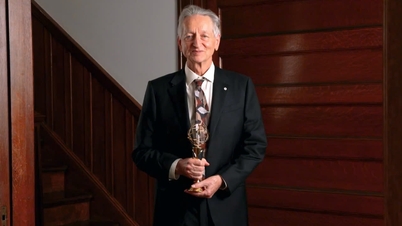
(NLDO) - Professor Geoffrey E. Hinton (Canada), the winner of the Vinfuture 2024 main prize, has just received the 2024 Nobel Prize in Physics.
This is the fifth scientist to receive the Vinfuture Prize and be awarded the Nobel Prize. Previously, Professor Katalin Karikó and Professor Drew Weissman, recipients of the 2021 Vinfuture Prize; and Dr. Demis Hassabis (UK) and Dr. John Jumper (USA), recipients of the 2022 Vinfuture Prize, were also awarded the Nobel Prize.
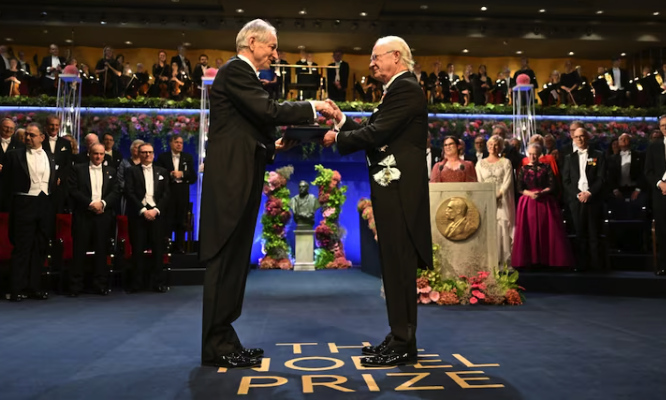
Professor Geoffrey E. Hinton (Canada), recipient of the Vinfuture 2024 main prize, has just received the 2024 Nobel Prize in Physics. Photo: AP
This demonstrates the pioneering vision of the founders of the Vinfuture Award - the first international science and technology award initiated by Vietnamese people, which has made its mark in the international scientific community after only 4 years of operation.
Geoffrey Hinton is often referred to as the "godfather of deep learning" due to his immense contributions to the fields of artificial intelligence and machine learning.
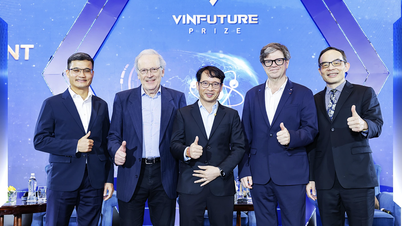
Professor Geoffrey E. Hinton's contributions, along with those of four scientists: Yoshua Bengio, Jen-Hsun Huang, Yann LeCun, and Fei-Fei Li, in advancing deep learning, were honored with the main prize of $3 million USD (over 76 billion VND) at VinFuture 2024.
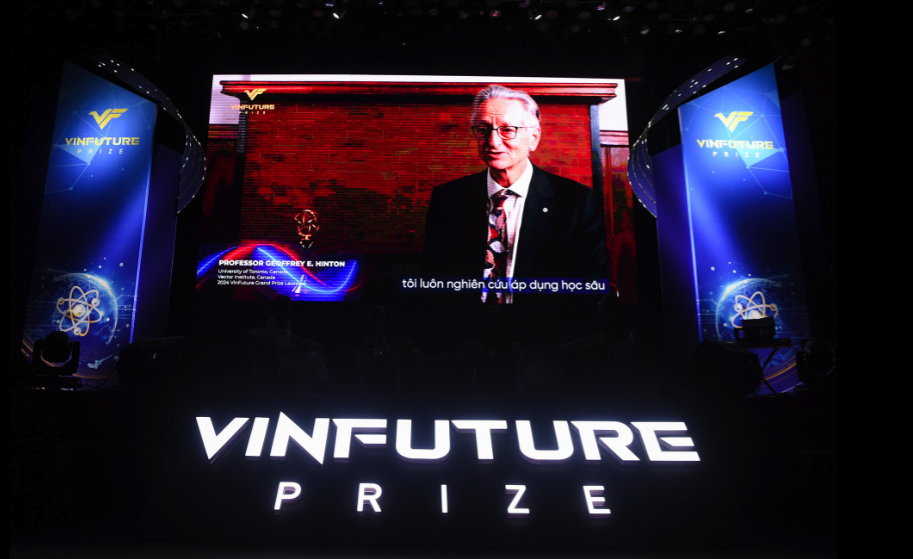
Geoffrey Hinton is often referred to as the "godfather of deep learning" for his immense contributions to the fields of artificial intelligence and machine learning.
The award committee recognized him for his leadership and foundational research on neural network architecture. His 1986 paper, co-authored with David Rumelhart and Ronald Williams, demonstrated distributed representations in neural networks trained by the backpropagation algorithm. This method has become a standard tool in artificial intelligence and has led to advances in image and speech recognition.
Born on December 6, 1947, in Wimbledon, London, Hinton is a descendant of the logician George Boole, who laid the foundation for digital circuit design theory. He is a British-Canadian cognitive psychologist and computer scientist, widely recognized for his pioneering research in artificial intelligence (AI).
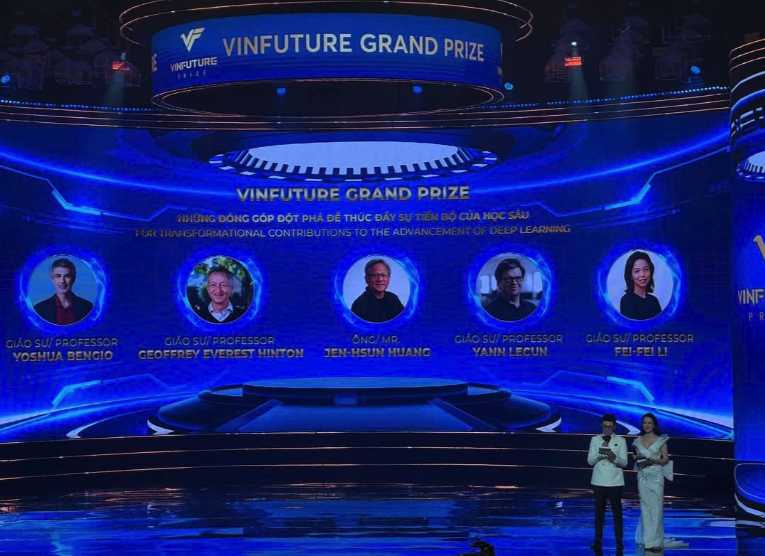
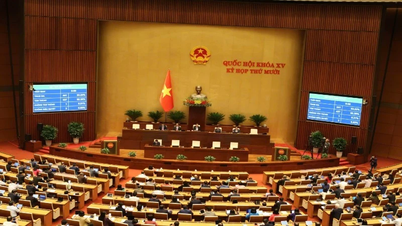
Five scientists received the Vinfuture 2024 Grand Prize at the awards ceremony on the evening of December 6th (the name and photo of Professor Geoffrey E. Hinton are the second on the screen).
One of Hinton's most notable predictions is that AI will soon be able to understand and produce natural language at a level that is on par with humans. This prediction is based on the rapid progress of machine learning and reinforcement learning algorithms.
Another area of Hinton's research is unsupervised learning, a type of machine learning where algorithms learn from unlabeled data. Most current AI systems are based on supervised learning, where algorithms are trained on a large, labeled dataset. However, Hinton argues that unsupervised learning is key to AI more closely mimicking how humans learn. He is developing new algorithms for unsupervised learning, aiming to create AI systems that can learn from their environment like a child.
In a video shared with VinUni University students immediately after the VinFuture awards ceremony on December 7th, Professor Geoffrey Hinton argued that halting development is not a safe option when AI becomes smarter than humans.
"I'm concerned, but I don't think 'the end of the world' is inevitable. However, we can't ignore the possibilities and need to work hard to prevent it. Hopefully, the most talented students will choose to study AI security, finding ways to make it safer and address diverse threats, from the long-term threat of AI taking control to short-term threats like cybercrime."
And he advised the students: "The best way to do excellent research is to pursue what you are truly interested in. Curiosity is the driving force behind great research. In particular, you should look for areas where people seem to be pursuing a common approach and you have a feeling they are doing it wrong. You just need a hunch that something is wrong with how they are doing it and you need to investigate it. Many times your hunch may be wrong, but sometimes it is right, and with persistence you will find out what they are doing wrong and the right way to do it. That is how excellent research is born. If you can do that, you can do very great research."
Source: https://nld.com.vn/chu-nhan-giai-thuong-chinh-vinfuture-2024-nhan-giai-thuong-nobel-vat-ly-2024-19624121116401877.htm


























![[Video] The craft of making Dong Ho folk paintings has been inscribed by UNESCO on the List of Crafts in Need of Urgent Safeguarding.](https://vphoto.vietnam.vn/thumb/402x226/vietnam/resource/IMAGE/2025/12/10/1765350246533_tranh-dong-ho-734-jpg.webp)














































Comment (0)