

|
Delegation of the National Liberation Front of South Vietnam (later the Provisional Revolutionary Government of the Republic of South Vietnam) holding discussions at their headquarters in Paris, January 1969. (Archival photo) |
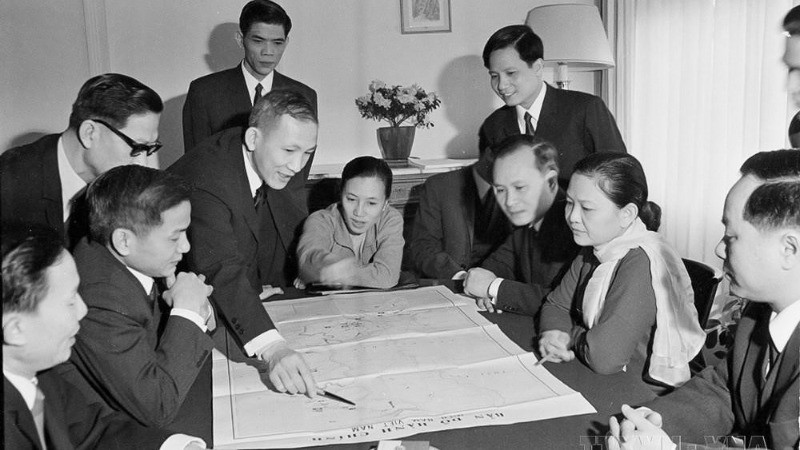
The protracted resistance war against foreign invaders went through many stages of struggle, filled with the policies and strategies of our Party, thwarting the enemy's schemes.
In my opinion, one unique and ingenious strategy was the establishment of the National Liberation Front of South Vietnam in 1960.
According to the Geneva Accords, a general election to unify the country would be held after two years, but the US intervened and established the Saigon government in the South in an attempt to permanently divide the country. The National Liberation Front of South Vietnam advocated for the gathering of all social strata, classes, ethnic groups, and religions, uniting all Vietnamese people to fight for independence and national reunification. The National Liberation Front of South Vietnam was established in accordance with the aspirations of the people of South Vietnam, and therefore received strong and widespread support.
With multifaceted support from the socialist North, the National Liberation Front of South Vietnam rapidly grew stronger, leading political and armed struggles and effectively managing the government. At the same time, the Front also focused on international mobilization with a foreign policy of " peace and neutrality" as outlined in its Platform. The Front successfully garnered support from people around the world with diverse political leanings.
From 1960 onwards, at international forums and peace and democracy conferences, there were two Vietnamese delegations: the socialist North Vietnamese delegation and the National Liberation Front of South Vietnam delegation. The half-red, half-blue flag of the Front flew everywhere in the world , in demonstrations of solidarity with Vietnam. Although the National Liberation Front of South Vietnam was not yet a government, it had representative offices in many countries and received support and assistance from their governments in its activities.
By 1969, following the Tet Offensive, many American strategies had failed, and the opportunity arose. The Party advocated a strategy of "fighting and negotiating simultaneously" to end the war and unify the country. The US, realizing it could not defeat us with its special, localized war strategies, also decided to open a channel for negotiations to appease the anti-war movement and shift to the "Vietnamization of the war" strategy.
But when negotiations began, the US initially only wanted to negotiate with the Democratic Republic of Vietnam. However, we resolutely demanded the presence of the National Liberation Front of South Vietnam, the force that directly fought against the US in the South.
After months of protracted diplomatic struggle, the US was forced to accept four-party talks with the participation of the National Liberation Front of South Vietnam. However, after six months, we established the Provisional Revolutionary Government of the Republic of South Vietnam; the Front's negotiating team automatically became the negotiating team of the Provisional Revolutionary Government.
The establishment of the Provisional Revolutionary Government of the Republic of South Vietnam was a significant and innovative development in the revolutionary struggle for the liberation of South Vietnam and the reunification of the country. It broke the "legal" monopoly of the Republic of Vietnam Government in South Vietnam, while simultaneously opening a broad front to unite all patriotic and peace-loving forces in the struggle for peace, independence, and national unity.
In terms of foreign policy, the Provisional Revolutionary Government, with its policy of "peace, independence, and neutrality," garnered the support of many peace-loving and justice-seeking forces around the world and people of different political views. From the time the Provisional Revolutionary Government was established until the complete liberation of the South and reunification of the country, 65 countries recognized the Provisional Revolutionary Government. The Provisional Revolutionary Government had representative offices in nearly 30 countries worldwide.
At the four-party Paris Conference, we had two negotiating delegations: the Democratic Republic of Vietnam and the Provisional Revolutionary Government of the Republic of South Vietnam, which enhanced our position at the Conference and on the international stage.
At these negotiations, our side was "two yet one, one yet two." "One" here refers to a shared goal of national independence and reunification, and a shared strategic task of fighting for "the US to withdraw while we remain." "Two" refers to the proactive and flexible tactics of each negotiating team.
During the negotiations, the Provisional Revolutionary Government proposed solutions to end the war, and the delegation of the Democratic Republic of Vietnam fully supported them, further clarifying our just position. When the balance of power on the battlefield shifted in our favor, the Provisional Revolutionary Government presented its final solutions, while the delegation of the Democratic Republic of Vietnam secretly negotiated with the United States to draft the Paris Agreement aimed at ending the war in Vietnam.
The Paris Agreement, signed with the withdrawal of US troops, led to a situation where the parties in Vietnam had to resolve their issues among themselves.
In 1973, the Paris Agreement was signed, and three months later the US withdrew all its troops. However, the Saigon government refused to implement the Paris Agreement, continuing the war with US aid and assistance, hoping to defeat us through the "Vietnamization of the war" strategy.
By 1975, the Party realized that using political solutions with the Saigon government would not solve the problem because the Saigon government still wanted war. Therefore, the Party decided to launch the Spring Offensive of 1975 to completely liberate the South and unify the country.
The greatest lesson our people have learned is: Strong national unity, coupled with a massive international solidarity movement, has enabled our people to defeat foreign invaders, regardless of whether they were imperialists or colonialists. Only with strong national unity can there be a broad international solidarity movement leading to ultimate victory.
Nhandan.vn
Source: https://nhandan.vn/chung-mot-bong-co-cung-mot-muc-tieu-doc-lap-dan-toc-thong-nhat-dat-nuoc-post871834.html
![[Photo] Prime Minister Pham Minh Chinh receives Lao Minister of Education and Sports Thongsalith Mangnormek](/_next/image?url=https%3A%2F%2Fvphoto.vietnam.vn%2Fthumb%2F1200x675%2Fvietnam%2Fresource%2FIMAGE%2F2025%2F12%2F16%2F1765876834721_dsc-7519-jpg.webp&w=3840&q=75)
![[Photo] Prime Minister Pham Minh Chinh receives the Governor of Tochigi Province (Japan)](/_next/image?url=https%3A%2F%2Fvphoto.vietnam.vn%2Fthumb%2F1200x675%2Fvietnam%2Fresource%2FIMAGE%2F2025%2F12%2F16%2F1765892133176_dsc-8082-6425-jpg.webp&w=3840&q=75)
![[Live] 2025 Community Action Awards Gala](/_next/image?url=https%3A%2F%2Fvphoto.vietnam.vn%2Fthumb%2F1200x675%2Fvietnam%2Fresource%2FIMAGE%2F2025%2F12%2F16%2F1765899631650_ndo_tr_z7334013144784-9f9fe10a6d63584c85aff40f2957c250-jpg.webp&w=3840&q=75)

![[Image] Leaked images ahead of the 2025 Community Action Awards gala.](/_next/image?url=https%3A%2F%2Fvphoto.vietnam.vn%2Fthumb%2F1200x675%2Fvietnam%2Fresource%2FIMAGE%2F2025%2F12%2F16%2F1765882828720_ndo_br_thiet-ke-chua-co-ten-45-png.webp&w=3840&q=75)












![[Video] Bach Mai Hospital puts into operation a group of the world's most modern equipment.](https://vphoto.vietnam.vn/thumb/402x226/vietnam/resource/IMAGE/2025/12/17/1765931442107_dung00-58-18-13still010-jpg.webp)






































Comment (0)