

Mr. T. (36 years old, Hanoi ) first tried laughing gas late last year, when he and his wife were out on Nguyen Hue pedestrian street (Ho Chi Minh City). Seeing his friends using it, he was curious, thinking it was just fun and harmless. Little did he know that after just one try, he would become addicted without realizing it.
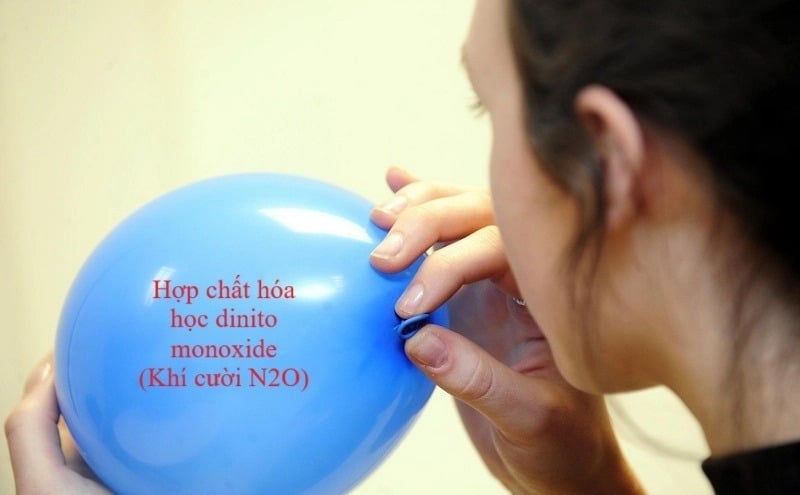 |
| Illustrative image. |
From just a few balloons "for fun," Mr. T. gradually became addicted to the euphoric feeling that N₂O gas provides. Each time he inhaled it, he felt like he was somewhere else – on the moon, under the sea – each person experiencing a different kind of hallucination. Initially, it felt refreshing and fun, but the more he used it, the more addicted he became. Once, in just two days, he spent nearly 20 million VND buying balloons.
And so, whenever they felt stressed, the couple would close the door to their room and turn to laughing gas to find a sense of happiness. The frequency of use increased day by day. At one point, they used it continuously, consuming 6 to 8 canisters a day, each containing about 40 balloons, only stopping when they were too tired; as long as they had the energy, they would continue using it.
After nearly 10 months of use, both of our bodies started "sending out distress signals." One day I felt a tingling sensation in my hands, I thought it was due to lack of sleep. A few days later, the numbness spread down my legs, and I would fall when I tried to stand up. I went to a private clinic but they couldn't find anything wrong. Only when I couldn't lift my legs anymore did I go to Bach Mai Hospital," Mr. T recounted.
His wife, Ms. H., also exhibited similar symptoms: numbness in both feet, a feeling "like ants crawling inside," and unsteadiness while walking. Upon admission to the Poison Control Center, doctors concluded that both had cervical spinal cord injuries due to N₂O gas poisoning, affecting both motor and sensory nerves.
Over the past few days, the couple has required the support of medical staff for intensive rehabilitation treatment, detoxification, combined with physical therapy and exercise. With a distant look in his eyes, Mr. T. shared that the doctor said the recovery process could last many months, and complete recovery might even be impossible if the spinal cord damage was severe.
"Now I just hope I can walk normally again. We were so foolish, thinking laughing gas was harmless, never imagining we'd become disabled. I hope everyone, especially young people, doesn't make the same mistake we did," Mr. T. said sadly.
According to Dr. Nguyen Trung Nguyen, Director of the Poison Control Center at Bach Mai Hospital, N₂O gas in laughing gas is a potent neurotoxin that can cause deep damage to three main organs: the nervous system, the blood system, and the reproductive system.
Neurologically, laughing gas destroys the myelin sheath, the insulating material of nerve fibers, cutting off signal transmission to the brain and spinal cord. The consequences include paralysis of the limbs, sensory disturbances, and even respiratory arrest. Some patients are unable to sit up on their own and experience complete paralysis.
Regarding blood, N₂O gas causes anemia and bone marrow suppression similar to diseases caused by toxic chemicals. As for reproduction, many young patients experience reduced sperm count, endocrine disorders, and decreased libido in both men and women.
Furthermore, through psychological surveys, the Center has noted that many people addicted to nitrous oxide suffer from memory disorders, depression, behavioral and emotional disorders, and signs of chronic brain damage.
This expert emphasized that laughing gas has an addictive mechanism similar to narcotics. Users must continuously increase the dose, from a few balloons to dozens per day. Some people, after treatment and partial recovery, relapse. This is a disguised drug, both toxic and addictive, with absolutely no safe dose.
Dr. Nguyen Dang Duc, the doctor directly treating Mr. T. and Ms. H., added that recently, the Center has continuously received cases of nitrous oxide poisoning, mainly among young people.
One patient, only 20 years old, was hospitalized with quadriplegia after using nitrous oxide for several months. MRI scans revealed irreversible spinal cord damage.
"The worrying thing is that laughing gas is still being widely traded under the guise of 'recreational gas'. We need to take strong action and step up communication to stop it at its root," said Dr. Nguyen Dang Duc.
Doctors warn that N₂O gas should not be inhaled directly. Just a few consecutive inhalations can cause acute neurotoxicity. A moment of euphoria can cost a lifetime of disability. One patient, only 25 years old, had to learn to walk again like a child.
Doctors at the Poison Control Center, Bach Mai Hospital, advise everyone to absolutely avoid using nitrous oxide (laughing gas) in any form. If you experience numbness, muscle weakness, or loss of balance after inhaling laughing gas, you should seek medical attention immediately. Parents, schools, and the community need to strengthen supervision and education to prevent the spread of this risk among young people.
Vietnam has decided to ban the production, trading, import, transportation, storage, and use of nitrous oxide (laughing gas) from January 1, 2025. This decision comes amidst growing concerns about the dangers of laughing gas, not only to health but also negatively impacting the development of young people.
Source: https://baodautu.vn/co-the-liet-toan-than-khi-su-dung-bong-cuoi-d424400.html

































































































Comment (0)