

The schemes of the American empire when sending troops into South Vietnam.
The US "Special War" strategy in South Vietnam was gradually coming to an end. In this difficult situation, the US Department of Defense presented three options: Withdrawal from the war – a humiliating defeat for the United States; continuing the war at its current level – a course that would weaken the US; and rapidly expanding and intensifying the war in both North and South Vietnam to achieve victory, but at enormous cost.
President Johnson and the US military decided on a third option: deploying ground combat troops to South Vietnam to implement a "limited war" strategy aimed at achieving a decisive victory. On July 17, 1965, President Johnson approved the troop increase and endorsed the "search and destroy" plan of General Westmoreland, Commander of the US Military Assistance Command, Vietnam (MACV). Following this decision, the number of US troops deployed to South Vietnam increased steadily, from 18,000 at the beginning of 1965 to nearly 81,500 in July 1965, and over 184,300 by the end of 1965.
 |
| American troops entered South Vietnam in 1965. (Archival photo) |
From mid-1965, the US imperialists shifted to implementing the "Limited War" strategy, initiating the highest level of the war and the highest military effort of the American ruling class to continue the new-style colonial war of aggression in Vietnam. The fact that a leading imperialist power with immense economic potential, abundant weaponry, and advanced military technology massively deployed expeditionary forces to fight in South Vietnam, and then used its air and naval forces to attack North Vietnam, caused some of our officers and soldiers to worry and feel apprehensive because we lacked experience in fighting the Americans.
What were America's intentions when it massively deployed troops to South Vietnam? How should we counter the American and Saigon puppet forces? What were our strategic requirements? Did we dare to fight the Americans? Could we defeat them, and if so, how?... These were questions that our strategists and battlefield commanders needed to clearly understand, deeply examine, and thoroughly analyze.
The Party directed the resolute effort to defeat the American invaders.
Faced with the escalating actions of the US imperialists, Comrade Le Duan, First Secretary of the Central Committee of the Vietnam Workers' Party, affirmed: "We must be prepared to counter and defeat the enemy if they expand into the North with their entire army" and "it is absolutely necessary to seize and firmly hold the initiative on the battlefield, always attacking strongly while simultaneously defending well."
To proactively cope with the increasingly fierce war situation and maintain the offensive strategy, the Politburo, President Ho Chi Minh, and the Central Military Commission directed the rapid development of the people's armed forces in both quantity and quality. In particular, they focused on building and developing the main force according to the requirement: "Building the main force into a strong, compact, and swift striking force" and firmly deploying it in key strategic areas. The Party directed our army and people to proactively find ways to fight the Americans, maintaining the initiative on the battlefield by organizing preemptive attacks against the American expeditionary forces, implementing the motto: "If we fight the Americans, we will find a way to defeat them."
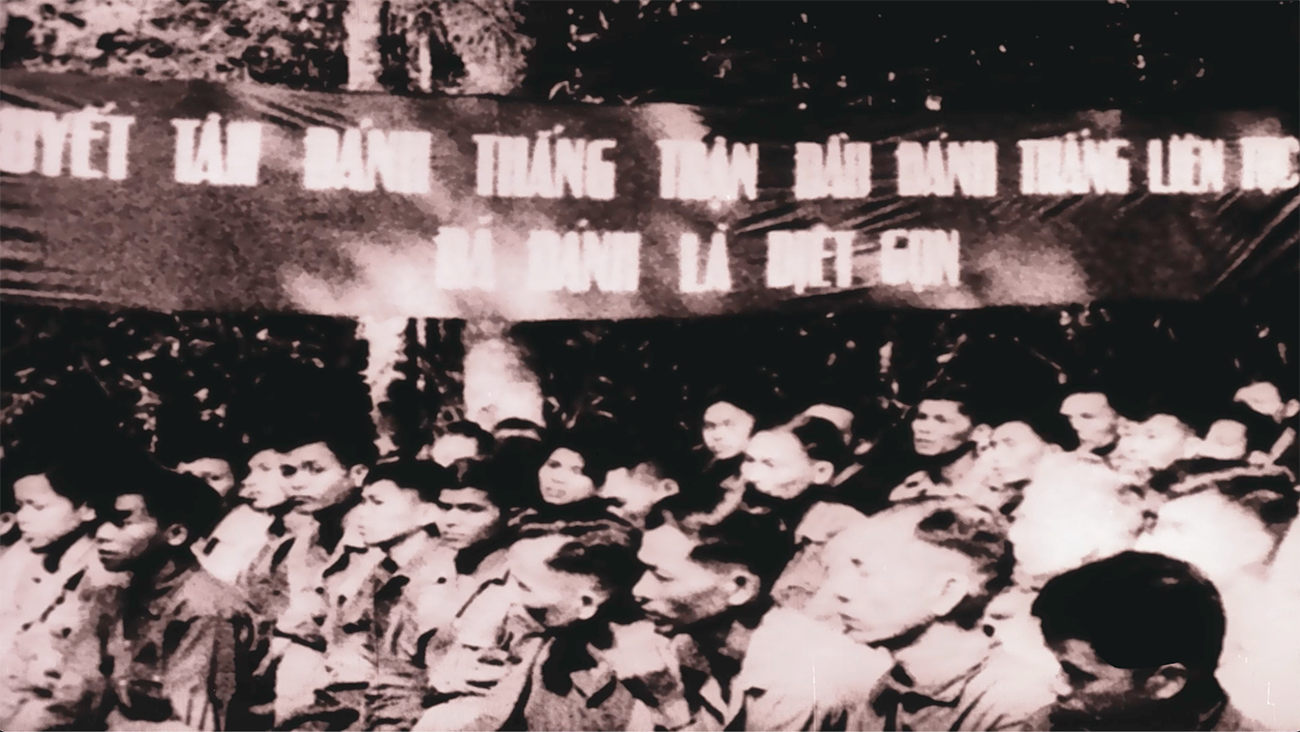 |
| A slogan expressing determination to defeat the Americans during the first battle at Nui Thanh (Quang Nam), 1965. (Archival photo) |
In early March 1965, the first American battalions that had just landed in Da Nang and Chu Lai, still unsteady on their feet, were attacked by local militia and guerrilla forces right in their own bases. Local militia and guerrillas, in conjunction with political forces, fought firmly in the villages, encircling and attacking American bases from all three fronts: military, political, and troop mobilization. During this time, we proactively deployed local forces to the front lines to "seek out and destroy the Americans."
On May 10, 1965, the 5th Military Region Command instructed the Quang Nam Provincial Military Command: Destroy a US unit to undermine their prestige from the outset and gain experience for the entire region. The target would be chosen by the province. The unit to attack would be selected by the province, and the attack would be carried out according to the province's level of expertise and equipment capabilities.
On the night of May 25th and the early morning of May 26th, 1965, the Quang Nam Provincial Military Command organized a local company to attack Company 2 of Battalion 2, Brigade 9, 3rd Marine Division of the US Army at Nui Thanh Hill. Using a cunning and unexpected attack, our forces quickly achieved a great victory, killing and wounding 140 enemy soldiers.
Although the Battle of Nui Thanh was not large in scale, it was the first battle in which our revolutionary armed forces annihilated American expeditionary forces on the Southern battlefield. This first victory affirmed the determination of the Southern army and people to fight the Americans; it strongly encouraged the fighting spirit against the Americans and contributed to building the confidence of our army and people in defeating them.
While the militia, guerrillas, and local troops in South Vietnam had launched attacks and initially defeated the American expeditionary forces, the main army units lacked experience in fighting the Americans. Many questions arose that needed answering: How should the main army units fight the Americans? Should they concentrate their forces or disperse them to engage in small-scale battles like the local forces? Could the main army units completely annihilate the American forces and launch a military campaign?... On August 18, 1965, at Van Tuong (Quang Ngai), a main army regiment of the Liberation Army of Zone V, in coordination with local troops, militia, and guerrillas, relying on the guerrilla defenses of Chu Lai and Binh Son districts, repelled the first offensive of 6,000 American soldiers and 3,000 South Vietnamese troops.
Our troops applied the strategy of "clinging to the Americans' backs to fight," cutting off the enemy's tanks and marines, causing chaos in their formations and forcing them to huddle together to defend themselves. The enemy shifted from an offensive to a passive defensive position. After two days, we eliminated 900 enemy soldiers. The victory at Van Tuong further strengthened our resolve to "keep fighting the Americans and we will find a way to defeat them," and our armed forces were able to initially assess the actual strength and discover the weaknesses of the American army, both in terms of morale and tactics.
The victories at Nui Thanh and Van Tuong demonstrated that defeating the American expeditionary forces had become a reality on the battlefield, answering the question of how to defeat the Americans in the "Limited War" strategy and the ability of the main army units to fight the Americans; and encouraging the movement to eliminate the Americans on the Southern battlefield.
----------------------------------------------
THACH ANH MINH - NGUYEN VAN HAI
Source: https://www.qdnd.vn/quoc-phong-an-ninh/nghe-thuat-quan-su-vn/cu-danh-my-se-tim-ra-cach-danh-thang-my-831134
![[Photo] Prime Minister Pham Minh Chinh receives the Chinese Ambassador to Vietnam](https://vphoto.vietnam.vn/thumb/1200x675/vietnam/resource/IMAGE/2026/04/05/1775397481797_ndo_br_dsc-5512-jpg.webp)




















































Comment (0)