

For the timber industry to develop sustainably, in addition to meeting rules of origin, businesses need to invest in technology and expand exports to new markets.
The United States continues to be the top market for Vietnamese timber.
According to statistics from the Customs Department ( Ministry of Finance ), the export value of wood and wood products in February 2025 reached US$1.03 billion, a decrease of 27.7% compared to January 2025, but an increase of 33.9% compared to February 2024; of which, the export value of wood products reached US$665.7 million, a decrease of 32.2% compared to January 2025, but an increase of 38.9% compared to February 2024.
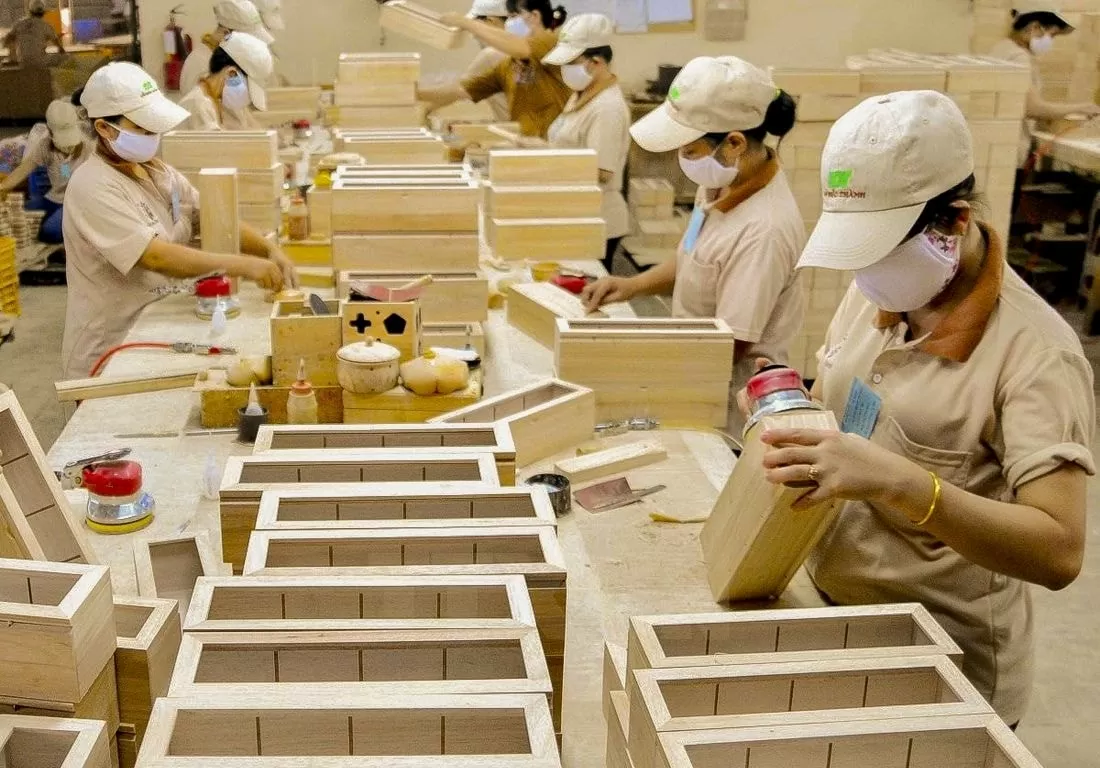 |
| In the first two months of 2025, the value of exports of wood and wood products reached US$2.45 billion, an increase of 9.4% compared to the same period in 2024. (Image: Illustration) |
Overall, in the first two months of 2025, the export value of wood and wood products reached US$2.45 billion, an increase of 9.4% compared to the same period in 2024; of which, the export value of wood products reached US$1.65 billion, an increase of 9.1% compared to the same period in 2024.
Exports of wood and wood products in the first two months of 2025 were favorable, with export values to major markets recording positive growth. Leading the way in terms of export value of wood and wood products was the US market, reaching $1.3 billion, an increase of 9.5% compared to the same period in 2024.
The United States is Vietnam's largest market for wood and wood products, accounting for 53.1% of total export value. This is followed by exports to Japan, reaching US$323.4 million, up 21%, accounting for 13.2%; China, with US$259.9 million, down 15.2%, accounting for 10.6%; and South Korea, with US$119.5 million, up 6.3%, accounting for 4.9%...
Although the export value of wood and wood products performed well in the first two months of 2025, the industry still faces many difficulties in the coming period, as major export markets increasingly demand stricter control over the origin of wood.
Speaking with a reporter from the Industry and Trade Newspaper, Mr. Tran Le Huy, Vice Chairman of the Binh Dinh Wood and Forest Products Association (FPA Binh Dinh), said that in 2025, amidst significant changes in the macroeconomic environment, which deepened the challenges and difficulties from 2024 such as the ongoing Russia-Ukraine conflict, supply chain fluctuations with high sea freight costs, and changes in trade policies in many countries, the Vietnamese wood industry will face considerable impacts on investment, development, production, business, and export turnover.
Specifically, with regard to the US market, tax policies and trade protection policies are subject to many unpredictable changes, while the export value of Vietnam's wood industry to the US market accounts for nearly 60% of total export value. Therefore, any change in policy in this market will have a significant impact on investment, development, production, business, and export value of Vietnam's wood industry.
Meanwhile, for the EU market, the EU's Non-Deforestation Product Regulation (EUDR), which will officially come into effect on December 31, 2025, along with the Carbon Border Adjustment Mechanism (CBAM) and the Corporate Sustainability Reporting Directive (CSRD) related to greenhouse gas emission reduction and eco-design, will also have a significant impact on the wood processing and export industry.
For the Japanese market, changes in feed-in tariff (FIT) policies and regulations on the use of wood with clearly traceable origins will impact Vietnam's wood pellet export industry.
Meanwhile, in South Korea, a major import market for Vietnamese plywood, wood pellets, and laminated boards, the country's economy has yet to recover. The Bank of Korea has revised down its GDP growth forecast for 2025 from 1.9% to 1.5%, the deepest downward revision since 2022.
China, which imports over 70% of Vietnam's wood chips and wood products, is being impacted by the EU's Trade Retaliation Act (EUDR) as well as the US policy of increasing import tariffs.
Meanwhile, according to businesses in the industry, the price of imported raw timber is currently increasing due to limited supply. In addition, the Vietnamese timber industry faces fierce competition from other major supplying countries, including China, Malaysia, and Indonesia, which are also large timber exporters with advantages in technology and cost.
Towards sustainable development
With its natural, environmentally friendly characteristics, the wood industry has significant potential to contribute to the nation's decarbonization and sustainable development goals. Urban and industrial development trends are driving an increasing market demand, both in quantity and quality, for furniture and engineered wood products.
From the perspective of the Ministry of Industry and Trade , Mr. Vu Ba Phu - Director of the Trade Promotion Department - stated that, to support the Vietnamese wood industry in keeping pace with this trend, the Trade Promotion Department will develop an export promotion strategy aiming for wood and forestry product exports to reach 25 billion USD by 2030. The goal is for the Vietnamese wood industry to develop sustainably based on proactively securing raw material supply, using certified wood, and producing products with reduced emissions.
Furthermore, improving the compliance and certification capabilities of wood businesses contributes to enhancing their competitive advantage in the market and expanding export opportunities. Compliance with standards also helps minimize legal and commercial risks for businesses. Simultaneously, it strengthens trade promotion and builds brand recognition for Vietnamese wood products.
Mr. Do Duc Duy, Minister of Agriculture and Environment, believes that the forestry sector in general, and the export of wood and forest products in particular, still have much room for development.
Emphasizing the "sustainable" and "multi-purpose" orientation for the forestry sector, Minister Do Duc Duy expressed hope that in the coming time, through changes in management methods, the forestry sector will further increase the content and processing technology, move beyond the "safe growth" zone of 5%, and soon achieve double-digit growth.
Experts also suggest that, for the wood industry to develop sustainably, in addition to meeting regulations and standards on origin and environment, Vietnamese businesses need to invest in processing technology and improve product quality to maintain a competitive advantage and expand exports to new markets.
| With strong growth in recent years, the export value of wood and wood products in 2024 reached over US$16.28 billion, an increase of 20.9% compared to 2023, further placing Vietnam among the world's leading exporters of wood and furniture. In January 2025 alone, exports of wood and wood products reached US$1.42 billion, placing wood among the top seven export items exceeding US$1 billion, accounting for 67.9% of the country's total export value. |
Source: https://congthuong.vn/da-dang-thi-truong-mo-rong-khong-gian-cho-xuat-khau-go-378025.html

![[Photo] Prime Minister Pham Minh Chinh receives the Governor of Tochigi Province (Japan)](/_next/image?url=https%3A%2F%2Fvphoto.vietnam.vn%2Fthumb%2F1200x675%2Fvietnam%2Fresource%2FIMAGE%2F2025%2F12%2F16%2F1765892133176_dsc-8082-6425-jpg.webp&w=3840&q=75)
![[Live] 2025 Community Action Awards Gala](/_next/image?url=https%3A%2F%2Fvphoto.vietnam.vn%2Fthumb%2F1200x675%2Fvietnam%2Fresource%2FIMAGE%2F2025%2F12%2F16%2F1765899631650_ndo_tr_z7334013144784-9f9fe10a6d63584c85aff40f2957c250-jpg.webp&w=3840&q=75)
![[Image] Leaked images ahead of the 2025 Community Action Awards gala.](/_next/image?url=https%3A%2F%2Fvphoto.vietnam.vn%2Fthumb%2F1200x675%2Fvietnam%2Fresource%2FIMAGE%2F2025%2F12%2F16%2F1765882828720_ndo_br_thiet-ke-chua-co-ten-45-png.webp&w=3840&q=75)
![[Photo] Prime Minister Pham Minh Chinh receives Lao Minister of Education and Sports Thongsalith Mangnormek](/_next/image?url=https%3A%2F%2Fvphoto.vietnam.vn%2Fthumb%2F1200x675%2Fvietnam%2Fresource%2FIMAGE%2F2025%2F12%2F16%2F1765876834721_dsc-7519-jpg.webp&w=3840&q=75)
























































































Comment (0)