

Vietnam is entering a phase of accelerating its commitment to achieving net-zero emissions by 2050. In this context, the question is no longer whether or not to embrace green transformation, but rather where businesses will begin, according to what standards, and with what tools to ensure they stay ahead of international trends.
The press conference on December 16th clarified the new approach of the "National Green Environment Program 2025". Going beyond general appeals, the organizers set a specific ESG standard – clear enough to measure, yet flexible enough for businesses to participate.
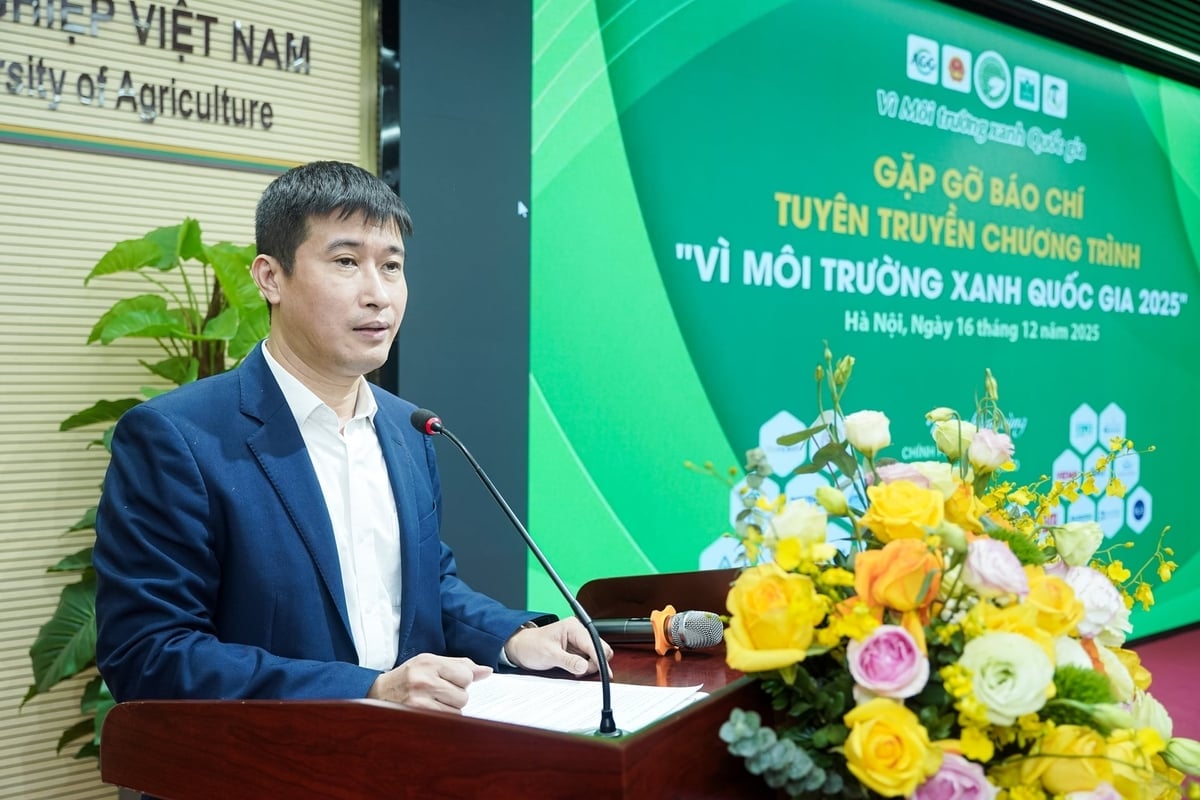
Dr. Hoang Hiep, Director of the Institute for Green Growth Research. Photo: Bao Thang.
According to Dr. Hoang Hiep, Director of the Institute for Green Growth Research (Vietnam Academy of Agriculture ), after more than 13 years of implementation, the program has shifted from a communication role to an action-oriented one. The focus in 2025 is to help businesses understand the green transformation roadmap and have tools to self-assess their readiness.
A key new development this year is the application of a set of 30 ESG criteria, referencing international standards such as GRI and MSCI, but adapted to suit the governance conditions, implementation capacity, and evidence-providing capabilities of Vietnamese businesses. The goal is not to create additional barriers, but to standardize the understanding of ESG within the domestic context.
This set of criteria is designed to simultaneously assess three pillars: environment, social, and governance, with weighting determined through expert surveys. This approach ensures that ESG is not merely understood as a formal report, but is linked to actual data and results in production and business operations.
The evaluation process is also conducted in a collaborative manner. Businesses participating in the survey will go through a preliminary assessment round. Units that meet at least 50% of the criteria are not immediately disqualified, but receive professional support from the organizing committee to complete their applications and adjust their ESG approach. Only in the final assessment round will the title of "National Green ESG Enterprise 2025" be considered for awarding to units that achieve 70 points or more.
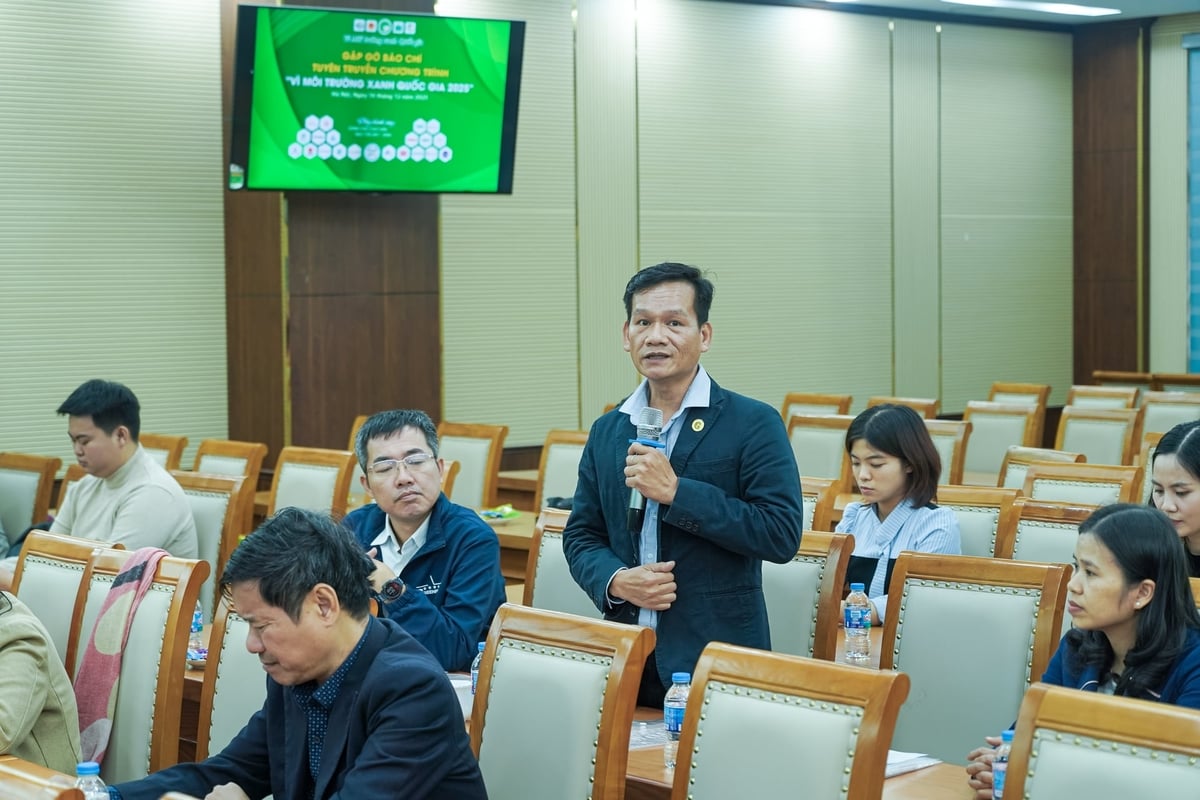
A representative from GreenFeed shared their opinion at the conference. Photo: Bao Thang.
According to Dr. Nguyen Bich Thao, representing the evaluation council, the 70-point mark is not a technical barrier, but rather a recognition threshold to ensure that the honored businesses have implemented ESG at a substantive level. Setting a clear threshold provides the market with a common reference standard and motivates other businesses to gradually upgrade.
Alongside the standardization of ESG assessments, the "National Green Environment Program 2025" also announced six key tasks for the 2025-2026 period, ranging from communication and training on the "Journey to Net Zero" program, greenhouse gas inventory in Ninh Binh , to community activities such as the National Green Station and competitions like the Green Ambassador and Green Fashion.
Emphasizing the program's connecting role, Dr. Tran Van Mieu, Vice President of the Vietnam Association for Nature and Environment Protection (VACNE), stressed that the key is to create a network of businesses, schools, and communities participating together, instead of each entity acting separately.
In 2025, the ESG survey attracted more than 100 participating businesses. The number of recognized participants was announced as 20, but this was not the main target. More importantly, the program helps businesses clearly see the gap between commitment and implementation, thereby allowing them to make adjustments that align with their capabilities.
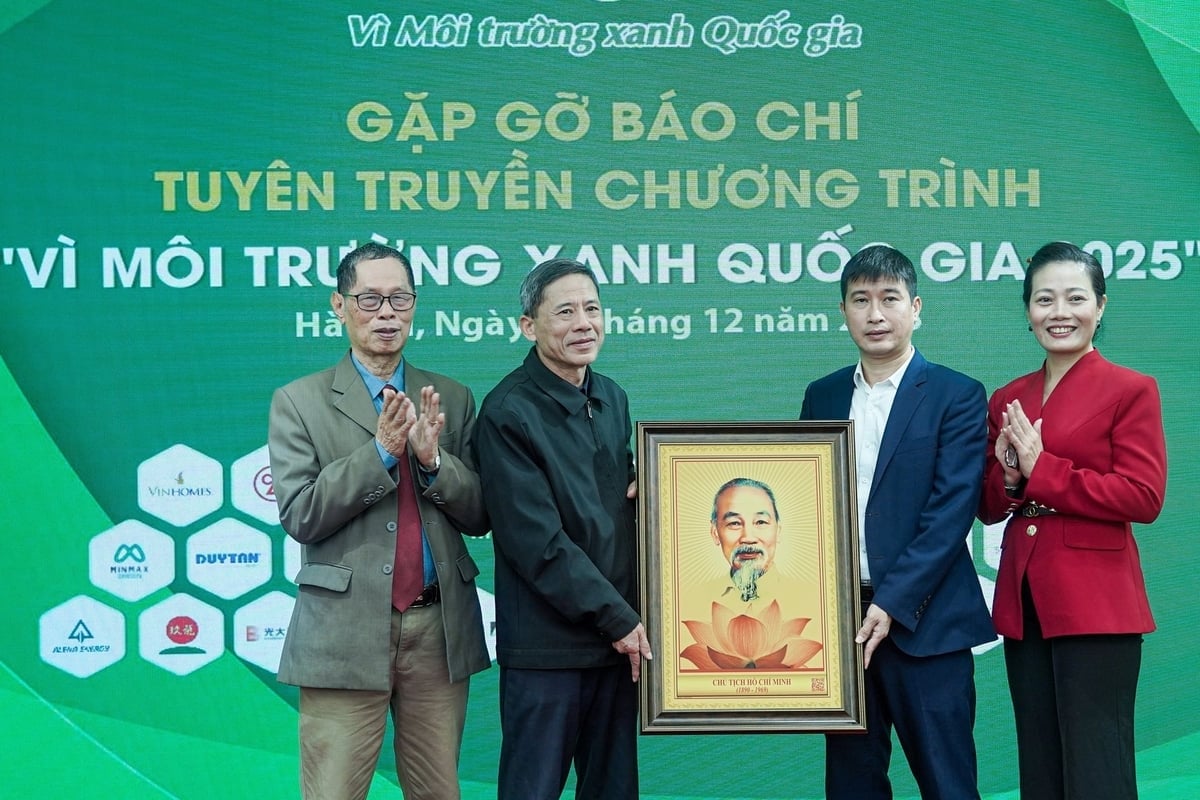
The organizers received commemorative gifts from businesses participating in the program. Photo: Bao Thang.
GreenFeed, representing the business sector, views ESG no longer as a cost, but as a management tool that optimizes operations, improves brand image, and expands collaboration opportunities. Early participation allows businesses to familiarize themselves with the new requirements before ESG becomes mandatory.
Through support from the program, GreenFeed has clearly identified key solutions to participate in the net-zero emissions roadmap. First, it is reviewing all emission sources in the production chain to optimize processes. The company is gradually switching from fossil fuels to biogas for its boiler system, while also investing in rooftop solar power to supplement its clean energy sources.
In addition, the company is focusing on waste recovery, improved sanitation and environmental protection, and converting forklifts from diesel to electric. In livestock farming, the company is promoting automated feeding and watering, and transporting feed directly to the barns using a silo system, thereby reducing approximately 500-600 tons of plastic waste released into the environment each year, gradually limiting and eventually eliminating the use of plastic packaging in animal feed.
"ESG is a long-term process, accompanied by pressure from market, customer, and institutional demands, and requires businesses to invest capital," the company emphasized. Based on practical implementation, the unit recommends creating more favorable conditions for accessing green credit, expanding mechanisms for using solar power and rooftop solar power, and improving circular agriculture standards, especially regulations on using wastewater from livestock farming for crop cultivation to effectively utilize liquid fertilizer.
The closing ceremony and announcement of the "National Green ESG Businesses 2025" list is scheduled to take place on the evening of December 20th in Hanoi , as part of the National Green Concert. The organizers hope that the event will not only be an honorary occasion but also a next step in spreading a suitable, practical, and widely applicable approach to ESG.
Source: https://nongnghiepmoitruong.vn/dat-chuan-esg-phu-hop-de-doanh-nghiep-tham-gia-chuyen-doi-xanh-d789715.html

![[Photo] Prime Minister Pham Minh Chinh receives the Governor of Tochigi Province (Japan)](/_next/image?url=https%3A%2F%2Fvphoto.vietnam.vn%2Fthumb%2F1200x675%2Fvietnam%2Fresource%2FIMAGE%2F2025%2F12%2F16%2F1765892133176_dsc-8082-6425-jpg.webp&w=3840&q=75)
![[Live] 2025 Community Action Awards Gala](/_next/image?url=https%3A%2F%2Fvphoto.vietnam.vn%2Fthumb%2F1200x675%2Fvietnam%2Fresource%2FIMAGE%2F2025%2F12%2F16%2F1765899631650_ndo_tr_z7334013144784-9f9fe10a6d63584c85aff40f2957c250-jpg.webp&w=3840&q=75)
![[Image] Leaked images ahead of the 2025 Community Action Awards gala.](/_next/image?url=https%3A%2F%2Fvphoto.vietnam.vn%2Fthumb%2F1200x675%2Fvietnam%2Fresource%2FIMAGE%2F2025%2F12%2F16%2F1765882828720_ndo_br_thiet-ke-chua-co-ten-45-png.webp&w=3840&q=75)
![[Photo] Prime Minister Pham Minh Chinh receives Lao Minister of Education and Sports Thongsalith Mangnormek](/_next/image?url=https%3A%2F%2Fvphoto.vietnam.vn%2Fthumb%2F1200x675%2Fvietnam%2Fresource%2FIMAGE%2F2025%2F12%2F16%2F1765876834721_dsc-7519-jpg.webp&w=3840&q=75)
















































![[Photo] Prime Minister Pham Minh Chinh attends the Vietnam Economic Forum 2025](https://vphoto.vietnam.vn/thumb/402x226/vietnam/resource/IMAGE/2025/12/16/1765893035503_ndo_br_dsc-8043-jpg.webp)





















Comment (0)