

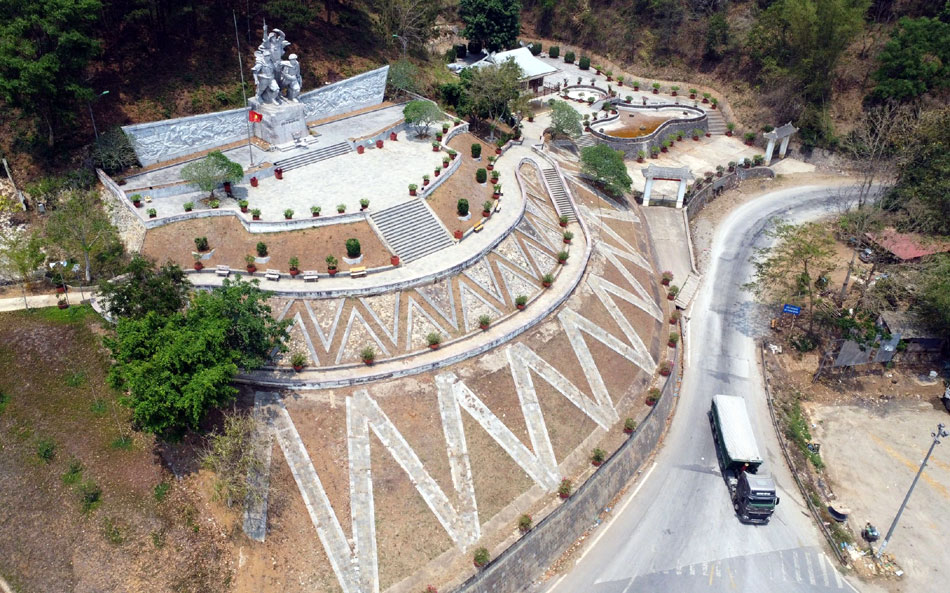
The Co Noi Junction, connecting Route 41 (now National Highway 6) with Route 13 (now National Highway 37), is a narrow, deep valley flanked by hills, strategically positioned for French air strikes. All support operations, including the transportation of weapons, food, and civilian laborers by the Viet Minh from Yen Bai and from the Northern Delta to Dien Bien Phu, had to pass through this crucial junction. General Vo Nguyen Giap stated: "The Co Noi Junction is a gateway; all those going to battle must cross it." The overarching slogan of the Vietnamese army and people during the historic Dien Bien Phu Campaign was "All for the front lines, all for victory."
Having identified the strategic importance of the Co Noi junction, the French army concentrated its air power to launch a fierce attack, aiming to cut off the only vital supply route to Dien Bien Phu. According to statistics, the enemy bombed and shelled the area on average every 13 minutes; on some days, 300 demolition bombs, delayed-action bombs, napalm bombs, and butterfly bombs were dropped there.
The General Youth Volunteer Brigade assigned the 40th Youth Volunteer Brigade the task of directly holding and serving the line from Yen Bai to Co Noi Junction. Many examples of bravery, resourcefulness, and creativity from the youth volunteer force were demonstrated. Under the rain of bombs and bullets, the youth volunteer force at Co Noi Junction stood tall and courageous, carrying out the tasks assigned by the Party and the State. The Dien Bien Phu Campaign ended in victory, thanks in part to the important contributions of the youth volunteer force in general, and at Co Noi Junction in particular. The blood of hundreds of youth volunteer martyrs who bravely sacrificed themselves at this historic junction further embellished the glorious golden history of the Dien Bien Phu Victory.
To forever honor the sacrifices of the young volunteer martyrs who fought and died for the independence and freedom of the Fatherland at Co Noi Crossroads, on April 21, 2000, the Central Committee of the Ho Chi Minh Communist Youth Union and the People's Committee of Son La province commenced the construction of a memorial complex for the young volunteer martyrs at the site of the former "fire zone". The Co Noi Crossroads historical site has become a familiar destination for locals and tourists from all over the country on their journey to the historical roots.
Along with the "red spot" of Cò Nòi, Pha Đin Pass was one of the key transportation hubs that the French colonialists attacked with extreme ferocity. The French knew that if they could cut off this vital route, the Vietnamese army would have no chance of winning at Điện Biên Phủ. Therefore, Pha Đin Pass became a "fire zone," a "bombing target," enduring intense air raids by the French colonial forces. Every day, the French sent planes to patrol the pass area dozens of times, dropping hundreds of bombs; on some days, the enemy dropped more than 16 tons of bombs of various types in an attempt to destroy this important transportation route.

"All for the front lines, all for victory," we mobilized a powerful rear base from the free zones, the newly liberated areas, from Military Regions III and IV, Viet Bac and Northwest, pouring all their manpower and resources into supporting Dien Bien Phu. Tens of thousands of civilian laborers and volunteer youth tirelessly crossed the legendary Pha Din Pass, sparing no blood or sacrifice, ready to make the most of the road connecting the rear base and the front lines. The cliffs and vast forests here seem to constantly echo the calls to arms, fueled by the powerful national spirit.
On Pha Din Pass, the women carry the loads and the men haul them.
At Lung Lo Pass, men sing and women chant.
Despite bombs and bullets that shattered bones and torn flesh,
Undeterred, without regret for my youth…
Despite fierce attacks by the French army and the dispersal of their forces, with the determination that "as long as the youth volunteers remain, the vital transportation routes will always be maintained," the youth volunteer companies bravely overcame bombs and bullets, working tirelessly and tenaciously day and night to build and repair roads, clear mines, and ensure the smooth flow of traffic to the front lines. For 48 days and nights, the French bombed Pha Din Pass, resulting in the deaths of over 8,000 youth volunteers, and thousands more lost limbs. With unwavering determination and courage, the soldiers, civilian workers, and youth volunteers maintained the vital transportation routes, ensuring timely support for the Dien Bien Phu Campaign until the final victory.
Pha Din Pass is a testament to the glorious victory of the historic Dien Bien Phu campaign – one of the symbols of the Vietnamese spirit and strength, inspiring admiration and pride among the people of the whole country, international friends, and those on the other side of the battlefield.
Source
![[Image] Leaked images ahead of the 2025 Community Action Awards gala.](/_next/image?url=https%3A%2F%2Fvphoto.vietnam.vn%2Fthumb%2F1200x675%2Fvietnam%2Fresource%2FIMAGE%2F2025%2F12%2F16%2F1765882828720_ndo_br_thiet-ke-chua-co-ten-45-png.webp&w=3840&q=75)
![[Photo] Prime Minister Pham Minh Chinh receives the Governor of Tochigi Province (Japan)](/_next/image?url=https%3A%2F%2Fvphoto.vietnam.vn%2Fthumb%2F1200x675%2Fvietnam%2Fresource%2FIMAGE%2F2025%2F12%2F16%2F1765892133176_dsc-8082-6425-jpg.webp&w=3840&q=75)

![[Live] 2025 Community Action Awards Gala](/_next/image?url=https%3A%2F%2Fvphoto.vietnam.vn%2Fthumb%2F1200x675%2Fvietnam%2Fresource%2FIMAGE%2F2025%2F12%2F16%2F1765899631650_ndo_tr_z7334013144784-9f9fe10a6d63584c85aff40f2957c250-jpg.webp&w=3840&q=75)
![[Photo] Prime Minister Pham Minh Chinh receives Lao Minister of Education and Sports Thongsalith Mangnormek](/_next/image?url=https%3A%2F%2Fvphoto.vietnam.vn%2Fthumb%2F1200x675%2Fvietnam%2Fresource%2FIMAGE%2F2025%2F12%2F16%2F1765876834721_dsc-7519-jpg.webp&w=3840&q=75)





































![[Photo] Prime Minister Pham Minh Chinh attends the Vietnam Economic Forum 2025](https://vphoto.vietnam.vn/thumb/402x226/vietnam/resource/IMAGE/2025/12/16/1765893035503_ndo_br_dsc-8043-jpg.webp)





















Comment (0)