

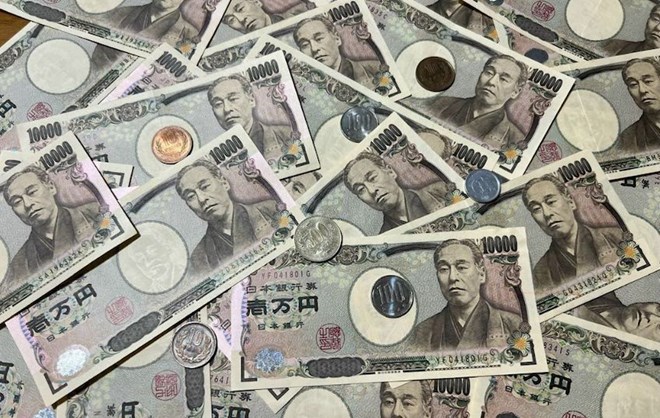
The Bank of Japan's (BOJ) decision to raise interest rates sent shockwaves through the global economy immediately after its announcement. The yen rose to its highest level in seven months. The Nikkei stock index, after a sharp drop on Monday, rebounded by 10.23% today. This was the largest single-day gain since October 2008 and the highest increase in index points.
Asian stocks also recovered from yesterday's sharp sell-off. South Korea's Kospi index rose over 3%. China's CSI 300 index was flat, while Hong Kong's Hang Seng index gained 0.9%. Australia's S&P/ASX 200 index rose 0.41%.
Japanese Finance Minister Shunichi Suzuki said authorities are closely monitoring movements in the exchange rate. It should fluctuate in a stable direction and reflect the fundamentals of the economy.
Minister Shunichi Suzuki said, "It's difficult to say the reason behind the stock market decline." He added that the government is working with the Bank of Japan (BOJ) and closely monitoring the markets with a sense of urgency.
According to Mizuho Bank analyst Vishnu Varathan, the BOJ is in a more difficult position, struggling to make a credible comeback after its hawkish stance caused an unwanted plunge in the Nikkei index.
Marketwatch noted that the recent surge in the value of the Yen, combined with the Bank of Japan's interest rate hike, has created a general sense of uncertainty among investors. This is not limited to just the US or Japanese markets, but is a global phenomenon due to interconnectedness.
The tremors also came from the other side of the globe, as the US non- farm payrolls report last weekend showed labor market data cooling down faster than expected. This raised concerns about the risk of an economic recession.
Regarding Vietnam specifically, Barry Weisblatt David, Director of Analysis at VNDIRECT Securities, believes that Japan's interest rate hike will have very little impact. He said: "Japan is Vietnam's sixth largest export market. Most of Japan's investment in Vietnam is development assistance (between governments) or long-term FDI, such as SMBC's $1.5 billion investment in VPBank. This capital flow is not sensitive to moderate currency fluctuations in the same way that ETF flows would react."
Therefore, yesterday's news is unlikely to cause much change in Japanese investment flows into Vietnam. I don't think global investors will leave Vietnam to move to Japan just to receive an additional 25 basis points in the Yen interest rate."
In the first seven months of this year, Japan remained in the top 5 largest FDI investors in Vietnam with $991.5 million. Of this, the manufacturing and processing industry accounted for 50% of the total investment capital from Japanese businesses in our country.
Due to the depreciation of the Yen, the number of new Japanese FDI businesses investing in Vietnam has also been affected. However, according to a representative from Jetro, this is only a short-term trend. 70% of Japanese businesses operating in Vietnam are looking to expand their production scale with new business models and activities. In the first half of this year, the number of newly approved projects decreased by 20%, but the investment amount from long-established businesses tended to increase.
Source: https://laodong.vn/kinh-doanh/dong-tien-se-khong-roi-viet-nam-khi-nhat-ban-tang-lai-suat-1376865.ldo


























































































Comment (0)