

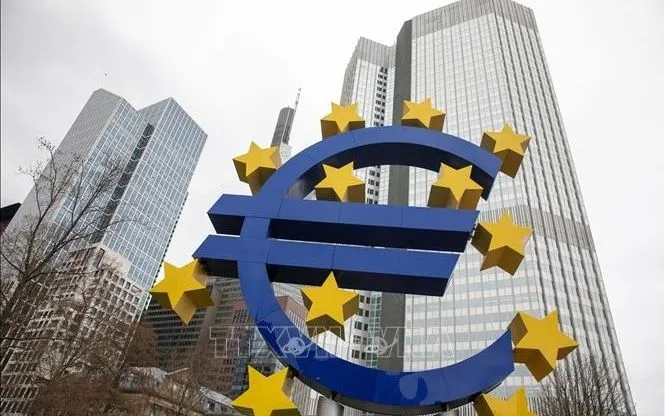
The euro symbol is displayed in front of the European Central Bank headquarters in Frankfurt, Germany. Photo: AFP/VNA.
According to a Bloomberg survey of economists conducted between October 17 and 22, the European Central Bank (ECB) is projected to keep interest rates unchanged at 2% until 2027.
Economists predict the ECB will keep deposit rates unchanged at its monetary policy meeting next week. However, the possibility of a different decision by the ECB cannot be ruled out. One-third of respondents expect the ECB to make at least one more rate cut after eight cuts already made so far, while 17% expect one or more rate hikes by the end of next year.
Dennis Shen, an economist at credit rating and analysis firm Scope, does not expect any further interest rate cuts this year, but the ECB will remain open to options, with the possibility of further easing monetary policy rather than tightening. He is also the one who warned of a significant appreciation of the euro, exceeding $1.20/euro, and further interest rate cuts by the US Federal Reserve.
Swedbank's chief economist, Nerijus Maciulis, believes inflation remains near its target, and although some growth indicators have been volatile in recent months, there is no guarantee of a change in the ECB's monetary policy.
ECB President Christine Lagarde is likely to reiterate her key message from the September 2025 meeting, stating that the economic situation and inflation remain good.
ECB officials are unlikely to change interest rates in the near future, pleased with the pace of consumer price increases and the state of the regional economy. They believe monetary policy is demonstrating a flexible response to new challenges. Europe is caught between US-China trade tensions over semiconductors and rare earth elements, while credit rating downgrades are complicating France's finances and doubts are rising about the potential of Germany's comprehensive infrastructure and defense investment plans. At the same time, Europe's delay in implementing a new emissions trading system risks putting pressure on inflation in the coming years, and rising asset prices are raising concerns about a potential market collapse.
If the outlook in December shows inflation falling significantly from the 2% target by 2028, with a key threshold of 1.6%, interest rates could fall further. Short-term risks to economic growth and inflation are assessed as balanced, while future uncertainty remains significant. However, many respondents are more concerned about upside risks than downside risks, after prices rose 2.2% in September 2025, the fastest increase in five months.
Even if Ms. Lagarde and other officials advocate for further interest rate cuts, analysts believe this would have only a limited impact on demand. Over 60% believe growth is hampered by both cyclical and structural factors. The majority of the remainder blame structural factors more for the bloc's stagnation. As the ECB maintains its optimal scenario of "moderate" inflation—neither too high nor too low—favoring long-term investment and spending, the short-term weakness caused by US tariff increases will soon be offset by fiscal stimulus in Germany, allowing the ECB to keep interest rates unchanged.
Source: https://vtv.vn/ecb-co-the-se-giu-nguyen-lai-suat-o-muc-2-cho-den-nam-2027-100251025054932164.htm


![[Photo] Prime Minister Pham Minh Chinh holds a phone call with the CEO of Russia's Rosatom Corporation.](/_next/image?url=https%3A%2F%2Fvphoto.vietnam.vn%2Fthumb%2F1200x675%2Fvietnam%2Fresource%2FIMAGE%2F2025%2F12%2F11%2F1765464552365_dsc-5295-jpg.webp&w=3840&q=75)










































































Comment (0)